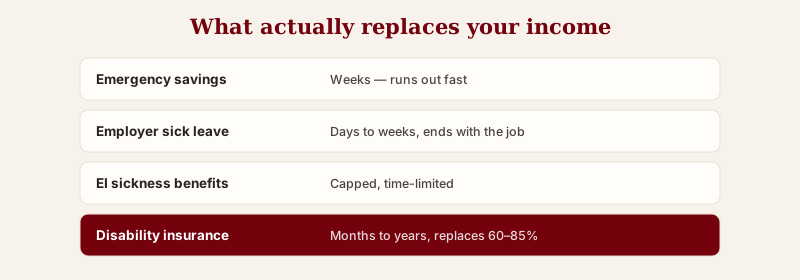
People with group disability coverage through work generally consider themselves covered, and to a point they are. But group and individual disability insurance are different products, and the differences only become visible at claim time — which is the worst moment to discover them.
Taxation: the biggest one
If your employer pays the premium, benefits are taxable income. If you pay the premium with after-tax dollars, benefits are generally tax-free.
This changes the arithmetic more than people expect. A group plan replacing 66% of income, taxable, might net closer to 45% after tax. An individual policy replacing 66% tax-free delivers the full 66%.
Same headline number, materially different outcome. If your group plan lets employees pay the premium themselves, that is usually the better trade — a small certain cost against a large uncertain benefit.
The definition of disability
Group plans commonly use own-occupation for an initial period — often two years — then switch to any-occupation. After that point, benefits continue only if you cannot perform any job you are reasonably suited to by education, training or experience.
For a skilled professional this matters enormously. A surgeon with a hand tremor cannot operate but could teach or consult. Under an any-occupation definition, benefits may end after two years.
Individual policies can be purchased with own-occupation coverage for the full benefit period. It costs more and, for people whose income depends on a specific skill, it is usually the difference that matters.
Portability
Group coverage ends when the job does. It ends when you are laid off, when you resign, and when you become self-employed — and it ends precisely when your income is already disrupted.
Worse, if your health has changed while covered by the group plan, you may be unable to buy individual coverage to replace it. People discover they are effectively uninsurable at the moment they lose the coverage that was masking it.
An individual policy is yours. It follows you across jobs and into self-employment.
Rate and benefit stability
Group plan terms are set between the employer and insurer. Premiums can rise at renewal, benefits can be reduced, and the employer can change carriers or cancel the plan entirely. You are not a party to that negotiation.
A non-cancellable, guaranteed renewable individual policy cannot have its premium changed or coverage altered as long as you pay. Over a coverage period that may last thirty years, that certainty has real value.
Caps and offsets
Group plans usually cap the monthly benefit, which can leave higher earners substantially under-covered relative to their income.
They also offset — reducing benefits by amounts received from CPP disability, workers' compensation, and sometimes other sources. So the actual payment may be materially less than the plan's stated replacement percentage suggests. Individual policies vary, and many do not offset in the same way.
Where group coverage wins
To be fair to it: group coverage typically requires no medical underwriting, which makes it invaluable for someone with health conditions who could not obtain individual coverage. It is usually cheaper or free to the employee. And it is automatic — no application, no exam.
For many people it is the only disability coverage they will realistically have, and it is far better than nothing.
The sensible approach
Treat group coverage as a base layer, not the whole structure.
If you are healthy and your income depends on specific skills, an individual policy layered on top — or replacing group coverage where permitted — addresses the taxation, definition and portability gaps at once. Many professionals hold both.
If your health means individual coverage is unavailable, value your group plan accordingly and think carefully before changing jobs without checking what the new plan provides.
Who pays the premium, and can I pay it myself? What is the definition of disability after the first two years? What is the maximum monthly benefit, and does it offset CPP disability? The answers determine what your coverage is actually worth.
If you want your group booklet read properly and the gaps identified, send it over — it is a short review and people are frequently surprised by what it says.