I work with a lot of newcomer families, and there is a moment I see repeatedly: someone arrives, assumes Canadian healthcare covers them from the moment they land, and discovers otherwise in an emergency room with a bill they were not expecting.
Canada's public healthcare is genuinely excellent. But coverage is provincial, not federal, and the rules differ meaningfully between provinces. Some cover eligible new residents almost immediately — Ontario removed its three-month wait — while others, including British Columbia, still apply a waiting period of roughly three months. Rules have changed in recent years, so confirm your own province's current position rather than assuming.
First: the health coverage gap
Provincial plans — OHIP in Ontario, MSP in British Columbia, AHCIP in Alberta — each set their own eligibility rules, and waiting periods differ. Some provinces cover new permanent residents almost immediately; others impose a waiting period that can run up to three months.
Two things follow. Apply the day you are eligible, because the clock generally starts from your application or arrival date rather than when you get around to it. And bridge the gap with private coverage, because an accident during the waiting period is entirely your financial responsibility.
The cost of not doing this is not theoretical. An ambulance ride, a night in hospital, or a fracture treated in an emergency department can each run into thousands of dollars for someone uninsured. Bridge coverage for the waiting period costs a small fraction of that.
Coverage bought before departure is usually cheaper and avoids waiting-period exclusions that apply when you buy after landing. If you have already arrived, coverage can still be arranged — but a waiting period may apply, and anything that happens before it ends will not be covered.
What provincial health insurance does not cover
Even once you have your card, the public plan does not cover everything, and newcomers are frequently surprised by the list:
- Prescription medication outside hospital
- Dental care
- Vision care and eyeglasses
- Physiotherapy, chiropractic and most paramedical services
- Ambulance fees, in many provinces
- Private or semi-private hospital rooms
If your employer offers a benefits plan, this is what it fills in — and it is worth weighing properly when comparing job offers. If you are self-employed or your employer offers nothing, individual health and dental plans are available and often cost less than people assume.
Bringing parents to visit: the Super Visa
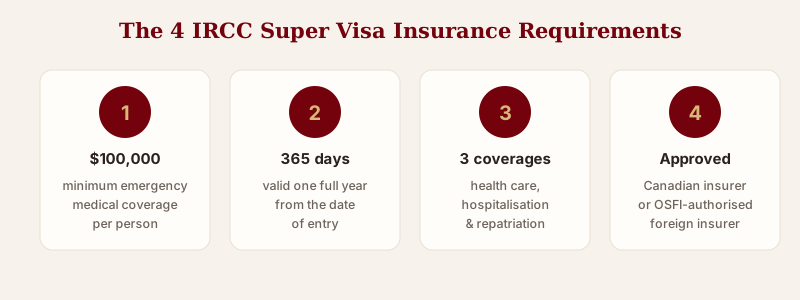
For many newcomers this becomes the priority once they are settled. The Super Visa allows parents and grandparents of citizens and permanent residents to stay up to five years per entry, and it requires qualifying medical insurance: at least $100,000 in emergency medical coverage, valid for a full year from entry, covering health care, hospitalisation and repatriation.
It is a specific product with specific rules, and getting it wrong is a common cause of refusal. I have written a detailed guide to the Super Visa insurance requirements covering the full checklist and the mistakes to avoid.
Building your financial foundation
Once health coverage is sorted, the next layer is protection and savings. A sensible order for most newcomer families:
Life insurance — earlier than you think
Two reasons not to wait. First, premiums rise with age and health changes, so buying young is materially cheaper for the same coverage. Second, many newcomers are supporting family both here and abroad, which means the financial consequences of their death extend across two countries. That is a real obligation and it deserves coverage.
One practical note: some insurers apply additional requirements or waiting periods based on time in Canada or immigration status, and these vary considerably. An independent broker can identify which insurers are most accommodating to your situation rather than you being declined by the first one you approach.
Critical illness and disability insurance
Newcomers often have thinner financial cushions in the early years — no extended family nearby with resources, no long-established savings. That makes income protection more valuable, not less. Disability insurance replaces income if illness or injury stops you working; critical illness pays a lump sum on diagnosis of a covered condition. If you are self-employed with no sick pay, these are close to essential.
Registered accounts — start the clock
Several Canadian accounts accrue benefits with time, so opening them early has value even if you cannot fund them immediately.
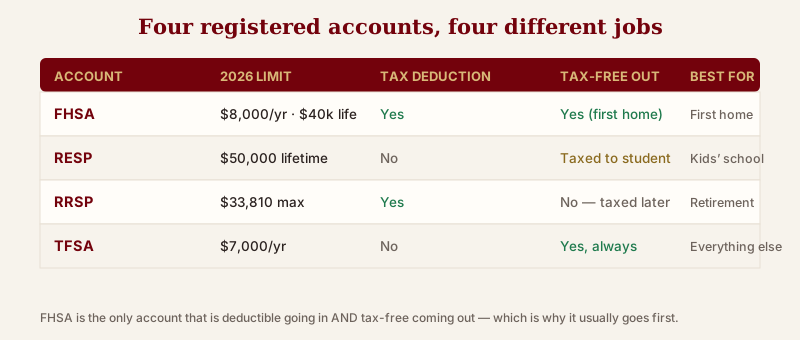
Your TFSA room begins accumulating from the year you become a resident (and are 18+), not from when you open the account. Your RRSP room is based on earned income, so it starts building with your first Canadian tax return — which means filing a return matters even in a low-income first year. The FHSA is different and important: its room only starts accruing once you open the account, so opening one early is genuinely worth doing if you might buy a home. And if you have children, an RESP attracts a 20% government grant on the first $2,500 contributed per child each year.
Filing establishes RRSP room, registers you for benefits like the GST/HST credit and Canada Child Benefit, and creates the record the CRA uses to calculate your contribution limits. Skipping it in your first year costs you room you cannot easily recover.
A realistic first-year sequence
- Before arrival: arrange private medical coverage for the waiting period.
- First week: apply for your provincial health card and get a SIN.
- First month: open a bank account; review any employer benefits carefully.
- Months 2–3: put life insurance in place while you are young and healthy.
- Months 3–6: add disability or critical illness cover, particularly if self-employed.
- First tax season: file a return even with minimal income; open a TFSA and, if relevant, an FHSA and RESP.
A note on advice
Newcomers are, unfortunately, a target market for people selling unsuitable products. A few things worth knowing: an initial consultation with an independent advisor should be free; you should never feel rushed into signing; and you are entitled to have every product explained in plain language before you commit. If someone cannot explain clearly what a product does and what it costs, that is information about the adviser rather than about you.
I work with families across the Greater Toronto Area and the rest of Canada, and a significant portion of my clients arrived here in the last decade. If you are working out what you need and in what order, that is a conversation I am glad to have — with no obligation attached.
Provincial health coverage: when it starts
The first assumption to correct is that healthcare begins on arrival. In several provinces it does not.
| Province | Typical wait for coverage |
|---|---|
| Ontario | Generally available without a waiting period for eligible new residents, but the application and documents take time |
| British Columbia | A waiting period of up to about three months is common |
| Quebec | A waiting period of up to about three months is common |
| Alberta | Generally available on establishing residency, subject to documents |
Rules change and depend on your immigration status, so confirm with your own province rather than relying on any summary, including this one. The practical point stands regardless: there is usually a gap between landing and being covered, whether that gap is a formal waiting period or simply the weeks it takes to apply, be approved and receive a card.
During that gap you are personally responsible for medical costs. An emergency department visit runs into hundreds or thousands of dollars, a hospital admission into thousands per day. Private coverage for those first weeks is inexpensive relative to that exposure, and most visitor insurance plans cover new residents explicitly — ask for a policy written for someone awaiting provincial coverage, and one you can shorten once your card arrives.
What provincial health does not cover, ever
Once your card arrives, a second gap appears that surprises many newcomers. Provincial plans cover physicians and hospitals. They do not generally cover:
- Prescription medication outside hospital, for most working-age adults
- Dental care of any kind
- Vision care, glasses and contact lenses
- Physiotherapy, chiropractic, massage and most paramedical services
- Ambulance, in most provinces, or only partially
- Medical equipment and devices
Employer benefits usually fill this, which is one reason a job offer's benefits package deserves as much attention as the salary. Without employer coverage, personal health and dental plans exist and are worth pricing, particularly for families with children.
A realistic first-year sequence
Everything at once is overwhelming and unnecessary. A workable order:
- Before or on arrival: private medical coverage for the gap before provincial health starts.
- Weeks 1–4: apply for provincial health coverage, a SIN, and open a bank account.
- Months 1–3: understand your employer benefits — what is covered, what the limits are, and what life insurance amount is included.
- Months 3–6: if anyone depends on your income, arrange life insurance. Buy it while you are young and well; premiums are set by age and health at application and only move one way.
- Months 6–12: open a TFSA and start building, even modestly. Contribution room accrues from when you become a resident, not from 2009.
- Year 1–2: once income is stable, look at RRSP contributions, and an FHSA if buying a first home is the plan.
Registered accounts: what a newcomer should know first
Three points that save confusion and, occasionally, penalties:
TFSA room starts when you become a resident. It does not backdate to 2009. Over-contributing on the assumption that the full cumulative amount is available is a common and penalised mistake.
RRSP room is based on earned income reported in Canada. With no Canadian income in your first year, you generally have no RRSP room in your second. It builds as you earn here.
The FHSA suits many newcomers well. Contributions are deductible like an RRSP and a qualifying withdrawal for a first home is tax-free, so it does both jobs at once. Room only starts once the account is open, which is a reason to open one early even with a small deposit.
Bringing parents to visit
For most newcomers this becomes a priority quickly. Two routes, and they are not interchangeable.
A visitor visa suits short trips — usually up to six months per entry. Insurance is not legally required but is strongly advisable, since visitors have no provincial coverage at all.
A Super Visa is for parents and grandparents specifically, allows stays of up to five years per entry, and requires $100,000 of medical coverage valid for a full year, plus a host income test that you must meet. See Super Visa insurance for the full requirements, or compare prices directly on the Super Visa quote.
One timing note worth knowing early: the host income test looks at your Canadian tax returns. A newcomer in their first year may not yet have the income history to qualify, which is a reason to plan the application rather than assume it can happen immediately.