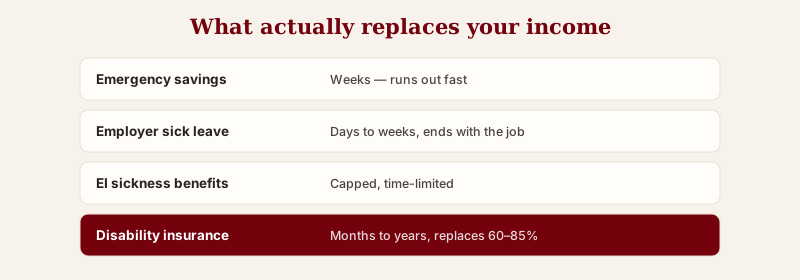
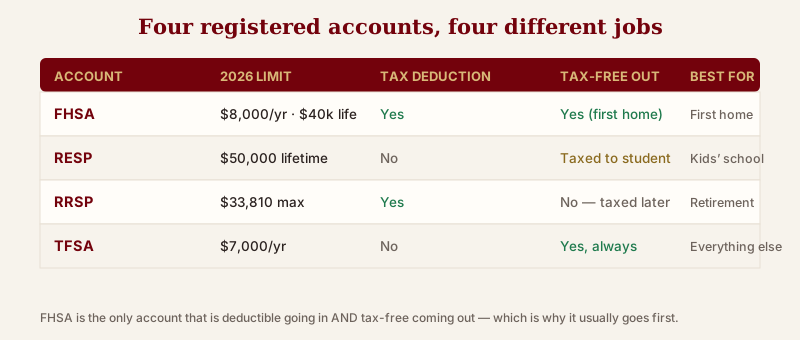
If I could get every eligible family in Canada to act on one thing, it would be this. The Registered Disability Savings Plan offers government support unmatched by any other registered account — and take-up remains far below the number of people who qualify.
The reasons are understandable: it is not widely marketed, it depends on a tax credit many people do not realise they qualify for, and the rules are genuinely more complex than a TFSA. None of which changes the arithmetic.
What is actually on offer
Two federal programmes pay into an RDSP.
The Canada Disability Savings Grant matches contributions, with the matching rate depending on family income. At lower income levels the match can reach 300% and 200% on portions of your contribution — meaning a $1,500 contribution can attract $3,500 in grant. The lifetime grant maximum is $70,000.
The Canada Disability Savings Bond pays into the plan for lower-income beneficiaries with no contribution required at all, up to a lifetime maximum of $20,000.
Read that second one again. For a family with limited means, simply opening the account and filing tax returns can result in the government depositing money into it. There is no other account in Canada that does this.
The Disability Tax Credit is the gateway
You cannot open an RDSP without the beneficiary being approved for the Disability Tax Credit (DTC). This is the step where most families stall, and it deserves more attention than it gets.
The DTC is not limited to visible or physical disabilities. Eligibility is based on a marked restriction in one or more basic activities of daily living — walking, dressing, feeding, elimination, hearing, speaking, vision, mental functions necessary for everyday life — or the cumulative effect of significant restrictions, or requiring life-sustaining therapy.
In practice this includes many people who would not describe themselves as disabled: severe ADHD or autism affecting mental functions, type 1 diabetes requiring intensive therapy management, significant learning disabilities, chronic conditions with substantial functional impact.
Application is via Form T2201, certified by a qualified medical practitioner. A point that matters: the practitioner's description of functional impact drives the outcome far more than the diagnosis label. Applications are frequently declined because the form understates day-to-day restriction, not because the person is ineligible.
A decline is not final. You can request a review or appeal, often with a more detailed description of functional limitations. It is also worth knowing the DTC can be applied retroactively for prior years when the condition existed, which can produce a meaningful tax refund quite apart from the RDSP.
Contribution rules
There is no annual contribution limit, and a lifetime limit of $200,000. Contributions are not tax-deductible — unlike an RRSP — but investment growth is tax-deferred inside the plan.
Grant and bond entitlement accumulates and can be carried forward for up to 10 years, so a family who opens the plan late can catch up on prior years' entitlement, subject to annual caps. Someone opening a plan for an adult beneficiary may be able to claim several years of accumulated entitlement at once — which is why "we should have done this years ago" is rarely a reason not to start now.
Contributions are permitted until the end of the year the beneficiary turns 59, and grants and bonds are generally payable until the end of the year they turn 49.
The rule you must plan around
This is the trap, and it is the reason RDSPs need actual planning rather than just opening.
If money is withdrawn from an RDSP, any grants and bonds paid into the plan in the preceding 10 years may have to be repaid to the government — up to $3 for every $1 withdrawn, under what is commonly called the 10-year rule.
The practical consequence: an RDSP is a long-horizon account. It is not an emergency fund, and withdrawing early can claw back a great deal of government money. Plans should be structured with the withdrawal timeline in mind from the outset.
How withdrawals work
Money comes out in two ways. Lifetime Disability Assistance Payments are recurring payments that must begin by the end of the year the beneficiary turns 60 and continue for life. Disability Assistance Payments are one-off withdrawals, subject to the plan terms and the repayment rule above.
On tax: your contributions come out tax-free, while grants, bonds and growth are taxable to the beneficiary. As beneficiaries often have modest income, the tax owed is frequently small.
One further point that matters greatly to families: RDSP assets and payments are exempt from most provincial disability benefit income and asset tests, including Ontario's ODSP. Saving in an RDSP does not generally jeopardise provincial support — a concern that stops many families before they start, usually unnecessarily.
A sensible sequence
- Apply for the Disability Tax Credit using Form T2201. Ask the practitioner to describe functional impact fully.
- Claim retroactive years if the condition existed previously — this alone can generate a substantial refund.
- Open the RDSP once DTC is approved.
- Capture the bond first if income-eligible, since it requires no contribution.
- Contribute to maximise the grant match, using carry-forward room where available.
- Plan the withdrawal timeline around the 10-year rule before you need the money.
This is genuinely one of the highest-value planning conversations available to a Canadian family, and it costs nothing to have. If someone in your family may qualify for the DTC, please look into it — whether or not you do that with me.
The Disability Tax Credit comes first
Nothing about the RDSP is available until the beneficiary is approved for the Disability Tax Credit. It is the gateway, and the application is where most of the difficulty sits.
The DTC is not means-tested and is not awarded for a diagnosis. It is assessed on whether a person is markedly restricted in a basic activity of daily living — walking, feeding, dressing, speaking, hearing, elimination, mental functions — or requires life-sustaining therapy. A medical practitioner certifies the restriction and its duration.
Two things worth knowing before applying. Approval can be backdated where the condition existed in earlier years, and those earlier years can also open RDSP grant and bond entitlement. And a refusal is not final — many initially refused applications succeed on reconsideration, often because the original form described the diagnosis rather than the functional restriction. How the practitioner words it matters enormously.
Carry-forward: the provision that changes the arithmetic
Unused grant and bond entitlement carries forward for up to ten years. A family opening an RDSP late can claim years of missed entitlement, subject to annual maximums on what can be paid in any one year.
The consequence is worth stating plainly: opening an account today for someone who has been DTC-eligible for several years can unlock a substantial sum that would otherwise be lost as those years age out of the window. Every year of delay permanently loses the oldest year.
This is the strongest argument for opening the account now, even with nothing to contribute. The bond requires no contribution at all, but the account must exist for anything to be paid into it. Exact grant and bond amounts depend on family income and are set by legislation, so check the current figures on the Government of Canada's RDSP page rather than any figure quoted elsewhere.
Who can open one, and who can contribute
The beneficiary is the person with the disability, and there is one per plan. The holder opens and manages it. Where the beneficiary is an adult able to manage their own affairs they are usually both; where they are a minor or unable to contract, a parent, guardian or legal representative holds it.
Anyone can contribute with the holder's written permission. That provision is genuinely useful and widely unknown: grandparents, aunts and uncles, family friends who want to help and would otherwise give cash. A contribution from a grandparent attracts exactly the same government match as one from a parent.
The ten-year repayment rule
The catch that surprises families: grants and bonds paid into an RDSP within the previous ten years must generally be repaid if money is withdrawn, at a set rate per dollar taken out.
An RDSP is therefore a long-horizon account. Money paid in this year is not comfortably accessible for a decade without triggering repayment. Plan contributions with that in mind and keep shorter-term savings elsewhere — a TFSA is usually the right companion. There are provisions that soften this where life expectancy is shortened, worth raising specifically if it applies.
How it affects other benefits
A frequent and reasonable fear is that saving will reduce provincial disability support. In general, RDSP assets and withdrawals are exempt from provincial disability benefit calculations in most provinces, including Ontario's ODSP. That exemption is a deliberate policy choice and it is what makes the account usable at all.
Because provincial rules differ and can change, confirm the current treatment in your province before making large withdrawals. But the default assumption — that an RDSP will cost someone their benefits — is generally wrong, and it stops families opening accounts they should open.
Common reasons families never open one
- "We have no money to contribute." The bond requires none. The account still has to exist to receive it.
- "It will cost us ODSP." Generally not, as above.
- "We were refused the DTC." Frequently overturned on reconsideration, particularly where the form described a diagnosis rather than a restriction.
- "Our bank does not offer it." True of some institutions; others do. Worth asking a second.
- "It is too late." Carry-forward covers ten years and contributions run well into middle age. Late is usually still worth a great deal.
Practical steps
- Apply for the Disability Tax Credit if not already approved, asking the practitioner to describe functional restriction rather than diagnosis.
- Request retroactive approval for earlier years where the condition existed.
- Open the RDSP at a participating institution — the list is shorter than for RESPs.
- Claim carried-forward entitlement, oldest years first, before they expire.
- Contribute what you can to capture the highest match rate, even if modest.
- Plan withdrawals around the ten-year rule.
See the RDSP page for more detail on how the account works.