Grandparents often want to help with education costs, and an RESP is one of the more effective ways to do it — government grant money makes it hard to beat.
There are two routes, and the choice matters more than most families realise.
Route 1: contribute to the parents' existing plan
Usually the simplest and safest. The parents' plan already exists, the beneficiary is registered, and contributions attract the grant in the normal way.
The main drawback is control: it is the parents' plan, and they manage the investments and withdrawals. For most families that is fine.
Route 2: open your own RESP
Grandparents can open an RESP naming a grandchild. You need the child's Social Insurance Number and the parents' cooperation to obtain it.
This gives you control over the investments and the timing, and it can sit outside the parents' financial affairs — which some families prefer.
It also creates the risk described next.
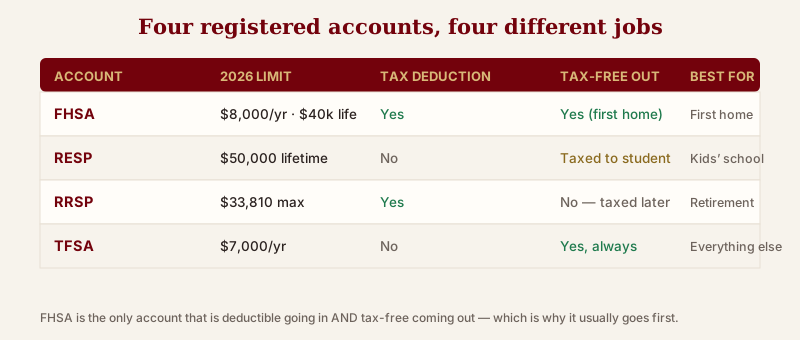
The lifetime contribution limit applies to the beneficiary across every RESP anywhere. If parents and grandparents both contribute without coordinating, the total can exceed it, and the penalty is 1% per month on the excess until withdrawn. Nobody is notified until the CRA works it out. Talk to each other before contributing.
The grant is also shared
The same principle applies to the Canada Education Savings Grant. The 20% match on the first $2,500 per year, up to $500 annually and $7,200 lifetime, belongs to the child, not to the plan.
If parents contribute $2,500 and grandparents contribute another $2,500 in the same year, the second $2,500 generally attracts no additional grant. It still grows tax-sheltered, but the most valuable feature is not doubled.
Better coordination: whoever can reliably contribute $2,500 a year does so to capture the grant, and any additional family contributions go in on top knowing they are for growth rather than matching.
Family plan or individual plan?
A family plan can name multiple beneficiaries who are related by blood or adoption to the subscriber, and funds can be shared between them. Grandparents qualify as related, so a family plan naming several grandchildren is possible and offers flexibility if one child does not pursue post-secondary education.
An individual plan names one beneficiary and can be opened for anyone, but offers no ability to reallocate.
For grandparents with several grandchildren, a family plan is often the better structure.
Points worth planning around
Succession. What happens to your RESP if you die before the child attends school? Naming a successor subscriber in your will keeps the plan intact. Without that, the plan may need to be collapsed, which can mean returning grants and paying tax on growth.
Timing. Grant eligibility ends after the year the child turns 17, and there are additional conditions at 16 and 17. Starting early captures far more.
Withdrawals. As subscriber, you control them. Coordinate with the parents so the student is not accidentally over-withdrawn in a year where it creates a tax issue, and so both plans are not drawn simultaneously without a plan.
A simple approach that works
For most families: let whoever is best placed contribute $2,500 a year to one plan to capture the grant, and have grandparents contribute additional amounts into that same plan, or into a separate family plan with the total tracked against the $50,000 limit.
Whatever you choose, write down who is contributing what. The penalty for over-contributing is entirely avoidable and arises almost exclusively from families not talking to each other.
If you would like the structure set up properly and the contribution schedule mapped, that is a short conversation and worth having before the cheques start.
The two routes side by side
| Give to the parents' RESP | Open your own RESP | |
|---|---|---|
| Who controls the money | The parents | You, as subscriber |
| Paperwork for you | None — you send a cheque or e-transfer | Open an account, supply SINs |
| Grant earned | Yes, through their plan | Yes, through yours |
| If the child does not study | Parents decide what happens | You decide, and contributions return to you |
| Estate planning | Leaves your estate at once | Stays yours; needs planning if you die first |
| Risk of over-contributing | Low — one plan to track | Higher — two plans, one lifetime limit |
Neither is better in general. The right one depends on how much you trust the plan to be run well, whether you want the money back if it goes unused, and how much administration you are willing to take on.
The lifetime limit catches families out
This is the single most important thing for a grandparent to understand, and it is widely missed.
There is a lifetime contribution limit per child, not per plan and not per contributor. If the parents have an RESP for your granddaughter and you open a second one for her, every dollar you both put in counts against the same ceiling. Nobody tracks that across plans for you — each provider sees only its own account.
Go over it and the excess is penalised at 1% per month for as long as it stays in, split between the subscribers. Families usually discover it at tax time, after months of penalty have built up.
The fix is simple and cheap: before you open anything, agree with the parents who is contributing what, and keep a shared running total. A one-line note in a family group chat each January is enough. The current lifetime figure is set by the federal government — confirm it on the Government of Canada's RESP page rather than relying on a number repeated elsewhere.
The grant has an annual ceiling too
The Canada Education Savings Grant pays 20% on contributions up to a yearly amount per child. Put in more than that in one year and the extra earns nothing, though some unused grant room from earlier years can be caught up.
In practice this means two households contributing to the same child can easily double up in one year while leaving grant on the table in another. Coordinating, so that between you the child gets the full grant every year and no more than that is contributed, is worth more than any investment decision you make inside the plan.
| Situation | What to do |
|---|---|
| Parents already contribute the full grant amount each year | Your money earns no extra grant. Consider a TFSA gift or a lump sum later instead. |
| Parents contribute a little | Top up to the grant amount between you. Best use of your money. |
| Parents have no RESP yet | Help them open one, or open your own and coordinate. |
| Several grandchildren | A family plan in your name can hold them all. |
A family plan in your name
Grandparents can open a family plan and name several grandchildren as beneficiaries, because beneficiaries must be related to the subscriber by blood or adoption, and grandchildren qualify.
The advantage is flexibility. Growth and grant can be shared among the grandchildren, so if one goes to university and another takes an apprenticeship and a third does neither, the money follows whoever studies. In an individual plan the money is tied to one child.
Two rules to know. New beneficiaries can only be added to a family plan while they are under 21. And grants are still tracked per child, so the sharing works on growth and on grant within limits, not without restriction.
If the grandchild does not go on to study
This is where owning the plan yourself matters most.
- Wait. A plan can stay open for decades. Plenty of people return to education in their twenties.
- Switch to another grandchild in a family plan, or to a sibling.
- Move growth into your RRSP, if you have room and the plan has been open long enough, avoiding the extra tax.
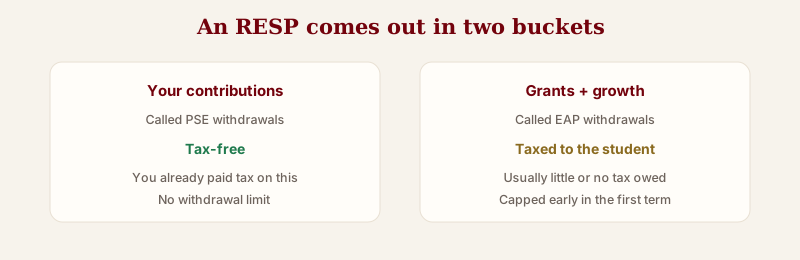
- Close it. Your contributions come back to you tax-free. Grants go back to the government. Growth is taxed as your income plus a penalty tax.
For grandparents already retired, that last route has a sting: growth added to your income can push you toward the OAS clawback. Worth knowing before you choose to own the plan rather than give to the parents.
What happens to your RESP if you die first
An uncomfortable question and a real one. An RESP is not like a TFSA or RRSP where you name a beneficiary on the account. It forms part of your estate unless you plan otherwise.
Without instructions, the executor may have to collapse it, grants go back, and growth is taxed — the opposite of what you intended. The fix is to name a successor subscriber in your will, usually one of the parents, so the plan carries on for the grandchild. It is a line in a will, and it is worth adding the same week you open the account.
A simpler alternative worth considering
If coordinating plans, lifetime limits and succession sounds like more than you want, there is a cleaner route: give the money to the parents and let them contribute it to their own plan. You lose control of it, but you also lose every one of the risks above. For many families that trade is worth it.
Another option is to keep the money in your own TFSA and give it as a lump sum when the grandchild starts school. No grant, but full flexibility and no lifetime-limit bookkeeping.
See the RESP page for how the plan works end to end, or book a free conversation if you want someone to look at your family's plans together before anyone opens a new account.
A worked example
Take grandparents with three grandchildren aged 2, 5 and 9. The parents of the two younger children contribute a little to an RESP; the nine-year-old's parents have no plan at all.
The sensible split: help the nine-year-old's parents open a plan, or open a family plan yourselves that includes all three. For the two younger children, top up the parents' contributions each year so that between you, each child collects the full annual grant — and not a dollar more, because anything beyond earns nothing and eats into the lifetime limit.
Then write down who contributes what, name a successor subscriber in your will if the plan is in your name, and review it once a year. Ten minutes a year keeps the grant flowing and the penalties away.
Questions to settle with the parents first
- Is there already an RESP for each grandchild, and who is the subscriber?
- How much do the parents contribute each year?
- Would they rather receive money to contribute themselves, or have you run a separate plan?
- If a child does not go on to study, what would you all want to happen to the money?
- Who keeps the running total against the lifetime limit?
Half an hour of conversation around the kitchen table answers all five, and it avoids the two expensive outcomes: grant left unclaimed and penalties for over-contributing.