Most Canadian snowbirds know there is a limit on how long they can stay in the United States. Fewer know that the tax test and the immigration limit are different things, and that the tax test counts days from previous years.
This is not insurance advice, and I am not a cross-border tax specialist. But it comes up constantly with clients arranging winter travel coverage, and the consequences of getting it wrong are significant enough to be worth flagging.
The substantial presence test
The United States uses a weighted calculation to decide whether you are a resident for tax purposes:
- All days present in the current year, counted in full
- Plus one third of the days in the previous year
- Plus one sixth of the days in the year before that
If that weighted total reaches 183 days — and you were present at least 31 days in the current year — you may be treated as a US resident for tax purposes.
Why consistent snowbirds get caught
Take someone spending four months in Florida every winter — around 120 days a year, comfortably inside the immigration limit and nowhere near 183 days in any single year.
Run the test: 120 for this year, plus 40 for last year, plus 20 for the year before. That is 180. They are just under, and a slightly longer winter tips them over.
Someone spending five months annually — about 150 days — reaches 225 on the weighted total and is well past the threshold every single year, despite never approaching six months in any one year.
What crossing it means
Potentially being treated as a US tax resident, which can bring a US filing obligation on worldwide income and associated reporting requirements. The Canada–US tax treaty prevents most people from being taxed twice, but the compliance obligations are real and the penalties for missed foreign asset reporting can be severe.
The Closer Connection Exception
The usual route for snowbirds is Form 8840, the Closer Connection Exception Statement. It asserts that despite meeting the day count, your closer connection is to Canada — your home, family, bank accounts, driver's licence, doctor and social ties are here.
Two things matter about it. It is generally available only if you were present fewer than 183 days in the current year specifically. And it must be filed on time; it is not automatic, and eligibility does not help if the form is never submitted.
The single most useful habit is a running log of US entry and exit dates. Border records are increasingly shared between the two countries, so estimating after the fact is both unreliable and unnecessary. A note in your calendar each trip takes seconds and settles the question definitively.
Where this touches insurance
Two genuine connections.
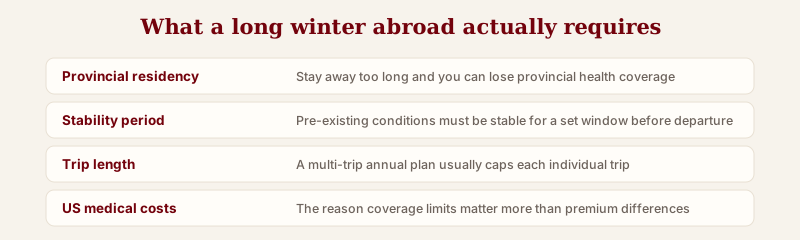
Provincial health coverage. Your province requires physical presence for a minimum period each year. Extended US stays can jeopardise provincial coverage — which in turn undermines travel insurance, since most travel medical policies are designed to sit on top of provincial coverage rather than replace it. The two limits are separate but interact.
Trip-length caps. Multi-trip annual travel policies typically cap each individual trip, often well below a four-month winter. A top-up is usually needed. This is worth confirming rather than assuming your annual plan covers the whole stay.
If you own US property
Beyond the day count, US real estate brings its own considerations — US estate tax exposure for non-residents can apply above certain thresholds, and rental income generally creates a US filing obligation. Ownership structure matters here and is worth professional advice before purchase rather than after.
What to actually do
- Log your US days every trip.
- Run the three-year calculation each autumn before booking.
- File Form 8840 on time if you meet the day count but qualify for the exception.
- Check your province's absence rule and apply for any extension in advance.
- Confirm your travel policy's trip-length cap and arrange a top-up if needed.
- Speak to a cross-border accountant if you are near the threshold or own US property.
I can handle the travel insurance and flag where the two sets of rules interact. For the tax filing itself, use a specialist — it is a narrow field and worth the fee.
The day count, worked through
The substantial presence test uses a weighted count over three years. You meet it if you were in the US at least 31 days this year, and the weighted total reaches 183 days:
| Year | Days counted | Weight |
|---|---|---|
| This year | Every day present | Full |
| Last year | Days present | One third |
| Two years ago | Days present | One sixth |
Worked example. A snowbird who spends 150 days in Florida every winter:
- This year: 150 days × 1 = 150
- Last year: 150 days ÷ 3 = 50
- Two years ago: 150 days ÷ 6 = 25
- Total: 225 — over the 183 threshold
Notice that 150 days a year is comfortably under six months, and it still trips the test. This is why so many careful snowbirds are caught: they count days in the current year and assume they are fine.
A quick rule of thumb: spending more than about 120 days a year in the US, year after year, will put you over. At 121 days each year the weighted total reaches 181.5, just under. Beyond that you need to act.
What counts as a day
Any part of a day counts as a full day. Driving across for dinner and back counts. A connection through a US airport where you clear customs counts. Days in transit between two foreign points without entering usually do not.
A few exemptions exist — for example days you could not leave because of a medical condition that arose while you were there — but they have to be claimed properly, not assumed.
The practical advice: keep a simple log. A note on your phone each time you cross is enough, and it will save you reconstructing a year of border crossings later. The US border agency can also provide your recorded travel history.
Form 8840: the closer connection exception
Most Canadian snowbirds who meet the test do not have to become US tax residents. They can claim the closer connection exception by filing IRS Form 8840 each year, showing that their real home, family, bank accounts, driver's licence and ties remain in Canada.
| What to know | |
|---|---|
| Who files | Each person separately — spouses file one each |
| When | Usually by mid-June for the previous year, if you have no US income to report |
| Limit | Only available if you were in the US fewer than 183 days in the current year |
| Cost | Free to file |
| If missed | You may lose the right to claim the exception for that year |
That fourth row matters: the exception works only if you stayed under 183 days in the current year itself. Stay longer than that and a different, more involved route under the Canada–US tax treaty applies, which is a job for a cross-border tax professional.
What happens if you do nothing
If you meet the test and file nothing, the IRS may regard you as a US tax resident. That can bring an obligation to report worldwide income to the US, and disclosure of Canadian accounts — including RRSPs and TFSAs, which the US does not treat the way Canada does. Penalties for missed information returns can be substantial even where no tax is actually owed.
The asymmetry is stark: filing Form 8840 takes perhaps half an hour and costs nothing. Not filing can cost a great deal. If you are near the threshold, file.
Where this touches your insurance
Tax residency and health coverage are separate systems, but they pull on the same number — days away.
| Days away per year | US tax | Provincial health |
|---|---|---|
| Under about 120, every year | Usually under the test | Fine |
| About 120–182 | Likely over — file Form 8840 | Fine in Ontario; check your province |
| About 183–212 | Over, and Form 8840 no longer available | Near Ontario's limit |
| Over about 212 | Over | Likely breaching Ontario residency |
Losing provincial coverage is the more dangerous of the two, because it can take your travel insurance down with it. See the snowbird travel insurance guide for how residency affects cover.
If you own property in the US
Owning a winter home adds two separate issues, neither of which Form 8840 solves.
Renting it out creates US-source income, which generally means a US tax filing regardless of how many days you spend there.
US estate tax can apply to US property held by Canadians at death, depending on the size of the worldwide estate. The treaty provides relief in many cases, but it has to be claimed, and the planning is best done while you are alive.
Both are worth a conversation with a cross-border accountant. I am not a tax advisor, and these are areas where specialist advice pays for itself.
A simple yearly routine
- Keep a crossing log all year.
- In January, total the last three years using the weighting above.
- If you are over 183 weighted days but under 183 actual days this year, file Form 8840 by the June deadline.
- Check your provincial residency against the same log.
- Before you leave each autumn, review your travel insurance — see the travel insurance page — and answer the medical questions fresh.
If you would like your cover reviewed before the season, get in touch. For the tax side, a cross-border accountant is the right professional.
Common mistakes
- Counting only the current year. The three-year weighting is what catches people.
- Assuming a spouse's form covers both. Each person files separately.
- Not counting short trips. A day trip across the border is a full day.
- Filing late. Missing the deadline can cost the right to claim the exception for that year.
- Confusing this with health coverage. Staying under the US threshold does nothing for provincial residency, and vice versa. Track both.
A note on the border
Separately from tax, US immigration rules generally allow Canadian visitors up to about six months in a year. That is a different rule from the tax day count and it is enforced at the border. Snowbirds planning to push toward six months should check the current US visitor rules before travelling, because an overstay can affect future entry.
None of this is reason to stop wintering in the sun. It is reason to keep a log, file one free form, and make sure the travel insurance you are relying on still works. Those three habits cover almost everyone.