Having arranged Super Visa insurance for a lot of families, the same errors recur. Almost all are avoidable with a few minutes of checking beforehand.
1. Buying a policy shorter than 365 days
The most common. Families reason that if the visit is four months, four months of coverage should suffice.
It does not. The requirement is coverage valid for at least 365 days from the date of entry, regardless of the intended length of stay. A six-month policy fails the requirement outright.
2. A policy without repatriation
The coverage must include health care, hospitalisation and repatriation. Many inexpensive visitor plans exclude repatriation — the cost of returning the insured to their home country if medically necessary or in the event of death.
If the wording does not mention it, the policy does not qualify. Read the coverage summary rather than the marketing page.
3. Submitting a quote instead of a paid policy
IRCC requires proof of paid, active coverage. A quote or an unpaid confirmation is treated as no insurance.
If you are using a monthly plan, the initial payment must be made and the documentation must state clearly that the policy is in force for the full 365 days.
4. Miscounting household size for the income test
As the host you must meet the Low Income Cut-Off for your household size — and the visiting parents count in that number.
A couple with two children inviting both parents is a household of six, not four. The threshold for six is meaningfully higher, and families who checked against four often believe they qualify when they do not.
5. Understating a parent's health history
Tempting, because disclosure raises the premium. It is the most expensive saving available.
Pre-existing conditions must generally have been stable for a defined period — commonly 90 or 180 days — with no new diagnosis, symptoms, medication change, treatment or hospitalisation for that condition during the window.
If a condition is not disclosed, it is precisely the condition most likely to generate a claim, and the claim will be assessed against what was declared. Disclose everything and let the policy be matched to the real situation.
A routine dosage adjustment weeks before travel can breach a stability requirement, even a reduction. If a parent has a managed condition, ask their doctor whether upcoming changes can reasonably wait, or plan the policy start date around the window.
6. Leaving the insurance to the last minute
Two problems. Quotes for older applicants with health histories take time to arrange properly, and comparing pre-existing condition wording across insurers is not a same-day task if you want it done well.
More importantly, rushing tends to produce the cheapest policy rather than the right one — which is how errors two and five happen.
7. Assuming a refusal means starting over entirely
Not a cause of refusal, but a common misconception afterwards.
Most Super Visa policies refund the premium, less an administrative fee, where the visa is refused and coverage has not started. Confirm the refund terms before buying, particularly if the application has any uncertainty.
And a refusal is not permanent. Applications can be resubmitted addressing the reasons given. If the refusal related to income, a stronger tax year or adding a co-signing spouse may resolve it.
A sequence that avoids most of this
- Confirm the income requirement for the correct household size, before anything else.
- Gather the financial documentation — Notice of Assessment, T4s, employment letter.
- Get quotes early, disclosing full health history.
- Compare the stability wording, not just the price.
- Buy and pay, confirming 365 days and repatriation in writing.
- Submit with proof of paid coverage attached.
I handle the insurance side and will tell you plainly if it looks like the income requirement is the actual obstacle — there is no sense buying a policy for an application that is not ready. For complex immigration questions, a licensed consultant or lawyer is worth the fee.
The mistakes ranked by how often they cause trouble
| Mistake | How costly | How easily avoided |
|---|---|---|
| Understating a health history | Very — a denied claim can run to five or six figures | Entirely, by answering accurately |
| Miscounting household size | High — a refusal on the income test | Entirely, by counting carefully |
| Submitting a quote, not a paid policy | High — treated as no insurance | Entirely |
| A policy under 365 days | High — fails the requirement outright | Entirely |
| No repatriation cover | High — fails the requirement | Entirely, by checking the wording |
| Missing the medical exam | Moderate — delays the file | Entirely |
| Leaving insurance to the last minute | Moderate — rushed choices, worse terms | Entirely |
Every row in that last column says the same thing. None of these are bad luck. They are all decisions made without knowing what the rule actually said.
Counting household size correctly
This deserves its own section because the count is larger than families expect, and getting it wrong means applying against the wrong income threshold entirely.
IRCC's own guidance includes all of the following in the count:
- The host child or grandchild
- The host's spouse or common-law partner, which can include a separated spouse
- Every dependent child of the host and of their partner — regardless of custody or child support arrangements
- You and any other super visa applicant applying at the same time, such as your spouse
- Anyone previously approved on a letter of invitation from the host that is still applicable
- Anyone the host or co-signer has previously sponsored, where the undertaking is still in effect
The last two catch people out most often. A host who sponsored a sibling years ago, on an undertaking still running, must count that person — even though they have nothing to do with this application.
One correction worth making while we are here: the Super Visa uses the plain Low Income Cut-Off. Many articles state LICO plus 30%, which belongs to the Parents and Grandparents Program for permanent residence. Using the wrong figure convinces families they fall short when they do not. Because the table is revised each January, check IRCC's current figures rather than any number quoted on an insurance site.
What changed in 2026, and who it helps
Two changes took effect on 31 March 2026, and both widen eligibility.
The host can now use the better of the last two tax years. Previously only the most recent year counted, so a single weak year — parental leave, a business loss, a job change — could sink an otherwise strong application.
Or 75% of the threshold, topped up with the applicant's income. Where the host reaches at least three-quarters of the figure in the most recent year, the visiting parent's or grandparent's own income can close the gap. A retired parent with a foreign pension is no longer invisible to the calculation.
If your family concluded a year or two ago that you did not qualify, that conclusion may simply be out of date.
The insurance requirements, precisely
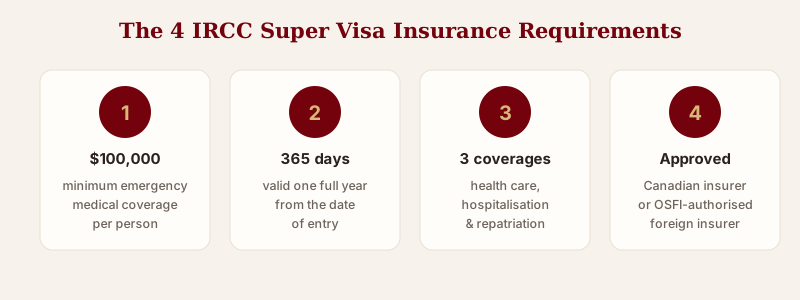
All four must be true, and a policy failing any one of them is not a cheaper option — it is a refused application:
- At least $100,000 of emergency medical coverage
- Valid for at least one year from the date of entry
- Covering health care, hospitalization and repatriation
- Paid — in full, or in instalments with a deposit made. Quotes are not accepted.
That last point is more generous than families assume: monthly plans are explicitly acceptable, provided the first payment has been made. It is payment that matters, not payment schedule.
The insurer may now be a Canadian company or an insurer outside Canada approved by the Minister. The $100,000 and one-year minimums did not change; only the range of acceptable insurers widened.
The mistake that costs the most
Of everything on this page, understating a parent's health history is the one that does real financial damage — and it is the only one where the consequence arrives long after the visa is granted.
The premium drops, the policy is issued, and nothing appears to be wrong. Then a claim is made, the insurer requests medical records, and the gap between what was declared and what the records show is where the claim dies. The family is left with a hospital bill that the insurance was bought specifically to prevent.
Declaring a condition accurately may cost more, or may narrow which insurers will offer cover. It is also the only version of this that protects anyone. If a parent's condition is recent or unstable, that is worth a conversation before buying rather than a hopeful answer on a form.
A sequence that avoids nearly all of it
- Check the income test first, with a correct household count, before spending anything.
- Get quotes early, so the cost is known while you are still deciding. Compare on the Super Visa quote rather than taking the first number offered.
- Read the stability wording against each parent's real medical history.
- Buy and pay, keeping the confirmation showing amount, term and start date.
- Book the immigration medical exam with an approved panel physician.
- Assemble the rest — invitation letter, proof of relationship, proof of host status, income documents, passports, biometrics.
- Apply, and send a copy of the policy with your parents, because an officer can ask to see it on every entry.
See the Super Visa insurance page for the full requirement list.
What happens if it is refused anyway
Refusals happen to well-prepared families, so it is worth knowing the position before it arises rather than during.
There is no formal appeal in the way a permanent residence decision might be appealed. The practical route is to address the stated reason and reapply. Refusal letters are often terse, but the reason given is the thing to work on — most commonly the income calculation, incomplete proof of the relationship, insurance failing one of the four conditions, or a missing medical exam.
On the insurance you have already bought: most insurers refund the premium, less an administration fee, on proof of the refusal. Terms differ between insurers, which is one more reason to compare refund wording before buying rather than after. Families on a monthly plan have risked only the first payment, which is a genuine argument for monthly where an application feels uncertain.
Reapplying is not starting from zero. The documents largely carry over, the medical exam usually remains valid for a period, and a second application that directly answers the refusal reason is often straightforward.
A short pre-submission check
Run through this before the file goes in. Each line is one of the mistakes above, turned into a question:
- Is the policy term at least 365 days from the intended date of entry?
- Does the wording explicitly include repatriation?
- Is the coverage at least $100,000 per person, each parent covered individually?
- Has it actually been paid — in full, or a first instalment?
- Does the confirmation show amount, term and start date on one document?
- Does the household count include dependent children, previously approved visitors and anyone still under an undertaking?
- Have both parents' health histories been declared accurately, including medication changes in the past year?
- Is the immigration medical exam booked or completed?
- Does the invitation letter list everyone in the family size count, with the total?
Nine questions. Answering them honestly takes about ten minutes and removes most of the reasons these applications fail.