Super Visa insurance quotes vary far more than people expect, and the variation is not arbitrary. Five factors do almost all the work, and understanding them lets you make sensible choices instead of just picking the cheapest number.
1. Age — the dominant factor
Nothing else moves the premium as much. Insurers price emergency medical risk, and that risk rises sharply with age. The difference between insuring a 62-year-old and a 78-year-old is substantial, and pricing often steps up at specific age bands rather than smoothly.
One practical implication: if a parent is close to an age band boundary, the policy start date can matter. Worth checking rather than assuming.
2. Coverage amount
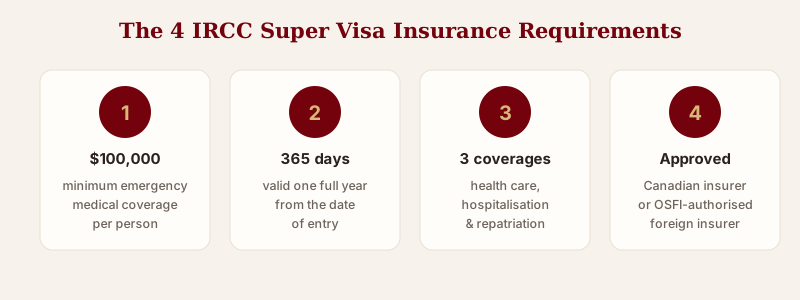
The Super Visa requires a minimum of $100,000. Many families choose $150,000 or more.
The premium difference between coverage levels is usually smaller, proportionally, than the difference in protection. Given that a serious cardiac event or an extended hospital stay can run well beyond $100,000 for someone with no provincial coverage, the higher limit is often the better value even though it costs more.
If budget is tight, I would generally rather adjust the deductible than drop to the bare minimum coverage.
3. Pre-existing conditions and the stability period
This is where quotes diverge most between insurers, and where advice actually matters.
Coverage for a pre-existing condition typically requires it to have been stable for a defined window before the policy takes effect — commonly 90 or 180 days, with longer periods for older applicants at some insurers.
Stability generally means no new diagnosis, no new symptoms, no change in medication or dosage, no new treatment and no hospitalisation for that condition during the window.
Definitions differ meaningfully between companies. One insurer may treat a routine dosage adjustment as breaching stability while another does not. For a parent with managed hypertension or diabetes — extremely common — the right match can be the difference between a claim being paid and refused.
A cheaper premium obtained by omitting a condition is worthless, because that condition is exactly what a claim is most likely to involve. Disclose everything and let me find an insurer that will cover the situation as it actually is.
4. The deductible
Choosing a deductible — the amount you pay before coverage responds — reduces the premium. Options typically range from zero up to several thousand dollars.
This is the most sensible place to economise, provided the family could genuinely cover the deductible if needed. Taking a $1,000 deductible to reduce the premium is reasonable if $1,000 is available. Taking a $5,000 deductible you could not pay defeats the purpose — you would be uninsured in practice for anything smaller.
5. Payment structure
Paying the full year up front is generally the lowest total cost. Monthly plans spread the payment and are often the difference between a family being able to arrange coverage at all and not.
Monthly typically costs slightly more in total. For most families the cash-flow benefit outweighs that, but you should see both numbers before deciding rather than being shown only one.
Where you should not economise
Two places.
Coverage below what the visa requires. A policy under $100,000, under 365 days, or missing repatriation does not qualify — it is not a cheaper policy, it is a refused application.
An insurer whose stability wording does not fit your parent's health. The premium saving is small; the claim risk is the entire policy.
The refund question
Most Super Visa policies refund the premium, less an administrative fee, if the visa is refused and coverage has not started. Terms vary between insurers, so it is worth confirming before purchase — particularly if there is any uncertainty about the application succeeding.
How to compare properly
Get quotes from several insurers at the same coverage amount and deductible, so you are comparing like with like. Then read the pre-existing condition wording for each, since that is where the real difference sits. Then decide on payment structure.
That is the work I do for clients, and it is why I quote multiple insurers rather than one. If you would like the comparison run for your parents' actual ages and health history, it costs nothing and takes a short conversation.