Couples who have lived together for years reasonably assume the law treats them like a married couple. For some purposes it does — tax, benefits, support obligations. For inheritance in Ontario, it does not, and the gap is severe.
The intestacy problem
If you die without a will in Ontario, provincial intestacy rules distribute your estate. Those rules provide for a married spouse. A common-law partner is not automatically included, regardless of how long you have been together.
So the estate may pass to children, or to parents and siblings — while the person who shared your home and your mortgage for twelve years receives nothing by default. They may have a claim as a dependant, but that means litigation, cost, delay and uncertainty at the worst possible time.
Rules vary by province and some treat common-law partners more generously. In Ontario, the position is stark enough that a will is not optional for common-law couples. It is the single most important document you can have.
Where designations save you
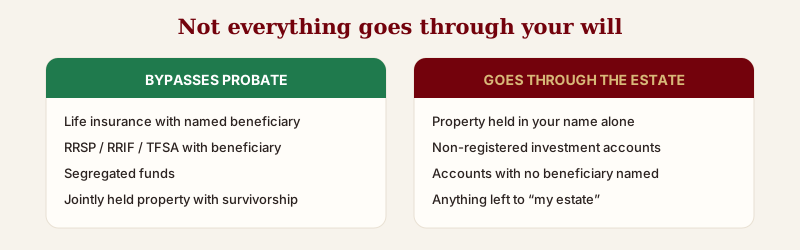
Here is the useful part. Assets with a valid beneficiary designation pass outside the estate and outside intestacy rules entirely.
Life insurance naming your partner, an RRSP naming your partner, a TFSA naming your partner — these go to them directly, promptly, and without regard to whether the province recognises the relationship for inheritance.
For common-law couples, this makes designations disproportionately important. They are the mechanism that reliably works.
Outside Quebec, a TFSA can name a “successor holder” — available to a spouse or common-law partner — which lets them take over the account intact, keeping its tax-free status. Naming them as a plain “beneficiary” instead means the account stops being a TFSA at death. Common-law partners generally qualify for successor holder status; it is worth confirming yours is set that way.
Property is not automatically shared either
Another difference that surprises people. In Ontario, the equalisation of net family property on separation applies to married couples. Common-law partners do not have the same automatic entitlement, and claims typically proceed through constructive trust or unjust enrichment arguments — which are fact-specific and expensive to litigate.
Practically, this means how property is titled matters more. If the home is in one partner's name alone, the other's position on death or separation is considerably weaker than a married spouse's would be.
Joint tenancy with right of survivorship is one straightforward tool: the property passes automatically to the survivor outside the estate. Whether it suits your situation, particularly with children from earlier relationships, is a conversation for a lawyer.
Where common-law status does apply
To be balanced: for many purposes you are treated as spouses. Income tax filing, eligibility for spousal RRSP contributions, pension survivor benefits under CPP, and support obligations on separation generally recognise common-law relationships after a qualifying period.
So the picture is uneven rather than uniformly unfavourable, which is precisely why people are caught out — the rules recognise you in some contexts and not others.
A checklist
- Make a will. For common-law couples in Ontario this is essential, not advisable.
- Name your partner on life insurance, RRSP, TFSA and pension designations.
- Use successor holder for the TFSA rather than beneficiary.
- Name contingent beneficiaries everywhere.
- Review how property is titled, and consider whether joint tenancy fits.
- Consider a cohabitation agreement, which can address property and support expressly.
- Check your life insurance amount — if your partner would need to carry the mortgage alone, that is the number to cover.
Blended families need extra care
If either of you has children from a previous relationship, the interaction between providing for a partner and providing for children needs deliberate structuring. Leaving everything to a partner and trusting they will provide for your children later is a common arrangement that frequently does not survive.
Trusts and appropriately designated insurance can provide for a partner during their lifetime while ensuring children eventually receive their share. That is a conversation for a lawyer, and I work alongside them on the insurance side.
If you are common-law and have never reviewed your designations, that is the quickest meaningful step you can take. It is a short review and the consequences of leaving it are permanent.
What "common-law" means depends on which rule you are asking about
Part of the confusion is that there is no single definition. The same couple can be common-law for one purpose and not another, on the same day.
| For the purpose of | Roughly what applies |
|---|---|
| Income tax and federal benefits | Generally 12 continuous months of cohabitation, or sooner with a child together |
| Spousal support in Ontario | A cohabitation period set by family law, or a child together |
| Dividing property on separation | No automatic equalisation — see below |
| Inheriting without a will | No automatic entitlement in Ontario |
| Insurance and plan designations | Whatever the contract says — you simply name them |
So a couple can be treated as spouses by the CRA, owe each other support under family law, and still have no inheritance right whatsoever. That last row is where the damage happens.
What actually happens without a will
If an Ontario resident dies without a will, the estate passes under intestacy rules to legally married spouses and blood relatives. A common-law partner is not in that list — regardless of how long you lived together, whether you owned a home together, or whether you raised children together.
In practice that can mean the surviving partner watches the estate pass to parents or siblings of the person they shared a life with. They may have a claim as a dependant, but a claim is a court process: slow, expensive, uncertain, and conducted while grieving.
Two documents fix this almost entirely: a will, and beneficiary designations.
Designations are the quickest protection available
This is the reassuring part. Insurance and registered plans pass outside the estate and outside intestacy rules. Naming your partner takes minutes and does not require a lawyer.
- Life insurance: name them as beneficiary. The money reaches them directly, usually within weeks, bypassing probate and creditors.
- TFSA: a common-law partner qualifies as a successor holder — the account carries on as theirs, keeping its tax shelter and using none of their own room.
- RRSP or RRIF: naming a qualifying partner allows a tax-deferred rollover. Without it, the whole value is generally taxed on the final return, which can take a large bite before anything reaches anyone.
- Pension: check the plan's definition and nominate them where the plan allows.
For an unmarried couple these designations frequently matter more than the will, because they cover the largest assets and cannot be contested the same way.
Property is not automatically shared either
The other half of the myth. Married spouses in Ontario have an equalisation right on separation. Common-law partners do not. If the home is in one name, it is that person's property, and the other may be left arguing an unjust enrichment claim in court.
What helps: holding title jointly where that reflects the real arrangement, a cohabitation agreement recording contributions and intentions, and keeping records of who paid for what. A cohabitation agreement is not romantic and is considerably less unpleasant than litigation.
A checklist for an unmarried couple
- Make wills. This is the single step that closes the biggest gap.
- Name each other on life insurance, RRSP, RRIF and pension; use successor holder on TFSAs.
- Check group life at work — it probably still names a parent.
- Review how the home is titled, and whether that matches what you both believe.
- Consider a cohabitation agreement, especially where one person owned the home first or contributions are uneven.
- Consider life insurance sized to the mortgage, so the survivor can stay in the home rather than needing to sell.
- Grant powers of attorney for property and personal care — without them your partner may have no authority if you are incapacitated.
That last point surprises people as much as the inheritance one. Being someone's partner of fifteen years does not, by itself, give you the right to make their medical decisions.
Wills, agreements and powers of attorney are legal work and need an Ontario lawyer. The designations and the insurance I can help with directly — get in touch, or see beneficiary designations and estate planning basics.
Blended families need extra care
Where one or both partners have children from an earlier relationship, the usual arrangement — leave everything to each other, and it passes to all the children eventually — depends entirely on the survivor keeping that intention. They are free to remarry, to change their will, or to spend it.
That is not cynicism about any particular person; it is simply that an informal understanding has no force once you are gone. Options that do not rely on goodwill:
- Insurance naming your own children directly, so their share does not depend on anyone's later decisions.
- A spousal trust, giving your partner the use of assets for life with the remainder going to your children.
- Splitting assets deliberately — the home to the partner, registered plans or insurance to the children.
The trust route needs an estate lawyer. The insurance route is straightforward, and it is often the cleanest way to treat children from a previous relationship fairly without forcing the sale of a home the survivor lives in.