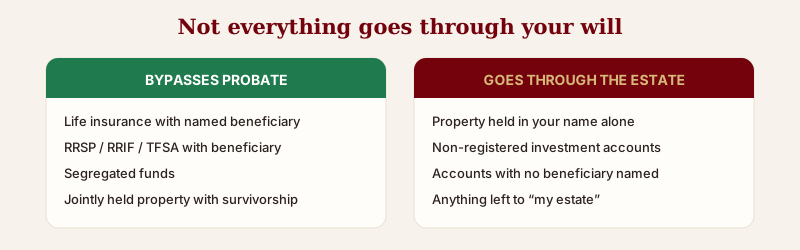
If I could get every client to do one thing this year, it would be this. Checking your beneficiary designations takes about ten minutes, costs nothing, and prevents outcomes that cannot be fixed afterwards.
Why it matters more than your will
Assets with a valid beneficiary designation pass outside your estate and are not governed by your will. Life insurance, RRSPs, RRIFs, TFSAs, pensions and segregated funds all work this way.
So a carefully drafted will can be entirely correct and entirely irrelevant to your largest assets. The designation controls, and it was probably completed years ago in a few seconds on a form.
The four errors
An outdated person. Ex-spouses remain named for decades. Divorce does not automatically remove them, and in many cases they remain legally entitled.
No contingent beneficiary. If your sole beneficiary predeceases you, the proceeds usually fall into your estate — losing the speed, privacy and probate savings that were the point.
A minor named directly. Minors cannot receive proceeds directly. Without an appointed trustee, funds may be held by the court and released at the age of majority — 18 in Ontario, which is young for a large sum.
“Beneficiary” where “successor holder” is better. Outside Quebec, a TFSA can name a spouse or common-law partner as successor holder, letting them take over the account intact with its tax-free status preserved. Naming them as beneficiary instead means the account stops being a TFSA at death. It is a free upgrade most people have not made.
It pulls the proceeds into probate, exposes them to estate administration tax and creditors, and delays payment by months. There are occasional deliberate reasons to do it, but as a default it discards the main advantages.
The seven events that should trigger a review
- Marriage or a new common-law relationship
- Separation or divorce — check your agreement first, since some require coverage to remain in place
- Birth or adoption of a child — and appoint a trustee
- Death of a named beneficiary
- A beneficiary developing a disability — naming them directly can disqualify them from provincial benefits; a Henson trust may be needed instead
- A new job with a new pension or group plan — new plan, new designation form
- Buying property or starting a business, where the overall plan changes
How to actually do it
Make a list of everything with a designation: each life insurance policy, RRSP, RRIF, TFSA, pension, group life plan and any segregated funds.
Then log in to each — or call — and read what is recorded. Not what you remember, what is on file. Administrative errors happen, and forms occasionally never get processed.
For each, confirm: the right primary beneficiary, a contingent beneficiary named, a trustee where a minor is involved, and successor holder used on a TFSA for a spouse.
Two situations needing more care
A beneficiary with a disability. Naming them directly can cost them provincial benefits worth more than the inheritance. Proceeds usually should go to a properly drafted trust instead. This needs a lawyer.
Blended families. Leaving everything to a new spouse and trusting they will provide for children from a previous relationship is common and frequently fails. Structuring this properly is worth doing deliberately.
While you are at it
Write down what exists. A single page listing each policy, the insurer, the policy number and where the documents are, kept with your will.
A meaningful number of Canadian policies are never claimed simply because nobody knew about them. Insurers do not learn of a death automatically — someone has to start the claim.
Ten minutes on designations, fifteen on the list. It is the best return on time available in personal finance, and if you would like help going through it, that is a short call.
Where to look, account by account
| Where | What to check |
|---|---|
| Life insurance policies | Primary and contingent beneficiary; whether it is revocable |
| RRSP and RRIF | Beneficiary; spouse rollover only works if the spouse is named |
| TFSA | Successor holder for a spouse, beneficiary for anyone else |
| Workplace pension | Survivor option chosen at retirement — often irreversible |
| Group life through work | The one people forget entirely; often still names a parent |
| Non-registered accounts | No designation — these pass by will |
The group life row deserves singling out. People name a parent when they join a company at 24, marry at 31, have children at 34, and never revisit the form. It sits in an HR system nobody looks at until a claim.
Successor holder versus beneficiary on a TFSA
These sound interchangeable and are not, and the difference is worth real money for a spouse.
- Successor holder (available only to a spouse or common-law partner): the account effectively becomes theirs. It keeps its tax-sheltered status and does not consume any of their own contribution room.
- Beneficiary (anyone): the account value is paid out. Growth after the date of death generally becomes taxable, and moving the money into their own TFSA requires their own room.
Naming a spouse as beneficiary rather than successor holder is one of the most common and most quietly expensive errors on this list. If you are married or common-law, check this one first.
Revocable and irrevocable
An irrevocable beneficiary cannot be changed without that person's written consent. That is occasionally deliberate — separation agreements often require it, to guarantee support obligations are funded — but it is sometimes selected by accident on an application form.
The consequences are real: with an irrevocable designation in place you may need consent to change the beneficiary, to surrender the policy, or in some cases to take a policy loan. If you do not remember choosing it, check which one your policy says.
What happens when the field is blank or wrong
| Situation | Result |
|---|---|
| No beneficiary named | Proceeds fall into the estate — probate, delay, creditors |
| Named person died first, no contingent | Same: it falls into the estate |
| Ex-spouse still named | They generally receive it |
| Minor child named | Cannot receive it directly; court or guardian involvement |
| "My estate" named | Probate and creditor exposure, losing the main advantage |
Naming a contingent beneficiary is the cheapest insurance against row two, and most people leave it blank. It costs nothing and takes one line on a form.
Doing it properly, in about ten minutes
- List every policy, registered account and group benefit on one page.
- Call or log in and read what is actually recorded — not what you remember choosing.
- Fix the obvious: an ex-spouse, a deceased person, a minor, a blank contingent, "estate".
- Check spouse TFSAs say successor holder, not beneficiary.
- Get written confirmation of every change, and keep it with the will.
- Tell your executor where the list lives. Half the delay after a death is simply finding out what exists.
Where a beneficiary receives provincial disability benefits, a direct payment can interrupt them — see planning for a child who will need lifelong support. For how designations interact with a will, see estate planning basics in Ontario. If you would like me to go through your policies with you, get in touch.
The events that should trigger a review
Designations do not decay on a schedule; they go wrong at specific moments. If any of these has happened and you have not checked since, this is the prompt.
| Event | What typically needs changing |
|---|---|
| Marriage or a new common-law relationship | Add the partner; switch a spouse TFSA to successor holder |
| Separation or divorce | Remove the ex, unless an agreement requires otherwise |
| A birth or adoption | Add contingents; use a trust rather than naming a minor |
| A death in the family | Replace anyone named who has died; add a contingent |
| A new job | Group life almost always starts with a blank or default form |
| Retirement | Pension survivor election — usually a one-time, permanent choice |
| A beneficiary's circumstances change | Disability benefits, bankruptcy, a troubled marriage |
Separation deserves emphasis because the gap is so long. People separate, intend to sort the paperwork once the agreement is final, and then it is years later and the designation still names someone they have not spoken to since. Being separated rather than divorced changes nothing about a designation you control.
Two situations that need more care than a form
A beneficiary receiving provincial disability benefits. A direct payment can interrupt ODSP and the supports attached to it. The money should usually go to a properly drafted trust instead — see planning for a child who will need lifelong support.
A blended family. Naming a second spouse and trusting that the money reaches your children afterwards depends entirely on choices made after you are gone. Naming your own children directly, or using a trust, removes that dependency. Common-law couples covers the related trap where no automatic inheritance right exists at all.
Both are cases where the right answer is a conversation with an estate lawyer rather than a change of name on a form.