Parents of a child with a significant disability tend to arrive at the same question, and it is rarely about investment returns. It is: what happens to them when I am gone?
There is a reasonably well-established framework for this in Canada. It has four parts, and they need to work together — getting one right while missing another can undo the whole plan.
1. The Disability Tax Credit
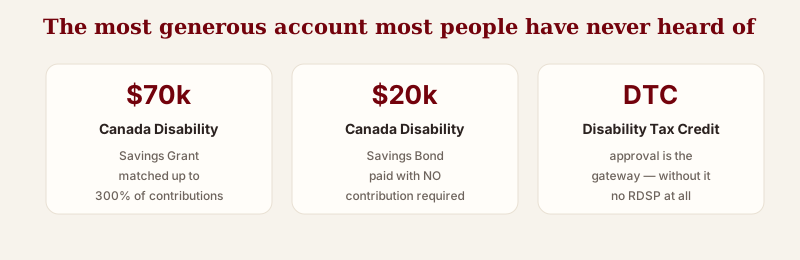
Everything starts here. The DTC is not merely a tax credit; it is the gateway to the RDSP and to several other supports. Without approval, the most valuable tool is simply unavailable.
Eligibility rests on a marked restriction in basic activities of daily living, or the cumulative effect of significant restrictions, or requiring life-sustaining therapy. It covers far more situations than the phrase "disability tax credit" suggests, including many cognitive and developmental conditions.
Application is Form T2201, certified by a medical practitioner. The outcome depends heavily on how thoroughly the practitioner describes functional impact — declines frequently reflect an understated form rather than genuine ineligibility. If you have been declined, it is worth appealing with a fuller description.
The DTC can also be applied retroactively for years the condition existed, which often produces a substantial refund.
2. The RDSP
Once the DTC is approved, the Registered Disability Savings Plan offers government support unmatched by any other account: matching grants up to $70,000 lifetime, and bonds up to $20,000 for lower-income beneficiaries with no contribution required.
Two features matter for long-term planning. Entitlement carries forward up to ten years, so opening late still allows catch-up. And the ten-year rule means withdrawals within a decade of receiving grants can trigger repayment — so it must be treated as a long-horizon account, planned around the beneficiary's expected needs.
Critically, RDSP assets and payments are exempt from most provincial disability benefit asset and income tests, including ODSP in Ontario. Saving here does not generally jeopardise provincial support, which is the fear that stops many families before they begin.
3. The Henson trust
This is the piece most parents have never heard of, and it is often the most important.
Provincial disability benefits such as ODSP are asset-tested. If you simply leave money to your child in your will, the inheritance can disqualify them from benefits until it is spent down — potentially costing them not just income but drug coverage and other supports worth far more than the inheritance.
A Henson trust is an absolute discretionary trust. Because the trustee has complete discretion over distributions, the beneficiary has no legal entitlement to the funds, and provincial authorities generally do not count the trust assets against them. The trustee can then supplement the beneficiary's life — travel, equipment, therapies, comforts — without displacing their benefits.
This requires a lawyer experienced in this area. It is not a template document, and the details determine whether it works.
Naming your child directly as beneficiary on a life insurance policy or RRSP can defeat the entire plan. The proceeds land in their hands, count as assets, and can disqualify them from benefits. Where a Henson trust exists, the trust is usually named instead. Check your designations against your trust — they must agree.
4. Permanent life insurance
This is where insurance genuinely belongs, rather than being sold as an investment.
The need here is permanent — your child will need support for their whole life, not for a 20-year term. A term policy that expires when you are 65 does not address a need that continues past your death.
Permanent insurance funds the Henson trust at the point it is needed, with certainty, regardless of when you die or how markets are performing. For many families it is the mechanism that makes the trust meaningful rather than theoretical.
Some families use a joint last-to-die policy on both parents, which pays when the second parent dies — often the moment the trust needs funding — and costs less than two individual policies.
Other pieces worth knowing
The qualified disability trust can allow graduated tax rates rather than top-rate taxation on trust income, subject to conditions.
Choosing a trustee is among the hardest decisions. It should be someone who will outlive you, understands your child, and can manage money — often a combination of a family member and a professional trustee.
A letter of wishes, though not legally binding, records what you know about your child's routines, preferences, medical history and what a good life looks like for them. Trustees consistently describe this as the most valuable document parents leave.
A sequence
- Apply for the Disability Tax Credit, claiming retroactive years.
- Open and fund the RDSP, capturing bond and grant entitlement.
- Have a lawyer draft a Henson trust in your will.
- Put permanent life insurance in place to fund it.
- Align every beneficiary designation with the trust.
- Choose trustees and write a letter of wishes.
This is one of the more meaningful pieces of planning available to a family, and the parts genuinely interlock. I can handle the insurance and the RDSP side and work alongside your lawyer on the rest. If you are at the beginning of this, the conversation costs nothing.
The four pieces, and the order they go in
| Piece | What it does | Why the order matters |
|---|---|---|
| Disability Tax Credit | Recognises the disability for tax purposes | Nothing else opens without it |
| RDSP | Long-term savings with government grants and bonds | Needs the DTC; grants carry forward ten years |
| Henson trust | Holds an inheritance without disqualifying benefits | Set up in the will, before it is needed |
| Permanent life insurance | Funds the trust when you are gone | Priced on your health now, so earlier is cheaper |
Each depends on the one above. Families who start at the bottom — buying insurance before the DTC is approved or the trust drafted — often find the money arrives with nowhere appropriate to land.
Why the DTC application is worth real effort
The Disability Tax Credit is the gateway, and the application is where most families stumble. It is not awarded for a diagnosis. It is assessed on whether the person is markedly restricted in a basic activity of daily living, or requires life-sustaining therapy, and a medical practitioner must certify that restriction and how long it has lasted.
Two things worth knowing before you apply. Approval can be backdated to earlier years where the condition already existed, which can also unlock earlier RDSP grant entitlement. And a refusal is not the end — many initially refused applications succeed on reconsideration, frequently because the original form described the diagnosis rather than the functional restriction. How the practitioner words it matters enormously.
If this is still outstanding, the RDSP and Disability Tax Credit guide walks through it in detail.
The RDSP, and the ten-year clock running against you
Unused grant and bond entitlement carries forward for up to ten years. That cuts both ways: a family opening an account late can claim several missed years at once, but every year of delay permanently loses the oldest year.
The bond requires no contribution at all for families under the income thresholds — but the account must exist for anything to be paid into it. "We have no money to contribute" is the most common reason families never open one, and it is precisely the situation the bond was designed for.
One structural point to plan around: grants and bonds paid in within the previous ten years generally must be repaid if money is withdrawn. An RDSP is a long-horizon account, so keep shorter-term money elsewhere — a TFSA is the usual companion. See the RDSP page for how the account works.
The Henson trust, and why a simple bequest can backfire
This is the piece that surprises people most, and it is worth understanding before you write a will.
Provincial disability benefits such as ODSP are asset-tested. A straightforward inheritance — money left directly to your child in your will — can push them over the asset limit and interrupt benefits, along with the drug coverage and supports attached to them. Families intend to help and instead create a problem that takes months to unwind.
A Henson trust is the standard Ontario answer. Because the trustee holds absolute discretion over whether to pay anything out, the assets are generally not treated as belonging to the beneficiary, so benefits are preserved while the trust can still fund the things benefits do not cover — equipment, travel, recreation, a better quality of life.
This is law, not insurance, and it is not a template exercise. I am not a lawyer and cannot draft one. It needs an estate lawyer experienced with disability planning, and the trustee choice deserves as much thought as the document — that person may be making decisions for decades.
Why permanent insurance rather than term
The need here does not expire, which is the whole argument. Term insurance is built to cover a stretch of years — a mortgage, the children's dependent years — and then end. A child who will need lifelong support still needs support after your term policy runs out, and by then you will be older and possibly uninsurable.
Permanent insurance also pays out a known amount at a moment that cannot be scheduled, which suits a trust. The alternative — saving the same money in investments — works only if you live long enough to accumulate it.
Two structures worth asking about:
- A policy on one parent's life, paying into the trust at that death.
- A joint last-to-die policy on both parents, paying when the second dies. Usually cheaper, and often the better match, since the need typically arrives when both parents are gone.
The beneficiary should normally be the trust, not the child. A policy paid directly to a beneficiary on provincial benefits recreates the exact problem the trust exists to avoid. The designation and the will have to be written to work together.
See term versus whole life for the underlying difference.
A workable sequence
- Apply for the DTC, asking the practitioner to describe functional restriction rather than diagnosis. Request retroactive years.
- Open the RDSP as soon as the DTC is approved, and claim carried-forward entitlement oldest year first.
- See an estate lawyer about a Henson trust and a will that matches it.
- Arrange permanent insurance naming the trust, priced while you are healthy.
- Write a letter of wishes for the trustee — routines, preferences, who matters to your child. Not legally binding, and invaluable.
- Review every few years, and after any change in benefits, health or family.
If you want help with the insurance piece and a view on how it should sit alongside the trust, book a free conversation. For the legal and tax pieces I will tell you plainly when you need a lawyer or an accountant rather than an advisor.