Search this question online and you will find strong opinions in both directions. One camp insists whole life is a poor investment sold on commission. The other insists term is money down the drain. Both arguments contain some truth and both, stated absolutely, are wrong.
Term and permanent insurance are different tools. Asking which is better is like asking whether a hammer beats a screwdriver. Here is a fair account of each.
What term life actually is
Term insurance covers you for a defined period — commonly 10, 20 or 30 years. If you die during the term, your beneficiaries receive the death benefit. If you outlive it, the coverage ends and nothing is paid out.
Its enormous advantage is price. Because most policies never pay a claim, term coverage costs a fraction of permanent coverage for the same death benefit. That is what makes it possible for a young family to secure a million dollars of protection on an ordinary budget — the exact moment when the need is greatest and the money is tightest.
Its disadvantage is equally simple: it ends. Renewing after the term typically costs far more, because you are older. And if your health has changed, buying a new policy may be difficult or impossible.
What whole life actually is
Whole life — and permanent insurance more broadly — covers you for your entire life, provided premiums are paid. It does not expire. It also accumulates cash value: a portion of each premium builds a pool you can borrow against or withdraw from during your lifetime.
The trade-off is cost. Permanent coverage commonly runs five to fifteen times the price of equivalent term coverage. For most families that difference is the reason they cannot afford adequate coverage if they buy permanent.
The honest case against whole life
The strongest criticism is that whole life bundles insurance with investing, and does neither optimally. The returns on the cash value component are typically modest — conservative by design — and in the early years much of your premium goes to costs rather than value. A common alternative argument, "buy term and invest the difference," is mathematically sound if you actually invest the difference. Many people do not.
It is also true that permanent insurance pays higher commissions than term, which creates an incentive worth naming plainly. You should know that when anyone recommends it — including me.
The honest case for whole life
Now the other side, because there are situations where permanent coverage is genuinely the right answer.
Lifelong dependants. If you support a child with a disability who will need care after you are gone, a policy that expires at 65 does not solve the problem. The need is permanent, so the coverage should be.
Estate and tax planning. In Canada there is no estate tax, but there is a deemed disposition at death: capital gains on a cottage, an investment portfolio or a business become taxable. That bill can force heirs to sell the asset. A permanent policy provides liquidity to pay it, which is a well-established planning use rather than a sales pitch.
Business continuity. Buy-sell agreements between business partners are frequently funded with permanent insurance, so a surviving partner can buy out the deceased partner's share without draining the business.
Guaranteed legacy. Some people simply want certainty that a specific sum passes to their children or a charity, regardless of market conditions or how long they live. Insurance delivers that certainty in a way investments cannot guarantee.
Forced discipline. This is unfashionable but real. For someone who reliably fails to invest the difference, a permanent policy that quietly accumulates value may leave them better off than a theoretical strategy they never execute.
How to choose
Ask what the money is for.
If you are protecting a temporary obligation — a mortgage, children until they are independent, income until retirement — the need has an end date, and term matches it at a fraction of the cost. This describes most families most of the time.
If you are addressing a permanent obligation — a lifelong dependant, a tax liability at death, a business agreement, a guaranteed legacy — the need never ends, and permanent coverage is the appropriate instrument.
Many people have both kinds of need, and a layered structure works well: a substantial term policy covering the high-need decades, plus a smaller permanent policy underneath it that never expires.
The conversion option — the detail worth knowing
Most quality term policies include a conversion privilege: the right to convert some or all of the coverage to permanent insurance later, without a new medical exam.
This is the single most underappreciated feature in life insurance, and it substantially defuses the whole debate. It means a 30-year-old can buy affordable term today and retain the option to secure permanent coverage at 45 — even if their health has deteriorated in the meantime. You are not locked out of the permanent decision by choosing term now.
Conversion privileges vary: some run to a set age, some expire earlier, and the range of permanent products available on conversion differs by insurer. If there is any chance you will want permanent coverage eventually, the terms of the conversion option deserve as much attention as the premium.
What I actually recommend
Most of my clients are best served by term, often with a strong conversion privilege, and I say so even though it pays me less. A young family's priority is having enough coverage during the years the need is greatest, and term is what makes that affordable.
Where a client has a genuine permanent need, I say that too. What I will not do is present permanent insurance as an investment product, because judged purely as an investment it usually is not a compelling one. Judged as insurance with useful secondary properties, it can be exactly right.
If you have been given a recommendation and want a second opinion with no stake in the outcome, I am happy to look at it with you.
Side by side
| Term life | Whole life | |
|---|---|---|
| Covers you for | A set period — 10, 20, 30 years | Your whole life |
| Cost per dollar | Low | Considerably higher |
| Cash value | None | Builds over time |
| Premium | Fixed for the term, then rises sharply | Fixed for life |
| Pays out | Only if you die within the term | Whenever you die |
| Best at | Covering temporary obligations | Permanent needs and estate planning |
| Flexible | Can often convert to permanent | Harder to unwind well |
Why term suits most families
Most of what people insure against is temporary. A mortgage gets paid off. Children grow up and become independent. Savings accumulate. By the time a 20-year term ends, a household that has been sensible usually needs far less coverage than when it started.
Term matches that shape, which is why the same premium buys several times more protection than whole life. For a young family, the choice is often between a large term policy that genuinely covers the mortgage and childcare, or a small whole life policy that does not — for similar money. Protection during the vulnerable years is what matters most, and term delivers more of it.
Where whole life genuinely earns its place
It is not a bad product; it is a specific one, for needs that do not expire:
- Final expenses. A funeral and estate costs arrive regardless of age, and term will have ended by then.
- A tax liability at death. A cottage, a rental property or a business can trigger capital gains on death. That bill does not expire, and permanent insurance is a common way to fund it.
- A dependant who will always need support, such as a child with a disability.
- Estate equalisation. Where one child inherits a business or property and another should receive equivalent value.
- Maximised registered accounts. For a household already filling RRSP, TFSA and other room, the tax-sheltered growth inside a policy can have a place.
Notice that every one of those is permanent by nature. That is the test: if the need has an end date, term is almost always the better value.
The honest case against whole life
Three criticisms are fair and worth stating plainly:
Early cash value is poor. Much of the first years' premiums go to costs and commission. Surrender in the first several years and you may get back less than you paid, sometimes considerably less.
It is inflexible. If the premium becomes unaffordable, the options are limited and often costly. Term can simply be dropped when the need ends.
The illustrations are optimistic. Projections rest on assumptions about dividends and returns that are not guaranteed. Ask to see the guaranteed column, not the projected one — that is the promise; the rest is a hope.
It is also, bluntly, the product with the larger commission, which is worth knowing when it is recommended strongly to a young family whose needs are plainly temporary.
The conversion privilege
This is the most valuable feature of a term policy and the least discussed at purchase.
Most term policies include the right to convert to permanent coverage without new medical evidence, up to an age set in the contract. That means if your health changes during the term — a diagnosis that would make you uninsurable — you can still secure permanent coverage on the strength of the health you had when you first applied.
Check three things before buying any term policy: that it is convertible, until what age, and into which products. Policies vary, and the difference only becomes apparent years later when it is far too late to change your mind.
A practical way to decide
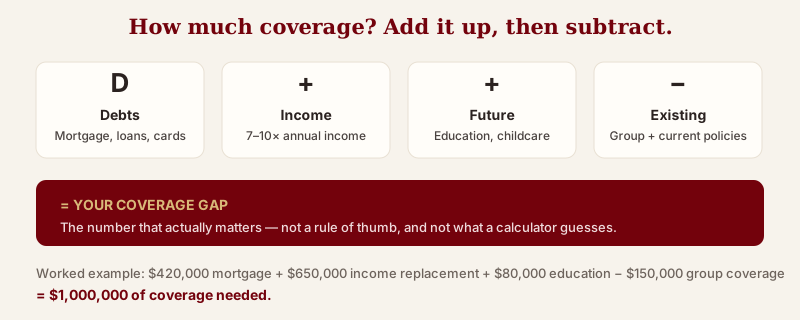
- Work out what you need and for how long. Mortgage, income replacement, childcare, education — each with an end date.
- Cover the temporary needs with term, sized properly rather than sized to fit a premium.
- Ask whether a permanent need actually exists — a tax liability, a dependant with lifelong needs, final expenses. If not, stop here.
- If one does, cover it with a smaller permanent policy alongside the term rather than instead of it.
- Confirm the term policy is convertible, which keeps the door open if circumstances change.
For most households the answer is a large term policy now and a conversation about permanent coverage later. Anyone recommending whole life to a young family with a big mortgage, before the term option has even been priced, is worth questioning. See the life insurance page for how the two work together.
What happens when a term policy ends
People are often told term coverage "expires and you get nothing", which is true but incomplete. Three things can happen at the end of a term, and knowing them changes how the choice looks.
It renews automatically, at a much higher premium. Most term policies renew yearly after the initial term without new medical questions — but the price reflects your age then, and it climbs steeply each year. Useful as a short bridge; expensive as a plan.
You convert it, using the conversion privilege, to permanent coverage without new medical evidence. This is the option that matters most if your health has changed.
You let it lapse, because the need has genuinely ended — mortgage cleared, children independent, savings sufficient. For most households this is the intended outcome and is not a loss. You paid for protection during the years you needed it, exactly as you pay for home insurance without expecting a refund.
"Buy term and invest the difference" — does it hold up?
The standard argument against whole life is that term costs less, so you should invest the savings and end up ahead. Mathematically it usually works. Behaviourally it often does not, and it is worth being honest about both halves.
It holds up when the difference is genuinely invested, consistently, in a tax-sheltered account, and left alone. For a disciplined household with TFSA and RRSP room available, that is frequently the better outcome.
It falls down when the difference quietly becomes spending money, which is the common case. It also assumes the need really is temporary — if a permanent obligation exists, no amount of investing replaces coverage that pays whenever you die.
So the honest version is: term plus genuine investing beats whole life for most families, provided the investing actually happens and the need actually ends. Where either assumption fails, the comparison changes.
Questions to ask before buying either
- What exactly am I protecting, and does it have an end date?
- If term: is it convertible, until what age, and into which products?
- If whole life: what does the guaranteed column show, ignoring projections?
- What is the surrender value in years one through ten?
- What happens if I cannot pay a premium?
- Can I see the term option priced alongside, at the same coverage amount?
That final question is the most revealing. If a permanent policy is being recommended without the term equivalent priced next to it for comparison, ask why before signing anything.