Ask the internet how much life insurance you need and you will get a number: ten times your income. It is not a terrible starting point. But it is a rule of thumb built for an average family that does not exist, and I have rarely seen it produce the right answer for a real one.
A family with a paid-off house and no children needs far less than that. A family with a large mortgage, three young kids and one income needs considerably more. The rule cannot tell the difference. Here is the calculation that can.
The method: add up obligations, subtract what you already have
Life insurance exists to replace what disappears financially when you do. So the question is not "what number sounds right" — it is "what would my family actually need to be alright?" That breaks into four parts.
1. Debts that would need clearing
Start with the mortgage — usually the largest single figure, and the one most families most want dealt with. Add car loans, lines of credit, credit card balances, and any business debt you have personally guaranteed. The goal is that your family is not serving debt on a reduced income.
2. Income your family would lose
This is the biggest and most-underestimated component. If your household depends on your income, that income needs replacing for as long as the dependency lasts.
A workable approach: multiply your annual income by the number of years your family would need support. For a parent with a newborn, that might be twenty years until the child is independent. For someone five years from retirement with grown children, it might be five. This is where the "7 to 10 times income" guideline comes from — it approximates a working lifetime — but doing it explicitly is far more accurate than accepting the multiple.
3. Future costs you intend to cover
Post-secondary education is the common one. Childcare is the one people forget: if a stay-at-home parent dies, the surviving parent may need to pay for care they previously provided, which can run to tens of thousands a year. Include final expenses too — a funeral in Canada commonly runs several thousand dollars, and it lands at the worst possible moment.
4. Subtract what already exists
Now reduce the total by existing resources: group coverage through work, any individual policies you already hold, and liquid savings your family could genuinely draw on. What remains is your actual gap — and that is the number worth insuring.
A worked example
Take a couple in Mississauga, both 38, with two children aged 6 and 3. One earns $95,000, the other $55,000. They have a $420,000 mortgage remaining and $18,000 on a car loan. The higher earner has $150,000 of group coverage through work.
For the higher earner:
- Mortgage and car debt: $438,000
- Income replacement — $95,000 for roughly 7 years while the children are dependent: $665,000
- Education for two children: $80,000
- Less existing group coverage: −$150,000
Total: approximately $1,033,000. In practice we would round to $1,000,000 of coverage.
Notice that "ten times income" would have suggested $950,000 — close, in this case, almost by coincidence. Change one variable — no mortgage, or a stay-at-home spouse, or a child with additional needs — and the two methods diverge sharply.
Don't overlook the lower earner
Households routinely insure the primary earner well and the second earner barely, or not at all. That is a mistake, and it is worse when one parent is at home full time.
If the parent providing childcare dies, the surviving parent faces a stark choice: pay for full-time care, or reduce their own working hours. Either outcome costs real money at exactly the moment income is under strain. The economic value of unpaid caregiving is genuine even though no salary reflects it.
Why group coverage isn't enough on its own
Employer coverage is a real benefit and worth having. But it has three limitations people discover at the wrong moment.
It is usually modest — often one or two times salary, which rarely closes the gap calculated above. It ends when the job ends, and it ends precisely when you are between jobs and least able to replace it. And it may become harder to replace later: if your health changes while you are covered by a group plan, you may not qualify for individual coverage when that plan disappears.
The practical answer is not to abandon group coverage but to treat it as a supplement — a layer on top of a personal policy you own and control.
How long should the coverage last?
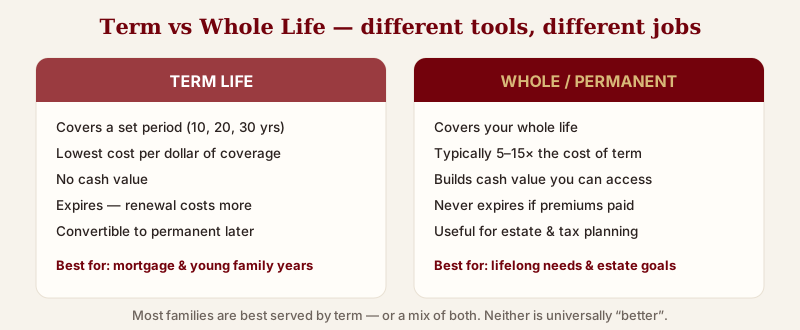
Match the term to the obligation. If the need is a 22-year mortgage and raising young children, a 20 or 25-year term aligns well and costs a fraction of permanent coverage. If the need is genuinely lifelong — supporting a dependent with a disability, covering estate taxes, or leaving a guaranteed legacy — permanent coverage is the appropriate tool despite the higher premium.
Many families end up with a sensible mix: a large term policy covering the high-need years, plus a smaller permanent policy that never expires.
One reason not to delay
Life insurance is priced on age and health, and both move in one direction. The same coverage costs meaningfully more at 45 than at 35, and a diagnosis in between can change your options entirely. This is not a scare tactic — it is simply how underwriting works. If you have been meaning to sort this out, the cheapest day to do it was some time ago, and the second cheapest is today.
If you would like the calculation done properly against your actual numbers, that takes about twenty minutes and costs nothing. I would rather you had the right amount of coverage than a number you picked from an article — including this one.
The calculation, laid out
| Add up | How to size it |
|---|---|
| Mortgage | Current balance, not the original loan |
| Other debts | Car, line of credit, cards, personal guarantees |
| Income replacement | Net income × years needed — commonly to the youngest child's independence |
| Childcare | What must be paid for if one parent is gone |
| Education | Any shortfall beyond an existing RESP |
| Final expenses | Funeral, estate administration, tax owing at death |
| Subtract existing cover | Personal policies, and group cover at its real current value |
| Subtract liquid savings | Only what could genuinely be accessed quickly |
The result is your number. It is usually larger than the rules of thumb suggest, because those rules ignore the two biggest lines: how long income must be replaced, and what childcare actually costs when one parent is no longer there.
Why "ten times salary" misleads
The familiar multiple is a starting point, not an answer, and it goes wrong in both directions.
It overstates the need for a household with no dependants, modest debts and solid savings. It understates it badly for a young family with a large mortgage in the Greater Toronto Area, where ten times one salary may not clear the mortgage, let alone replace income for fifteen years.
The multiple also ignores who is being insured. Two households with identical incomes need very different amounts depending on the number and ages of children, the size of the mortgage, and whether the surviving partner could realistically return to full-time work.
The stay-at-home parent problem
Households routinely insure the earner heavily and the non-earner barely, or not at all. The reasoning feels sound — no income is lost — and it is wrong.
If a stay-at-home parent dies, the surviving partner faces full-time childcare costs, after-school care, more paid help around the house, and often a reduction in their own working hours at exactly the moment money is tightest. In the Greater Toronto Area, full-time childcare for two young children is a substantial annual cost for years.
That is a real financial loss, and it is insurable cheaply. A term policy on a healthy parent in their thirties usually costs very little relative to what it protects against.
Choosing the term
The amount answers "how much". The term answers "for how long", and it is the question people spend least time on.
- To the youngest child's independence. The most common anchor — often 18 to 20 years from a birth.
- To the end of the mortgage. Sensible where the mortgage is the dominant obligation.
- To retirement. Where income replacement matters until pensions and savings take over.
Where these conflict, take the longest. Coverage that ends five years early protects nothing in the year it matters, and buying a longer term at today's age costs far less than buying a new policy later at an older age and whatever health you have by then.
A practical alternative to one large policy: layer two. A larger, shorter policy covering the intensive years of mortgage and childcare, and a smaller, longer one running to retirement. Total cost is often lower than a single policy sized for the peak and held for the whole time.
When to revisit the number
The figure is right on the day you calculate it and drifts afterwards. Worth redoing when any of these happen:
- A child arrives
- You buy a home or refinance a larger mortgage
- A partner stops or starts working
- Income changes materially
- A term policy is within five years of expiring
- You change jobs, and with it your group coverage
A review takes a short conversation, costs nothing, and quite often ends with "you are fine, leave it alone" — which is a useful answer too.
Two households, same income, different answers
To show why a multiple of salary cannot work, take two families each earning $140,000 net.
Family A: both partners in their early thirties, two children under five, a $700,000 mortgage with 27 years to run, modest savings. Income must be replaced for roughly two decades, childcare is expensive and immediate, education is entirely ahead of them, and the mortgage dominates. Their number runs well over a million dollars.
Family B: both in their early fifties, children finished university and working, mortgage down to $90,000 with six years left, substantial RRSP and TFSA balances. Income needs replacing only until retirement, there is no childcare, education is done, and savings already cover much of the gap. Their number might be a few hundred thousand, and shrinking each year.
Identical incomes, wildly different needs. The difference is not what they earn; it is what depends on them and for how long.
Common mistakes when running the numbers
- Using gross income instead of net. Your family replaces take-home pay, not salary.
- Counting group coverage at full value. It ends with the job, and often at the worst moment.
- Counting illiquid savings. Equity in the house is not money your family can use while living in it.
- Forgetting tax owing at death on a rental property, a cottage or a business.
- Insuring only one partner. Covered above, and the most frequent omission of all.
- Sizing the policy to a premium rather than to the need, then quietly hoping the gap does not matter.
What it costs, and why waiting is expensive
Premiums are set largely by age and health at application, and both move in one direction. A policy bought at 35 is meaningfully cheaper than the same policy at 45, and the premium is locked for the whole term once issued — so the age you buy at follows you for twenty years.
Health is the sharper risk. A diagnosis between now and "once things settle down" can move a policy from standard rates to rated, or occasionally to unavailable. Nobody plans for that, which is precisely the point of buying while you are well.
If the full amount feels unaffordable today, buy what you can now and add later rather than waiting to do it properly. Coverage in force beats coverage intended, and most term policies let you add a second policy alongside without disturbing the first.