Buried in most term life policies is a provision called the conversion privilege. It lets you exchange some or all of your term coverage for permanent insurance without new medical evidence — no exam, no questionnaire, no consideration of health changes since you bought it.
For someone whose health has deteriorated, it can be the difference between having permanent coverage available and having none. It also quietly expires, usually without anyone mentioning it.
Why it matters
When you bought term insurance at 32, you were underwritten on your health then. If you developed a serious condition at 47, buying new coverage would mean disclosing it — resulting in a rating, an exclusion, or a decline.
The conversion privilege sidesteps that entirely. The insurer already accepted your risk; conversion continues that acceptance in a different product. Your health today is irrelevant to whether you can convert.
The premium you pay after converting is based on your current age, not the age at which you first bought the policy, and permanent insurance costs considerably more than term. So conversion is not cheap. What it is, is available — which is the point.
When conversion privileges expire
This is where people lose the option without noticing.
Conversion rights are typically limited by age — often ending somewhere around 65 to 70 — or by a period within the term, or by the earlier of the two. Some policies allow conversion throughout the full term; others cut it off years before the term ends.
Insurers do not usually send reminders. The privilege simply lapses, and people discover it when they enquire about converting and find the window closed.
Dig out your policy or call the insurer and ask two questions: is my policy convertible, and by what exact date or age? Write the answer in your calendar. This takes ten minutes and preserves an option you may badly need in fifteen years.
When converting makes sense
Your health has changed and a permanent need has appeared. The strongest case. If you now have a lifelong dependant, an estate tax liability, or a business obligation — and you could not qualify for new coverage — conversion may be your only route.
A permanent need emerged that you did not anticipate. A child with a disability who will need lifelong support. A cottage with substantial accrued gains. A business succession plan requiring guaranteed liquidity.
Your term is expiring and the need continues. Renewing term after expiry is expensive, since it is priced at your then-current age and often escalates annually. Converting may be more economical over the long run, and the coverage will not expire again.
When it does not
If the need is still genuinely temporary — a mortgage with twelve years left and children who will be independent — permanent coverage costs many times more for a need that ends. Buying a new term policy, if you are healthy enough to qualify, is usually better value.
And if you are in good health, shop the market. Conversion is valuable precisely because it avoids underwriting; if underwriting is not a problem for you, fresh coverage is often cheaper.
Partial conversion
An underused option. Most policies allow converting part of the coverage while leaving the rest as term.
Someone with $1,000,000 of term might convert $200,000 to permanent — enough to cover final expenses and an estate tax bill — while keeping $800,000 of term for the remaining mortgage and childrearing years. That costs a fraction of full conversion and addresses both the permanent and temporary needs appropriately.
This is frequently the right answer and it is rarely offered unless you ask.
What you can convert into
The range of permanent products available on conversion varies by insurer. Some offer a full suite of whole life and universal life options; others restrict conversion to one designated product, which may not be the one you would choose.
Worth knowing when you buy the term policy, not when you convert. Two policies with identical premiums can have very different conversion terms, and that difference may matter far more in twenty years than a small price gap today.
What to do
- Confirm whether your policy is convertible and by what date or age.
- Diarise the deadline well in advance.
- Reassess when your circumstances change — a diagnosis, a dependant with lifelong needs, a business.
- Consider partial conversion rather than treating it as all or nothing.
- If shopping for new term, compare conversion terms, not just premiums.
If you hold term coverage and do not know your conversion terms, I am happy to look them up with you. It is a short call and the option is worth more than most people realise.
What the option is actually worth
A conversion privilege is a promise the insurer made when you bought the policy: that you may exchange some or all of your term coverage for a permanent policy without answering a single health question, as long as you do it before the deadline.
That matters because of who ends up using it. Somebody in good health rarely needs it — they can simply shop for a new policy. The person who needs it is the one who has been diagnosed with something since they bought the term policy, and who would now be rated or declined on a fresh application. For them, the conversion option is the only door still open.
| Your health now | What conversion is worth |
|---|---|
| Unchanged, still good | Little — compare the open market first |
| Something diagnosed since you applied | A great deal — possibly your only route to permanent cover |
| Serious condition, uninsurable elsewhere | Close to irreplaceable |
So the option is a form of insurance on your insurability. Most people never think about it until they need it, by which time the deadline may have passed.
The deadline is the part that catches people
Conversion privileges do not run for the whole term. They typically end at a set age, or a set number of years into the policy, whichever comes first — and the age limit is the one that surprises people, because it can arrive well before the term itself expires.
Someone who buys a 20-year term at 50 may find the conversion right lapses at 65 while the policy runs to 70. For the last five years they hold cover that is expiring and can no longer be converted. Nothing announces this; the deadline simply passes.
What to do about it: find your policy contract, locate the conversion clause, and write the deadline in your calendar with a reminder a year ahead. It takes ten minutes. If you cannot find the contract, the insurer will tell you the date if you ask.
What the new premium looks like
Converting does not preserve your term premium. The permanent policy is priced at your current age, using the health class you were originally granted. So the price rises — often sharply, because permanent insurance is fundamentally more expensive than term, and because you are older.
What you keep is the health class. Someone who was accepted as a healthy non-smoker at 35 and has since developed a serious condition still converts at that original classification, which is exactly the point.
The practical consequence: do not treat conversion as a budgeting decision made at the deadline. Get the actual converted premium in writing well in advance, so the number is not a shock in the month you have to decide.
Partial conversion, and why it is usually the right answer
Most policies allow you to convert part of the coverage and leave the rest as term. This is underused and often the sensible middle path.
Consider someone with $750,000 of term who now has a health condition. Converting the whole amount to permanent may be unaffordable. Converting $150,000 — enough for final expenses, taxes at death, and something for the family — while letting the rest run out with the mortgage, keeps lifelong cover in place at a manageable cost.
- Convert the part that reflects a permanent need: final expenses, estate taxes, a dependent who will always need support.
- Leave as term the part that reflects a temporary need: the mortgage, the years until the children are independent.
Check the minimum conversion amount in your contract, since most insurers set one.
Where conversion fits against the alternatives
| Option | Health questions? | Best when |
|---|---|---|
| Convert | No | Health has changed, or a permanent need exists |
| Buy a new policy | Yes, full underwriting | Health is still good — often cheaper |
| Renew the term | No | Short bridge only; renewal rates climb steeply |
| Let it lapse | — | The need has genuinely gone |
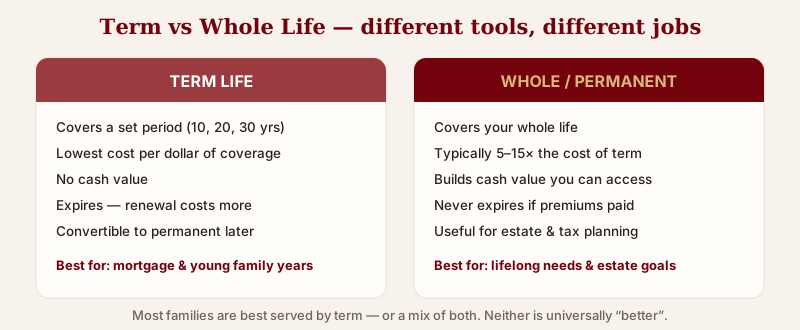
If your health is unchanged, shop the open market before converting — a new policy is frequently cheaper for the same cover. The difference between term and permanent is set out in term versus whole life, and what happens when your term expires covers the renewal path.
A short checklist
- Find the conversion deadline in your contract and diarise it a year early.
- Ask the insurer which permanent products you may convert into — the list is set by the contract, not by what is on the market today.
- Request the converted premium in writing before you need to decide.
- Work out what part of the need is permanent and convert only that.
- If your health is unchanged, get market quotes too and compare honestly.
If you are not sure what your policy allows, send it over and I will read the conversion clause with you — get in touch. For cover generally, see the life insurance page.