Insurance for children is sold emotionally, and I would rather set that aside and look at what the product actually does.
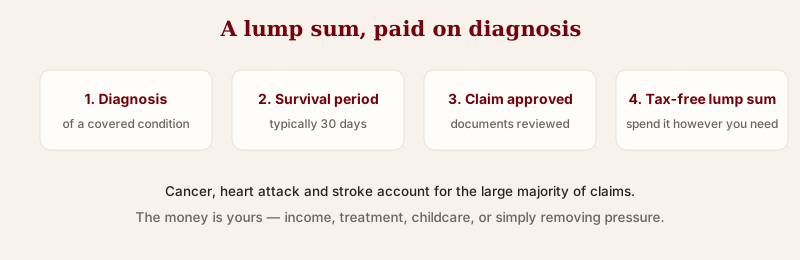
Child critical illness insurance pays a tax-free lump sum if a child is diagnosed with a covered condition. Policies typically cover the adult conditions plus childhood-specific ones — cerebral palsy, type 1 diabetes, muscular dystrophy, congenital heart conditions.
What the money is actually for
Not medical treatment. Provincial health care covers your child's care, and that is the point of the system.
The financial damage of a seriously ill child is parental income loss. One parent typically stops working or drops to part time, often for months. There is travel to a children's hospital in another city, accommodation, parking, meals, and care for siblings. Families describe those costs as relentless rather than dramatic.
A lump sum lets a parent stop working without the household finances collapsing. That is the honest use case, and it is a real one.
The stronger argument
Here is the case I find more persuasive, and it gets mentioned least.
Many child critical illness policies include an option to convert to adult coverage at a set age without new medical evidence. If your child develops a condition during childhood — type 1 diabetes, a serious mental health condition, anything that would complicate underwriting — that conversion right may be the only route to coverage as an adult.
You are not primarily insuring against childhood illness. You are buying your child's future insurability, cheaply, while they are healthy. For a family with a history of hereditary conditions, that is genuinely valuable.
“Does this policy convert to adult coverage without medical evidence, at what age, and for how much?” Policies differ considerably here, and it is the feature most likely to matter twenty years from now.
The honest case against
Serious childhood illness is, thankfully, uncommon. Most families will pay premiums for years and never claim — which is true of all insurance, but the probability here is lower than for adult coverage.
More importantly: if money is limited, the parents' coverage matters more. A child's illness is financially difficult; a parent's death or disability is financially catastrophic, because the household income disappears entirely.
I have had parents come to me wanting child coverage while carrying no disability insurance themselves. That ordering is backwards, and I say so.
Where it fits
My honest position: child critical illness is a reasonable purchase after the parents have adequate life and disability coverage and an emergency fund. It is inexpensive, so it rarely competes for much budget once those are in place.
It is not a substitute for those foundations, and it should never be sold as an investment because some policies return premiums later. Judged as an investment, the returns are unremarkable.
What to check
- The covered condition list, particularly childhood-specific ones
- Conversion rights — age, amount, and whether medical evidence is required
- Whether it can be added as a rider to a parent's policy, which is often cheaper than standalone
- The survival period, typically 30 days
- Return of premium terms, if included, and what they genuinely cost
If you are weighing this up, I am happy to look at your overall picture and tell you whether it belongs on the list yet — including if the answer is that your own coverage should come first.
What the money is actually for
This is the part that gets explained badly, which is why the product feels distasteful to some parents. A child critical illness policy does not pay for your child's medical treatment — in Canada, provincial health insurance covers the hospital and the physicians. It pays a lump sum to you, and what it really buys is the ability to stop working.
| What a serious childhood illness actually costs a family |
|---|
| A parent taking months off, often unpaid, sometimes both parents |
| Travel and accommodation near a specialist hospital in another city |
| Childcare for siblings over a long stretch |
| Drugs, equipment and therapies outside provincial coverage |
| Home modifications where there is lasting disability |
| Parking, meals and the hundred small costs of living at a hospital |
Framed that way, the question is not "am I betting on my child getting sick" but "if the worst happened, could we afford for one of us to be there full-time without the mortgage falling apart?" For many households the honest answer is no, and that is the gap this fills.
The stronger argument: future insurability
Most policies written on a child include the option to convert to an adult critical illness policy at a set age — commonly around 25 — without any medical evidence.
That matters more than it sounds. A child diagnosed with type 1 diabetes, epilepsy, Crohn's or a congenital heart condition at eight may find adult critical illness cover unavailable or heavily rated at twenty-five. A policy bought before the diagnosis carries a guaranteed right to convert, which is a benefit they cannot buy for themselves later at any price.
Several policies also return the premiums paid if no claim is made by a set date. Read that feature carefully — the conditions are specific and the option can be lost by converting or cancelling — but where it applies, the eventual cost of the cover can be considerably lower than the premiums suggest.
The honest case against
I would rather set this out plainly than sell past it.
- Serious childhood illness is rare. Most families will pay premiums for twenty years and never claim.
- The covered conditions are a defined list, and a child can be gravely ill with something that is not on it. Cover is not a guarantee of a payout.
- Nearly every other insurance need comes first. A household with no disability cover on the earner and no life insurance has more urgent gaps.
- The same premium invested over twenty years builds a fund usable for anything, not only a listed diagnosis.
- It is often sold emotionally, to new parents at a vulnerable moment. That is a reason for care, not a reason it is worthless.
Where it belongs in the order
| Priority | Why it outranks child cover |
|---|---|
| 1. Disability cover on the earners | Far more likely than child illness, and the household depends on that income |
| 2. Life insurance on the earners | Protects the children's whole future, not one listed event |
| 3. Emergency savings | Usable for any crisis, including the ones no policy lists |
| 4. Critical illness on the earners | Same logic as the child version, applied where the income is |
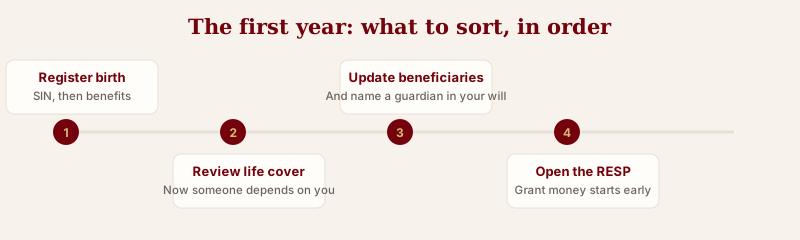
| 5. RESP for education | A certainty rather than a risk, with government grants attached |
| 6. Critical illness on the children | Worth considering once the above are in place |
If a conversation about child cover is happening before the first four, the order is wrong. See disability insurance, life insurance and the RESP.
What to check before buying
- The condition list, and specifically whether childhood-onset conditions such as type 1 diabetes and congenital heart disease are included.
- The conversion right — at what age, to what product, and whether it is truly without medical evidence.
- Survival period — typically a number of days after diagnosis before a claim is payable.
- Exclusions for congenital conditions present or diagnosable at birth.
- Whether a return-of-premium option applies, and what cancels it.
- Standalone or a rider on your own policy — a rider is usually cheaper, but check whether it survives if your policy ends.
If you want an honest view on whether this fits your family or whether the money is better spent elsewhere, ask me. I am comfortable saying no to this one, and often do.
Standalone policy or a rider on yours?
| Child rider on your policy | Standalone child policy | |
|---|---|---|
| Cost | Lower; often one price covers all children | Higher, priced per child |
| Coverage amount | Usually modest and capped | Chosen by you |
| Covers new children | Usually automatic | A new policy each time |
| If your policy ends | The rider generally ends too | Unaffected |
| Conversion right at adulthood | Varies — check carefully | Usually built in |
The rider is the sensible starting point for most families: cheaper, covers every child, and enough to fund time off work. The standalone policy earns its cost mainly where the conversion right is the reason you are buying — because that is the benefit your child keeps for life.
Check the fourth row before assuming a rider is equivalent. A rider attached to a 20-year term policy may disappear exactly when your child reaches the age at which the conversion option would have mattered.
A reasonable way to decide
Ask three questions in order. Could we manage financially if one of us stopped working for six months? If yes, the main argument weakens considerably. Are the earners' disability, life and critical illness cover already in place? If not, that money is better spent there first. Is there family history that makes future insurability a real concern? If so, the conversion right is worth more than the claim cover.
Two noes and a yes usually points to a small rider rather than a standalone policy. Three noes is a reasonable place to decide against it entirely, and nobody should make you feel otherwise.