New parents are given a great deal of advice about sleep and none about money. The financial side is not complicated, but a few things are genuinely time-sensitive, and a couple are easy to get wrong in ways that only surface much later.
1. Your life insurance need just changed completely
Before children, you may reasonably have needed little or no life insurance. That changed the day your child arrived.
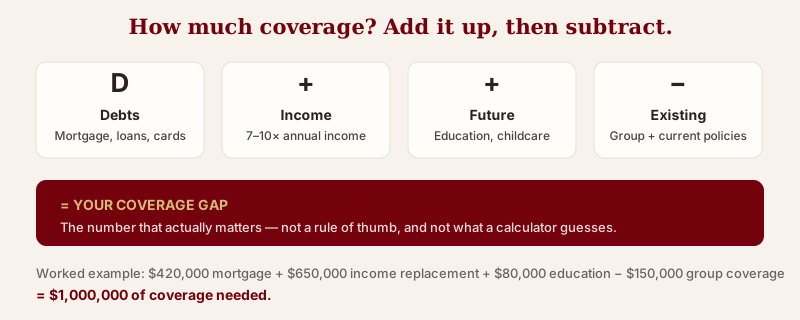
The calculation is not a rule of thumb. It is your mortgage and debts, plus enough income replacement to raise a child to independence — often 18 to 22 years — plus future costs like education, minus existing coverage. For most young families that lands considerably higher than they expect.
Term insurance is what makes this affordable. A 20 or 25-year term aligns neatly with the years your child depends on you, at a fraction of permanent coverage.
2. Insure the parent who is at home
The most consistently overlooked item. Households insure the higher earner well and the other parent barely.
If the parent providing full-time childcare dies, the surviving parent must either pay for that care or reduce their working hours. Either costs real money, at a moment when income is already under strain. The economic value of unpaid caregiving is genuine even though no salary reflects it.
3. Update your beneficiaries, and appoint a trustee
New parents frequently name their child as beneficiary on a policy. Sensible instinct, imperfect execution.
Minors cannot receive insurance proceeds directly. Without a properly appointed trustee, the money may be paid into court and released at the age of majority — 18 in Ontario. Handing a teenager a large lump sum on their eighteenth birthday is rarely what parents intend.
The fix is straightforward: name a trustee for the minor beneficiary, or direct proceeds to a trust established in your will. It takes a form and a conversation.
4. Name a guardian in your will
Not my department, but too important to leave out. If both parents die without naming a guardian, a court decides who raises your child — from among people who may all believe they are the right choice.
If you do not have a will, this alone is reason enough to get one.
5. Open the RESP early
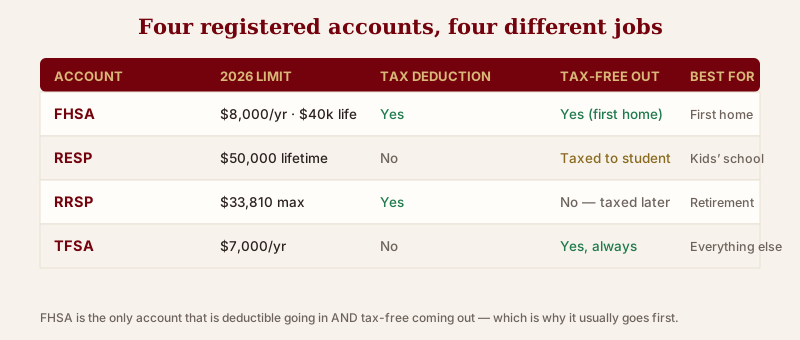
The Canada Education Savings Grant pays 20% on the first $2,500 contributed per child each year, up to $500 annually and $7,200 lifetime. It is close to a guaranteed 20% return, available to essentially every family.
Starting at birth and contributing $2,500 a year captures the full $7,200 comfortably. Starting at fourteen generally does not, because grant eligibility ends after the year the child turns 17 and the annual catch-up is capped.
You need the child's Social Insurance Number, which you can request as part of birth registration in most provinces. Do it then rather than later.
Grandparents and relatives often ask what would be useful. Contributions to the RESP attract the 20% grant, which no toy does. Some families set up a simple arrangement for birthday and holiday contributions — it compounds quietly for eighteen years.
6. Check what your employer actually provides
Group life insurance often defaults to one or two times salary, which rarely covers a young family's need. Many plans allow you to buy additional optional coverage, sometimes with limited underwriting after a life event such as a birth.
Also confirm whether your dental and health plan automatically adds a new dependant, or whether you must enrol them within a window. Miss the window and you may wait until the next enrolment period.
7. Consider disability insurance seriously
With a child depending on your income, the probability of being unable to work for an extended period during your working years is higher than the probability of dying. If you have group disability, understand its limits — it usually ends with the job. If you are self-employed with none, this is the most significant gap in your protection.
A realistic order
- Register the birth and request the SIN.
- Add the baby to your health and dental plan within the enrolment window.
- Review life insurance for both parents.
- Update beneficiaries and appoint a trustee for any minor.
- Make a will naming a guardian.
- Open the RESP and start contributing what you can.
None of this needs doing in the first fortnight. But it is worth working through in the first year, while it is still fresh — and before the years of grant money start slipping past.