Most financial advice assumes surplus income to allocate. The more common situation is a modest amount left over each month and a long list of things that all sound important.
Order matters more than amount. Here is a defensible sequence, and where I part company with the usual version.
1. High-interest debt
Nothing on this list beats clearing debt at 20% interest. Paying down a credit card is a guaranteed, tax-free 20% return. No investment reliably offers that.
The main exception is an employer match, which is why it appears shortly below.
2. A small emergency buffer
Not three to six months yet: one month, or even $1,000. Enough that a car repair or a dental bill does not go straight back onto the credit card you are trying to clear.
Without this, people cycle: pay down debt, hit an unexpected expense, add it back. A small buffer breaks the loop.
3. Employer match
If your employer matches pension or RRSP contributions and you are not capturing it, you are declining compensation. A 50% match is an instant 50% return, which beats even high-interest debt repayment.
Contribute exactly enough to capture the full match, then stop and return to debt.
4. Life and disability insurance: if anyone depends on you
This is where I differ from most versions of this list, which put insurance well below a fully-funded emergency fund.
An emergency fund handles a car repair or a few weeks between jobs. It does not handle a parent dying or being unable to work for three years. Those events are less likely but vastly more damaging, and for a household with young children they are the difference between difficulty and disaster.
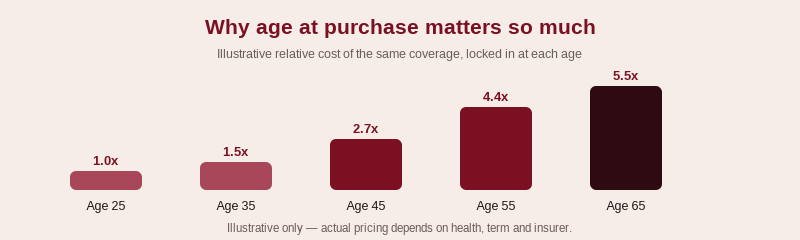
Term life insurance for a healthy person in their thirties costs less than most people's monthly subscriptions. Deferring it until an emergency fund is complete can mean going years unprotected during exactly the period the need is greatest.
If nobody depends on you financially and nobody co-signed your debt, skip this step for now. If someone does, it belongs here.
The test is not “how likely is this?” but “how bad is it if it happens and I am unprepared?” An emergency fund covers likely, survivable events. Insurance covers unlikely, unsurvivable ones. With dependants, you need a little of both before completing either.
5. Finish the emergency fund
Now build toward three to six months of essential expenses. Longer if your income is variable or your household depends on one earner; shorter if you have very stable employment and a second income.
Keep it accessible. This is the one place where cash in a savings account, rather than invested, is exactly right.
6. Long-term investing
With debt cleared, protection in place and a buffer built, the priority becomes tax-advantaged accounts. Roughly:
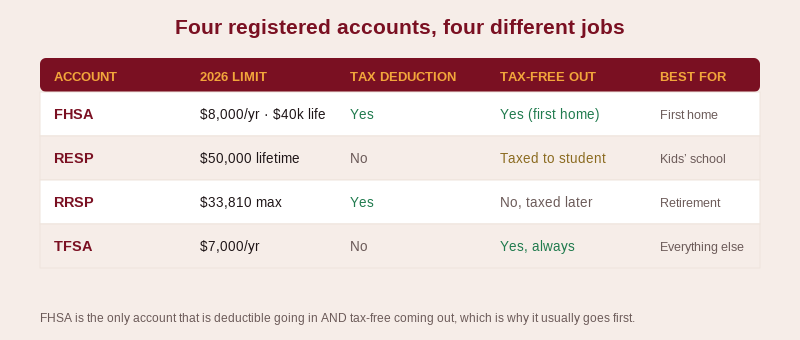
- RESP if you have children. The 20% grant on the first $2,500 per child per year is close to unbeatable
- FHSA if you might buy a first home: deductible in, tax-free out, and open it early since room only accrues once the account exists
- RRSP if you are in a higher tax bracket now than you expect in retirement
- TFSA for flexibility, for lower earners, and for everything after
Two things worth ignoring
Guilt about the order. If you are working through this list at all, you are ahead of most people. Progress matters more than optimisation.
Anyone selling you step six before step one. If someone recommends an investment product while you are carrying credit card debt and have no coverage, they are not looking at your situation. The sequence above is not complicated, and a good advisor will walk you through it even where the early steps earn them nothing.
Starting small is fine
The amounts matter less than the habit. $50 a month into an RESP captures $10 of grant. A small term policy is far better than none. A $500 buffer prevents one crisis.
People often wait until they can do things "properly" and lose years. Start at whatever scale is realistic and increase as income grows.
If you want this mapped against your actual numbers, that is a conversation I have regularly and there is no cost to it — including if the conclusion is that you should pay down debt for a year before doing anything else.
The order, and why it is this order
| Step | Why it ranks here |
|---|---|
| 1. High-interest debt | A guaranteed return equal to the interest rate; nothing else matches it |
| 2. A small buffer | Stops the next flat tyre going back on the card you just cleared |
| 3. Employer match | An immediate return no investment can beat |
| 4. Life and disability cover | Only if someone depends on you, protects every step above |
| 5. Finish the emergency fund | Three to six months, so a setback is not a crisis |
| 6. Long-term investing | Where the money grows, once the foundation holds |
The logic running through it: deal with guaranteed returns before uncertain ones, and protect the plan before growing it. A good investment plan that collapses the first time someone is off work for three months was never a plan.
Why insurance comes before the full emergency fund
This is the step people argue with, so it is worth defending properly.
An emergency fund handles a car repair or a few weeks between jobs. It does not handle the earner dying, or being unable to work for two years. Those are not emergencies you save your way out of, the numbers are too large.
The costs are also wildly asymmetric. Term life for a healthy person in their thirties is cheap. Disability cover costs more but still a fraction of the income it replaces. Against that, the cost of being wrong is the household losing its home.
The qualifier matters though: only if someone depends on you. A single person with no dependants and no co-signed debt can reasonably skip step 4 and go straight to step 5. Disability cover is still worth considering, because you depend on your own income even if nobody else does. See disability insurance.
Debt: which to attack first
| Type | Treatment |
|---|---|
| Payday loans | Clear immediately, rates are punitive |
| Credit cards | Step 1; the rate makes this the best return available |
| Unsecured line of credit | Usually step 1 if the rate is high |
| Car loan | Depends on the rate; often alongside investing |
| Student loans | Lower rates, sometimes a tax credit on interest, not urgent |
| Mortgage | Not an emergency; pay as agreed |
Avalanche or snowball? Mathematically, paying the highest rate first wins. In practice, clearing the smallest balance first builds momentum and more people stick with it. A plan you follow beats an optimal plan you abandon in March.
What to do with $50 a month
A fair question, and the answer is not "come back when you have more."
Put it where the foundation is weakest. No buffer at all? Build $500 first. That single step prevents more financial damage than any investment at this stage. Carrying card debt? It goes there. An employer match available? Take it, because nothing else returns that much. Dependants and no cover? A small term policy for a healthy young adult can cost less than a phone plan.
Once those are handled, $50 a month into a TFSA is a perfectly respectable start. The amount matters far less than beginning and not stopping. Consistency over fifteen years beats a larger amount started in year five.
Two things worth ignoring
Complicated products sold as an all-in-one answer. Combined insurance-and-investment products are rarely the right starting point for someone on a limited budget. Keep the pieces separate so you can see what each costs.
The feeling that it is too late. Starting at forty-five with a plan beats starting at thirty and giving up at thirty-two. The comparison that matters is you with a plan versus you without one.
If you want a straight view on which step you are actually on, book a free conversation. There is no cost, and if the answer is "handle the credit card first and come back in a year", I will say that.
Where the money should sit at each step
| Purpose | Sensible home | Why |
|---|---|---|
| Emergency buffer | High-interest savings, or a TFSA held in cash | Must be reachable in a day, with no loss |
| Employer match | The workplace plan | That is where the match lives |
| Long-term growth, lower income | TFSA | No deduction lost at a low rate; withdrawals never taxed |
| Long-term growth, higher income | RRSP | The deduction is worth more at a higher rate |
| A first home within years | FHSA | Deduction going in and tax-free coming out |
| A child's education | RESP | Government grant on contributions |
A common error at step 2 and 6 is putting the emergency fund into something that can fall in value, then needing it in a bad month. Emergency money has one job, and growth is not it.