Ask an insurance advisor whether a 26-year-old needs life insurance and you will usually hear yes. It is worth being more careful than that, because for some people in their twenties the answer is genuinely no — and saying otherwise damages trust for the cases where it matters.
Here is how I actually think about it.
When the answer is probably no
If you are single, have no dependants, no co-signed debt, and no one who would suffer financially if you died, you may not need life insurance right now.
Your student loans generally do not pass to your family unless someone co-signed. Your estate would cover your final expenses in most cases. If money is tight, building an emergency fund and clearing high-interest debt will do more for you than a policy protecting a risk that does not exist.
An advisor who tells you otherwise, with no dependants and no guaranteed debt in the picture, is selling rather than advising.
When the answer is clearly yes
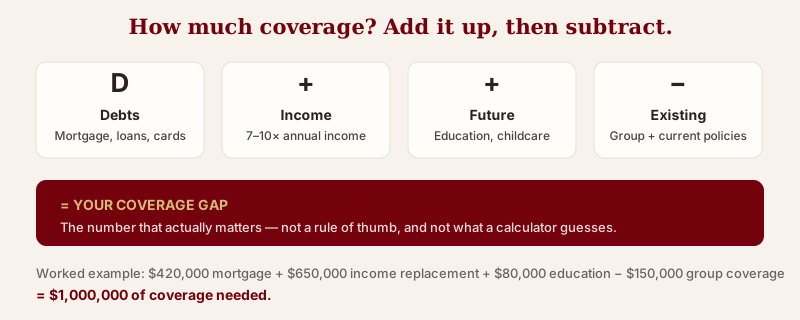
The picture changes completely once someone else depends on your income, or your debt could land on someone else.
- You have children, or one is on the way.
- You have a mortgage with a partner whose income alone would not cover it.
- Someone co-signed your debt — a parent on a student loan or a car loan, who would inherit that obligation.
- You support a parent or sibling financially, which is common and frequently overlooked.
- You are a business owner with a personal guarantee on business debt.
The argument that actually holds up
Beyond current need, there is one genuinely strong reason to buy young, and it is not the one usually emphasised.
It is not simply that premiums rise with age, though they do — substantially. It is that you are insuring your future insurability.
At 27 you are probably at your healthiest. Buy a 30-year term policy then and the rate is locked for three decades, regardless of what happens to your health afterwards. Develop a condition at 38 and that policy continues at the price set when you were healthy.
Wait until you have children at 38 and develop that condition first, and you may face a rating, an exclusion, or a decline. This is the scenario I see: people who intended to buy later and lost the option in between.
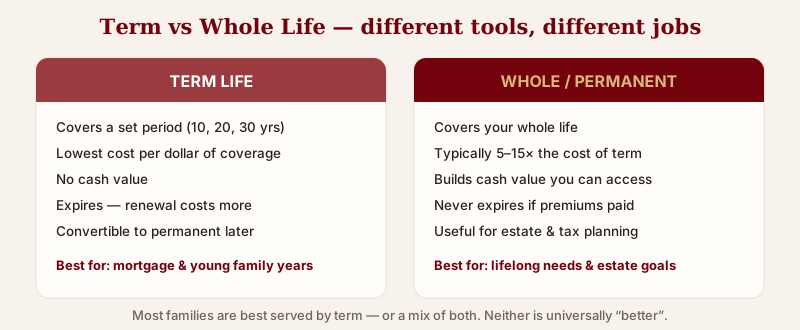
The conversion privilege on a good term policy strengthens this further. It lets you convert to permanent coverage later without new medical evidence — an option that costs little now and can be worth a great deal.
A modest term policy with a strong conversion privilege and a future-insurability option is usually better value at 27 than a large permanent policy. It costs little, locks in your health, and leaves every door open. Permanent insurance sold to a 25-year-old as an “investment” deserves real scepticism.
What about group coverage at work?
If your employer provides life insurance, that is a genuine benefit — and an incomplete answer. It typically ends when the job does, it is usually a modest multiple of salary, and, crucially, it does nothing to lock in your insurability. If you leave that job at 40 with a health condition acquired at 35, the group coverage disappears and buying individual coverage may be difficult.
Group coverage is a supplement. It is not a foundation.
What it actually costs
Less than most people assume. Term life for a healthy non-smoker in their late twenties is often one of the cheapest financial products they will ever buy — frequently comparable to a modest monthly subscription for a substantial amount of coverage.
The cost rises steadily with age, and the increase accelerates. The difference between buying at 27 and at 45 is not marginal; it is multiples, for the same coverage.
A straight answer
If you have no dependants and no co-signed debt and money is tight, build your emergency fund first. Come back to insurance when someone starts depending on you.
If someone already does depend on you, or you can comfortably afford a modest term policy and want to lock in your health while it is good, buying young is a rational decision — and it is one of the few financial choices that genuinely gets more expensive the longer you defer.
What I would not do is buy a large permanent policy in your twenties on the grounds that it is an investment. If you want that discussed honestly rather than sold, I am happy to have the conversation.