Most business owners I meet have commercial general liability and property coverage sorted. What they rarely have is protection against the three events most likely to genuinely end the business — all of which involve a person rather than a building.
Risk 1: A partner dies, and you inherit their family as co-owner
If you have a business partner and no funded agreement, their share passes to their estate on death. In practice that often means their spouse becomes your business partner overnight — someone who may know nothing about the business, may need cash rather than equity, and may have interests entirely opposed to yours.
The solution is a buy-sell agreement funded with life insurance. The agreement sets out that surviving partners will buy the deceased partner's share, and at what valuation. The insurance provides the cash to actually do it.
Without the funding, the agreement is a promise the survivors may be unable to keep. With it, the family receives fair value promptly and the survivors retain full control. Two common structures exist — cross-purchase, where partners insure each other, and corporate-owned, where the company holds the policies. Which is better depends on the number of partners, the corporate structure and tax considerations, so it is worth involving your accountant.
Risk 2: You cannot work, and the fixed costs keep arriving
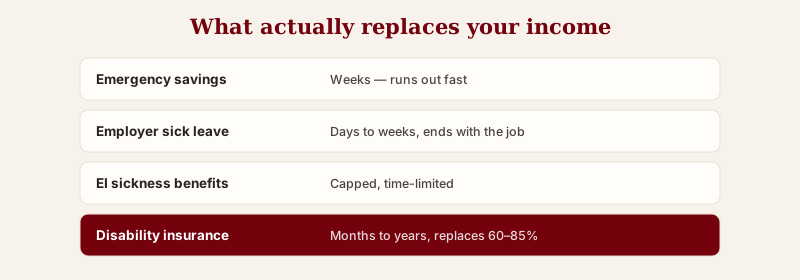
Personal disability insurance replaces your income. It does not pay the rent on your premises, the equipment lease, your employees' wages or the utilities. Those obligations continue whether you are working or not.
Business overhead expense insurance covers those fixed costs — typically for a defined period such as one or two years — so the business is still there when you return. It is not a substitute for personal disability coverage; the two do different jobs and most owner-operators need both.
Premiums are generally deductible as a business expense, with the benefits taxable to the business but offset by the deductible expenses they pay. Confirm the treatment with your accountant, as it depends on your structure.
Risk 3: A key person leaves a hole you cannot immediately fill
In many small businesses one individual holds the client relationships, the technical knowledge or the sales capacity that the revenue depends on. If that person dies or becomes disabled, revenue drops while costs continue, and the business may need to fund recruitment and a lengthy handover simultaneously.
Key person insurance is owned by the business on the life of that individual, with the business as beneficiary. The proceeds buy time — to recruit, to stabilise client relationships, to reassure lenders.
That last point matters more than owners expect. Lenders and investors frequently ask whether key person coverage exists, and its absence can affect borrowing terms.
The tax angle worth understanding
For incorporated businesses there is a genuinely valuable mechanism: the capital dividend account. When a corporation receives life insurance proceeds, the amount above the policy's adjusted cost basis is credited to the CDA and can generally be paid to shareholders as a tax-free capital dividend.
This is one of the few places in Canadian tax where money moves out of a corporation to shareholders without tax. It is a principal reason corporate-owned life insurance features so often in business succession planning — and a reason to involve your accountant rather than arranging it in isolation.
Business insurance sits at the intersection of insurance, tax and legal structure. I can arrange the coverage and explain the options, but the buy-sell agreement itself needs a lawyer and the tax treatment needs your accountant. Anyone offering to handle all three alone is overreaching.
What about your personal coverage?
Two things owners commonly get wrong on the personal side.
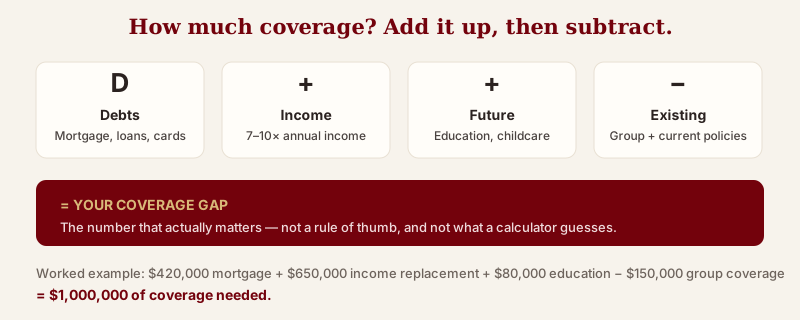
Personally guaranteed business debt. Many small business loans and leases carry a personal guarantee. If you die, that obligation can follow your estate and reach your family's assets. Personal life insurance should account for guaranteed business debt, not just the mortgage.
Underinsuring because income is retained in the company. Owners who pay themselves modestly and leave profit in the business may be underwritten against that modest salary. Insurers can often consider dividends and retained earnings, but the application needs to present the full picture properly — which is where an advisor who understands business income helps.
A reasonable order to tackle it
- Personal life and disability first — your family's position matters more than the business's.
- Buy-sell funding if you have partners. This is the one that creates immediate conflict when missing.
- Overhead expense if you carry meaningful fixed costs.
- Key person if revenue concentrates in one or two individuals.
If you own a business and have never had this mapped out, the conversation is worth an hour. I will tell you plainly which of these you actually need and which you do not.