People on work permits often assume insurance is closed to them until permanent residence comes through. That is mostly wrong, but the picture is genuinely more complicated than it is for citizens and permanent residents — and insurers vary more here than in almost any other situation.
Provincial health coverage
Work permit holders are frequently eligible for provincial health coverage, though the conditions differ by province and often depend on the length of your permit and your intention to reside there.
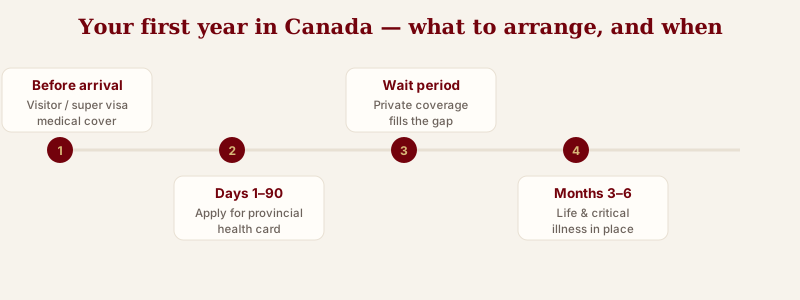
Two practical points. Some provinces require a permit of a minimum duration — a short contract may not qualify. And most provinces have a waiting period, so private coverage is needed to bridge the gap regardless.
Apply the moment you are eligible. Eligibility often runs from your arrival or the start of your permit rather than from when you get round to applying, so delay simply wastes coverage.
Life insurance: generally available
This surprises people, but life insurance is usually accessible on a work permit.
Insurers are pricing mortality, and your immigration status has limited bearing on that. What they do care about is whether you will remain in Canada — because a policy on someone who moves abroad permanently is harder to administer and underwrite.
So expect questions about your permit type and length, how long you have been in Canada, your intentions regarding permanent residence, and how much time you spend outside the country. Some insurers impose a minimum residency period before applying; others do not. Some are comfortable with most permit types; others restrict to specific categories.
This variability is precisely why an independent broker matters more here than for a citizen. One company's "no" tells you very little about the market.
Critical illness: usually available, sometimes restricted
Broadly similar to life insurance, with somewhat more caution from some insurers. Availability is generally good for people on longer permits with an established Canadian address and employment.
Disability insurance: the hard one
This is where temporary status genuinely limits options.
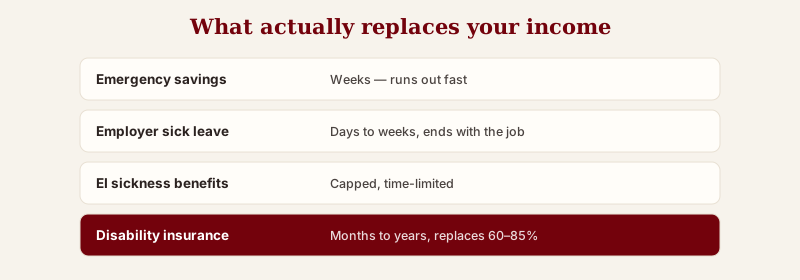
Disability insurance requires the insurer to assess your occupation, verify your income, and potentially pay benefits for decades. Several insurers require permanent residence or citizenship. Those that will consider work permit holders often want a longer permit, an established employment history in Canada, and sometimes a pending PR application.
If your employer provides group long-term disability, that is likely your best coverage while on a permit — and a strong reason to understand what happens to it if you change jobs.
Your policy travels with your status
Here is the point worth acting on. A Canadian life insurance policy issued while you are on a work permit remains in force when you become a permanent resident. You do not need to reapply, and you do not get re-underwritten.
So buying now, while you are young and healthy, locks in your health and price. Waiting for PR — which may take years — means being underwritten at an older age, with whatever health conditions have appeared in between.
If you have dependants now, they depend on your income now. The policy you buy today continues unchanged through PR and citizenship. The main thing waiting achieves is a higher price and more health history to disclose.
Supporting family abroad
A consideration specific to newcomers that standard advice overlooks entirely.
Many people on work permits support parents or siblings in their home country. That is a genuine financial dependency, and it should be reflected in how much coverage you carry. Canadian life insurance can name beneficiaries living abroad — though payment logistics are worth confirming with the insurer, and naming a Canadian contingent beneficiary is often sensible.
What to do
- Bridge the provincial waiting period with private coverage before or immediately on arrival.
- Apply for provincial health the day you are eligible.
- Understand your employer's group coverage, particularly disability, and what happens if you change jobs.
- Buy life insurance while young and healthy, rather than waiting for PR.
- Size coverage to include family you support abroad, not just those in Canada.
If you are on a permit and have been told you cannot get covered, it is worth a second opinion. Insurers differ enormously here, and the first answer is often not the market's answer.
What you can get, at a glance
| Cover | On a work permit | What insurers look at |
|---|---|---|
| Life insurance | Generally available | Health, residency, time in Canada |
| Critical illness | Usually available | Same, sometimes stricter |
| Disability | The hard one | Permit length, employment stability |
| Health and dental | Available | Whether provincial coverage has started |
| Travel / visitor | Available | Needed during any provincial waiting period |
The common assumption is that temporary status rules everything out. It does not. Life insurance in particular is usually straightforward, and that matters because it is priced on your health today — which is the one thing that will not improve by waiting for permanent residence.
The waiting period gap
Provincial health coverage is not always immediate for new arrivals, and the rules differ by province. Where a waiting period applies, you are responsible for medical costs during it — and that is precisely when a new arrival is least able to absorb a hospital bill.
Check your own province's current rule directly rather than relying on what a friend experienced, since these have changed. Ontario removed its three-month wait some years ago; other provinces still have one.
If a waiting period applies to you, private medical cover for that window is not optional. Visitor insurance or a similar newcomer product fills it, and the cost is trivial next to a single emergency admission.
Why disability is the difficult one
Disability insurance is a long-term promise, so insurers look at whether you will still be here to claim it. A two-year permit against a benefit period running to 65 is a mismatch they weigh carefully.
What tends to help:
- A longer permit, or a permit with a clear renewal history.
- An employer-sponsored permit with a stable, established employer.
- A PR application already in progress, with evidence of where it stands.
- Time already spent in Canada — some insurers want six or twelve months before considering an application.
If individual cover is unavailable, group disability through your employer may still be, since group plans do not underwrite individuals the same way. That is a strong argument for enrolling in whatever your workplace offers, even if the cover looks modest. See disability insurance.
Your policy does not expire with your permit
An important reassurance, because the worry is common.
A life insurance policy issued to you is a contract between you and the insurer. It does not lapse because your immigration status changes, your permit expires, or you later become a permanent resident or a citizen. Premiums are set for the term and do not rise because your status changed.
It also generally continues if you leave Canada, though claims administration can be more complex from abroad — worth asking the insurer how they handle it before assuming.
The practical consequence: buying while on a permit is not a temporary measure. You are locking in a price based on your current age and health, which is exactly what you want, and it carries forward through every status change afterwards.
Buy earlier rather than waiting for PR
The instinct is to wait until status is settled. The arithmetic argues the other way.
Waiting two or three years means applying older, and at whatever health you have then rather than now. Plenty of people develop something in that window. Meanwhile, the risk you are uninsured against — dying or becoming disabled while a family depends on you — is present the whole time.
The one thing genuinely worth waiting for is a longer permit if a disability application was declined on duration grounds. That is a specific obstacle with a specific fix, not a reason to defer everything.
If you support family abroad
Newcomers on work permits frequently send money home, and that obligation is routinely left out of insurance planning because it does not look like a Canadian household expense.
It is still a dependency. Size the cover to include it, and name beneficiaries carefully — paying a beneficiary overseas raises practical questions about documentation, currency and banking access that are better settled now than by a grieving family later. See supporting family abroad and the newcomers' guide.
And when parents visit, Super Visa insurance or visitor cover protects you as much as them, since an uninsured hospital stay becomes the family's bill. Get in touch if you would like it worked through.