Freelancers, contractors, commission earners and seasonal workers all run into the same friction. Underwriting is built around a predictable salary, and their income is not that.
It is a solvable problem, but the approach matters.
How insurers actually assess variable income
Two principles do most of the work.
They average. Most insurers look at two or more years and use an average rather than your best year. A year at $104,000 followed by one at $36,000 will not be underwritten at $104,000.
They use net, not gross. For self-employed applicants, coverage is based on income after business expenses. Someone billing $180,000 who declares $70,000 after aggressive expense claiming is generally underwritten against $70,000.
That second point creates a real tension. Minimising taxable income is rational for tax purposes and directly reduces how much coverage you can obtain. It is worth deciding deliberately rather than discovering the consequence when you apply.
What helps
Clean, consistent financial records. Two or three years of properly prepared statements and filed returns make a variable income legible. Disorganised records make an underwriter cautious, and cautious underwriters offer less.
A longer track record. Five years of variable income averaging $70,000 reads very differently from eighteen months of the same. If you are newly self-employed, some insurers will consider prior employment income, but options narrow.
Contracts and forward work. Evidence of committed future income — signed contracts, retainer agreements, a stable client base — supports the case that the average is sustainable.
Choosing the right insurer. Some handle self-employed and commission income considerably better than others. This is where an independent broker earns their fee, because the variation is wide and not published.
If you are leaving employment to freelance, apply while still employed. You are underwritten on a stable salary with a clean history, and the coverage continues unchanged afterwards. This single piece of timing is worth more than any other tactic here.
Disability insurance specifically
This is where irregular income bites hardest, because the insurer must decide what income to replace.
Look for policies offering residual or partial disability benefits, which pay proportionally based on actual income loss rather than requiring total inability to work. For someone whose work naturally varies, this fits reality better than an all-or-nothing definition.
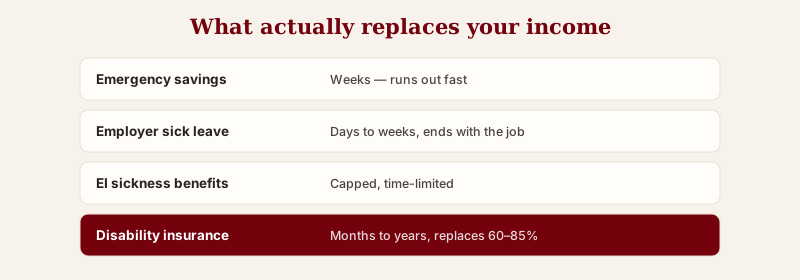
Also consider the waiting period carefully. Variable earners often keep larger cash reserves precisely because income is lumpy. If you genuinely hold six months of expenses, a longer waiting period substantially reduces the premium and matches how you already manage risk.
Life insurance is easier
Worth saying plainly: life insurance underwriting cares far less about income stability. It is pricing mortality, and your health and age dominate. Income matters mainly for justifying the amount of coverage, and insurers are generally more flexible there.
So if you are self-employed and worried about insurability, life insurance is usually straightforward. Disability is the harder conversation.
Business overhead expense
If you have fixed business costs — studio rent, equipment leases, a subcontractor you pay regardless — business overhead expense insurance covers those while you are unable to work. Personal disability insurance does not.
For a freelancer with minimal overhead this is unnecessary. For someone carrying real fixed costs, it is often the difference between a business that survives an illness and one that does not.
Practical steps
- Keep clean books and file consistently. This is underwriting evidence, not just tax compliance.
- Understand the trade-off between minimising taxable income and qualifying for coverage.
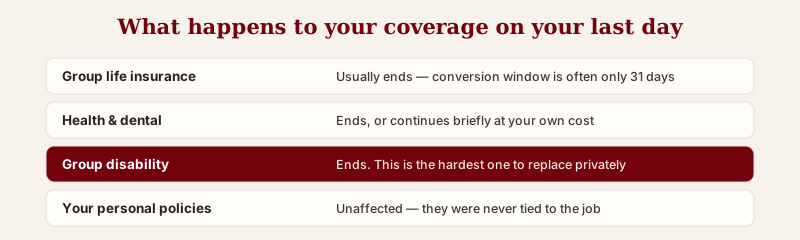
- Apply before leaving employment if a transition is coming.
- Prioritise residual disability coverage over a purely total-disability definition.
- Match the waiting period to the cash reserve you actually hold.
- Use a broker who knows which insurers treat self-employed income well.
If you have been told your income is too irregular to insure, it is worth a second look. The first answer is frequently not the market's answer.