Changing jobs, being laid off, or going self-employed all trigger the same overlooked problem: the insurance you had through work generally stops, and the window to do anything about it is short.
Most people discover this weeks later, when the window has closed.
What ends, and when
Group life insurance typically terminates on your last day or at the end of that month. Many group policies include a conversion privilege — the right to convert to an individual policy without medical evidence — but the window is commonly only 31 days from termination.
That privilege is genuinely valuable if your health has changed since you were hired. It is also routinely missed, because HR rarely highlights it and the departing employee has other things on their mind.
Health and dental ends too, sometimes with a short continuation at your own cost. Some insurers offer a conversion to an individual health plan, again within a limited window and often without medical underwriting if you apply promptly.
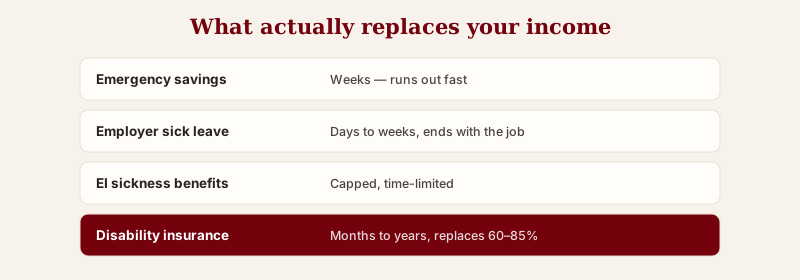
Group long-term disability ends, and this is the hardest to replace. Individual disability insurance is fully underwritten, so if your health has changed you may not qualify for equivalent coverage — or any.
The sequence that avoids the problem
If you have any warning that a job change is coming, the order matters enormously.
Apply for individual coverage while you are still employed and still covered. You are underwritten on a stable employment income with a straightforward history, the process takes weeks rather than days, and if you are declined you still have your group coverage while you work out alternatives.
Applying after you leave means underwriting against a period of unemployment or new self-employment, which some insurers treat less favourably, and with no safety net if the answer is no.
Approval is not the same as in force. Wait for written confirmation that the new policy is active before letting anything lapse, and never create a gap — even a few uncovered weeks is a real exposure.
If you have already left
Act quickly, in this order:
- Find out your conversion deadline. Call the group insurer, not just HR. Ask specifically about life and health conversion privileges and the exact expiry date.
- Convert if your health has changed. Conversion policies are usually more expensive than fresh individual coverage, so if you are healthy, shop the market instead. If you are not healthy, conversion may be the best option available and the deadline is unforgiving.
- Address disability coverage. If you are moving to self-employment with no group plan, this is now the largest gap in your protection.
- Arrange interim health and dental if you have ongoing needs, prescriptions or a family.
The new job's plan is not automatically better
People assume the next employer's benefits will replace what they lost. Sometimes yes, but check two things.
Waiting periods. Many group plans have an eligibility period of three months. That is three months with no coverage between jobs unless you arrange something.
Pre-existing condition provisions. Some group disability plans limit or exclude conditions you were treated for shortly before joining. A condition managed under your old plan may not be covered under the new one immediately.
The broader lesson
Group coverage is a benefit, not a foundation. It is generous while it lasts, it costs you little, and it disappears at precisely the moment your income is disrupted — which is when you need it most.
A modest personal policy alongside your group coverage costs less than most people expect and stays with you through every job change. If you are contemplating a move, or have just made one, it is worth a short conversation before the conversion window closes.