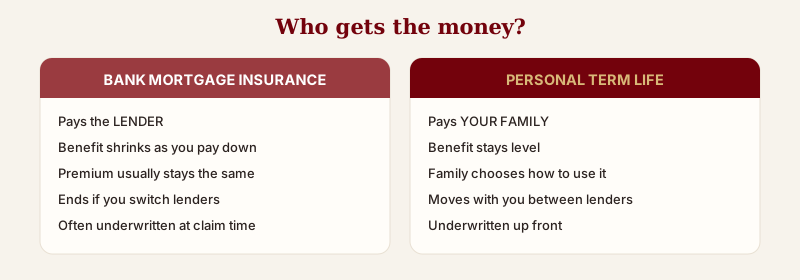
Mortgage insurance gets all the attention, and rightly — it is usually the largest debt. But creditor insurance is offered on almost every kind of borrowing, and the same structural questions apply each time.
Here is what to ask, debt by debt.
Car loans
Loan protection is usually offered when you finance a vehicle, often bundled with other products in one presentation. To be clear, this is life and disability cover on the loan — not auto insurance, which is a separate product from a general insurance broker. The amounts are smaller than a mortgage, so the stakes are lower, but the cost per dollar of coverage is frequently high relative to simply carrying a slightly larger term life policy.
If you already hold personal life insurance sized to your obligations, a car loan is usually already covered by it. Buying separate coverage for each debt means paying several times for overlapping protection.
Lines of credit and personal loans
Typically balance-based: the premium is charged monthly on whatever you currently owe. Convenient, and easy to forget you are paying for. If you carry a persistent balance, work out the annual cost and compare it against a small personal policy.
Worth checking the disability element too, if one is included. Definitions vary widely and determine whether it would ever actually pay.
Business loans and personal guarantees
This is the one most often overlooked, and it has the largest consequences.
Many small business loans and commercial leases carry a personal guarantee. If you die, that obligation can follow your estate and reach your family’s assets — the house included. Personal life insurance should account for guaranteed business debt, not just the mortgage.
There is also a narrow tax point worth raising with your accountant: where a policy is collaterally assigned to secure a business loan and the lender requires the coverage, a portion of the premium may be deductible. This is one of very few exceptions to the general rule that life insurance premiums are not deductible.
Co-signed and student debt
Federal and provincial student loans in Canada are generally forgiven on death. The important exception is anything co-signed — a private loan or line of credit with a parent as co-signer becomes their responsibility.
That is a genuine reason for a young person with no dependants to carry modest coverage. It is not about replacing income; it is about not leaving a parent with a debt.
The six questions, whatever the loan
1. Who gets paid? Creditor insurance pays the lender; a personal policy pays your family, who choose what to do.
2. Is my health assessed now or at claim time? Post-claim underwriting is where declined claims come from.
3. Does the benefit decline as I repay? If so, does the premium decline too? Usually not.
4. What happens if I refinance or switch lenders? Most creditor coverage ends with the loan it was attached to.
5. What is the total annual cost? Compare it against a personal quote for the same or more coverage.
6. If disability is included, how is “disabled” defined? The definition decides whether it ever responds.
When creditor insurance is genuinely the right answer
Two situations, and it would be dishonest to pretend otherwise.
Significant health issues. If you would be heavily rated or declined for a personal policy, the lighter initial questions on creditor insurance can make coverage accessible when nothing else is. Some protection beats none.
You need coverage immediately. Personal underwriting takes weeks. If a closing date is imminent and you have nothing in place, creditor coverage bridges the gap — and you can replace it later, once the replacement is in force.
The risk almost nobody insures
Everyone thinking about loan protection is thinking about death. But during your working years, an extended period of being unable to work is more probable — CLHIA’s own consumer guidance puts it at roughly one in three people being disabled for 90 days or more at least once before age 65 — and it threatens the loan payment just as directly, while your living costs continue.
If you are protecting a mortgage or a business loan, income protection deserves at least as much attention as life coverage. It usually gets far less.
If you have accumulated creditor insurance across several debts over the years and never compared it, that review is often worth doing — people are frequently paying for overlapping coverage that a single personal policy would replace more cheaply.
Creditor insurance across loan types
| Loan | Typically offered | Usual verdict |
|---|---|---|
| Mortgage | Life, disability, critical illness | A personal term policy almost always does better |
| Car loan | Life and disability on the balance | Rarely worth it — the balance is small and falling |
| Line of credit | Balance coverage, priced monthly | Expensive per dollar; a fluctuating balance makes it worse |
| Personal loan | Life, sometimes job loss | Usually fold the amount into existing personal cover |
| Business loan | Life, tied to a personal guarantee | Insure it — but personally, and for the full exposure |
| Student or co-signed debt | Sometimes offered to the co-signer | The real risk sits with the co-signer; cover them directly |
The consistent pattern: these products are priced on broad pools rather than on you, so a healthy person generally subsidises the pool. And every one of them pays the lender rather than your family.
The maths on a declining balance
Creditor insurance on an instalment loan has a structural problem. The premium is usually set against the original amount, or stays flat, while the benefit falls with every payment.
On a five-year car loan you are paying roughly the same each month for coverage that is worth less each month. By year four the benefit may be a quarter of what it was, and the cost per dollar of protection has quadrupled. On a mortgage the same effect runs for twenty-five years.
A personal term policy holds its face amount for the whole term at a fixed premium, and the money goes to your family, who can clear the loan or decide something else serves them better.
The risk almost nobody insures properly
Death is the risk people think about. Long-term disability is the one that is both more likely during working years and more damaging financially, because the household loses an income while every expense continues — and the person who is ill often needs more, not less.
EI sickness benefits pay for a limited number of weeks at a capped amount, a fraction of most incomes. A personal disability policy is designed for the longer, larger gap, and pays you rather than a lender.
One detail worth knowing: if you pay the premiums yourself with after-tax money, benefits from a personal policy are generally received tax-free, while benefits from an employer-paid group plan are usually taxable income. That difference changes how much coverage you actually need before the numbers even start.
Six questions for any loan-insurance offer
- Who receives the money — the lender or my family?
- Does the benefit fall as I repay, and does the premium fall with it?
- Is my health assessed now, or when a claim is made?
- What happens if I refinance, switch lenders, or pay the loan off early?
- What exactly is excluded, and for how long?
- Can I decline this and still get the loan?
The answer to the last is always yes. Creditor insurance is optional in Canada and a loan cannot be made conditional on it, which is worth knowing in a room where it is often presented as paperwork rather than a choice.
A simpler way to think about all of it
Rather than insuring each debt separately as it arrives, add up everything your household owes and everything it would need, and cover that total once with a personal policy. One premium, one insurer, one beneficiary, and coverage that does not evaporate when you switch banks.
It is also usually cheaper, because you are underwritten as an individual rather than pooled — and because you stop paying several overlapping premiums for shrinking benefits that each pay somebody else.
What to do if you already have several of these
Plenty of households have accumulated creditor insurance on a mortgage, a car loan and a line of credit without ever deciding to. Untangling it is straightforward, provided the order is right.
- List what you have. Each lender, what is covered, and the monthly premium — often buried in the statement rather than billed separately.
- Add up the total premium. Seeing the combined monthly figure is usually the moment the decision makes itself.
- Add up the total debt those policies are covering, and what your family would actually need beyond it.
- Apply for one personal policy covering the whole amount, with a term matching the longest obligation.
- Once it is issued and in force, cancel the creditor policies in writing and keep the confirmations.
Step five comes last for a reason. Cancelling first and applying second leaves a window with no coverage, and if something in your health has changed since the original loans, that window can become permanent.
The exception worth taking seriously
If a health condition means personal coverage is unavailable or heavily rated, creditor insurance changes from a poor deal to a reasonable one. Guaranteed acceptance has real value when the alternative is nothing at all.
Even then, two things are worth doing. First, test the personal market properly before concluding it is closed — insurers differ substantially on the same condition, and a rating is often milder than feared. Second, if creditor insurance is the answer, read the exclusions carefully: many creditor policies exclude pre-existing conditions for a period after enrolment, which can be exactly the risk you were insuring against.
If the personal market genuinely is not open, non-medical coverage often still beats creditor insurance on terms, because the money goes to your family rather than the lender.