When you sign a mortgage, you will be offered mortgage life insurance — often described as creditor insurance or mortgage protection. It is convenient, it takes a minute to accept, and for most families it is the weaker of the two available options.
This is not because banks are villains. It is because the product is structured to protect the lender's asset, and that is a different job from protecting your family.
Who receives the money
The starting point, and the difference that matters most.
Mortgage insurance pays the lender. The outstanding balance is cleared. Your family gets a paid-off house and nothing else.
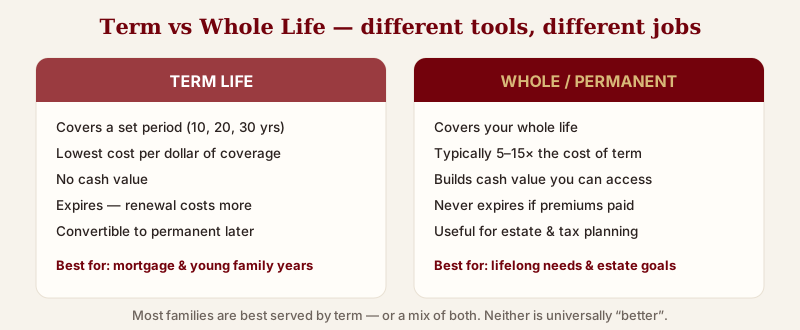
Term life insurance pays your beneficiaries. They receive the money and decide what to do. Pay off the mortgage entirely, pay part and keep a cash reserve, cover a few years of living costs while they steady themselves, or relocate closer to family.
That flexibility matters more than people expect. A widowed parent with three young children may not want to be cash-poor in a fully-owned house. They may need income far more than they need the mortgage cleared on day one.
The benefit shrinks; the premium usually doesn't
Mortgage insurance is declining term coverage — the payout tracks your outstanding balance. Year one it might be $500,000. By year eighteen it might be $150,000. The premium, in most cases, does not fall to match.
So you pay a similar amount each month for steadily less coverage. Personal term insurance keeps the death benefit level for the whole term. As the mortgage falls, the surplus becomes protection for everything else — income replacement, children's education, a cushion.
Underwriting: now or later?
This is the technical point with the largest practical consequences.
Mortgage insurance is often post-claim underwritten. You answer a few broad health questions at signing and are covered immediately. The insurer examines your medical history properly when a claim is made. If something on your record is judged inconsistent with those brief answers, the claim can be denied — after years of premiums, at the worst possible time for your family.
Personal term life is underwritten up front. The medical questions, and often an exam, happen before the policy is issued. Once the policy is in force and past the initial contestability period, the certainty is far greater. You know you are covered because the insurer already did their checking.
“Is this policy fully underwritten now, or reviewed at claim time?” The answer tells you a great deal about what you are actually buying, and the person selling it may not know.
It ends when you switch lenders
Mortgage insurance is tied to that mortgage with that lender. Refinance, switch to a better rate at renewal, or move house, and the coverage generally ends. You must reapply — at your new age, with your current health.
If your health has changed in the intervening years, you may not qualify. People have stayed with a worse mortgage rate because they could no longer replace the insurance, which is an expensive way to discover the limitation.
Personal term insurance is yours. It moves with you between lenders, houses and jobs, untouched.
Cost
Personal term life is frequently cheaper for the same initial coverage, particularly for younger and healthier applicants — while also giving level coverage, family control and up-front underwriting. Mortgage insurance is priced on broad bands rather than individual health, so healthy people effectively subsidise less healthy ones.
Where mortgage insurance can win on price is for someone with significant health issues who would be heavily rated or declined for personal coverage. Its lighter initial questions can make it accessible. That is a real advantage, and worth weighing honestly — though the post-claim underwriting risk remains.
A practical approach
If you are buying a home, the cleanest sequence is to apply for personal term life before or during the mortgage process, sized to cover the mortgage plus your family's broader needs. Once it is in force, decline the lender's coverage.
If you already have mortgage insurance, do not cancel it until a replacement policy is issued and in force. Never leave a gap. Get the new policy approved first, then cancel.
And if you are one of the people for whom personal coverage is genuinely difficult to obtain, keep the mortgage insurance — some protection beats none — while we look at whether a simplified-issue policy could do better.
If you want the two compared with real numbers for your mortgage and your health, that takes a short conversation and costs nothing.
The two products side by side
| Bank mortgage insurance | Personal term life | |
|---|---|---|
| Who receives the money | The lender | Your named beneficiary |
| Amount paid | The outstanding balance only | The full face amount |
| As you pay down the mortgage | Benefit shrinks | Benefit stays level |
| Premium over time | Usually unchanged | Fixed for the term |
| Health assessed | Often at claim time | At application |
| If you switch lenders | Coverage ends | Unaffected |
| Who controls it | The lender | You |
| Can the money be used elsewhere | No | Yes — family decides |
Reading down that table, the pattern is consistent: one product protects the lender's asset, the other protects your family. Both are legitimate, but only one of them was designed with your household in mind.
Why "the benefit shrinks" matters more than it sounds
Consider a $500,000 mortgage with 25 years to run. In year one, both products would pay roughly the same. By year fifteen the balance might be down to $250,000 — so bank coverage pays $250,000, while a $500,000 term policy still pays $500,000.
You have spent fifteen years paying premiums for a benefit that halved, while the premium itself generally did not. Put another way: the cost per dollar of protection rises every single year you hold it. Nobody would knowingly buy a product on those terms, which is why it is usually sold at the mortgage signing rather than shopped for.
The extra $250,000 in that example is not a windfall. It is what pays for childcare, lost income, or simply time before the surviving partner has to make permanent decisions.
Post-claim underwriting, in plain terms
This is the difference that costs families the most, and it is almost invisible at signing.
With most creditor insurance, the application is a few health questions ticked at the branch. Nobody verifies the answers then. Verification happens when a claim is made — at which point the insurer reviews medical records, and if something on that form turns out to have been answered incorrectly, the claim can be denied. Years of premiums, no payout, and a grieving family discovering it at the worst moment.
A personal policy works the other way round. Health is assessed at application: questions, sometimes a paramedical visit, sometimes records from your doctor. It takes longer to get in place — and once issued, you know where you stand. The insurer has already looked.
That is the trade: convenience now against certainty later. For something whose entire purpose is paying out at the worst possible time, certainty is worth the extra fortnight.
Where creditor insurance genuinely makes sense
It would be dishonest to say never. There are real cases:
- You cannot qualify for personal coverage. If a health condition means a personal policy is declined or heavily rated, guaranteed-acceptance creditor insurance may be the only cover available.
- You need something today. A personal policy takes weeks; creditor insurance starts at signing. Taking it as a stopgap while a proper policy is underwritten is sensible — then cancel it.
- The mortgage is small and short. On a modest balance with a few years left, the difference may not justify the effort.
Outside those, the comparison usually favours a personal policy on price as well as on terms, because creditor insurance is priced on broad bands rather than on you specifically. A healthy non-smoker in their thirties is typically subsidising the pool.
How to work through it
- Do not cancel anything yet. If you already have creditor insurance, keep it until replacement cover is issued and in force.
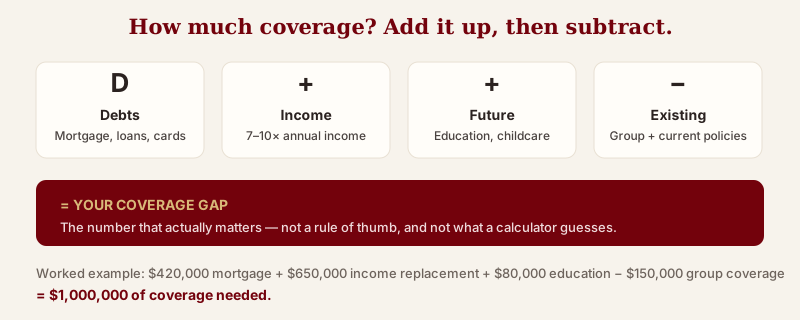
- Work out what your family actually needs — not just the mortgage. Income replacement, childcare, education, final expenses. The mortgage is one line in that, and see how much life insurance you need for the fuller picture.
- Apply for a personal policy with a term matching the mortgage, or longer if the wider needs run longer.
- Once it is in force, cancel the creditor coverage in writing and keep the confirmation.
- Review after major changes — a new mortgage, a child, a move. Personal coverage follows you, but the amount should keep pace.
The order matters. Cancelling first and applying second is how people end up uninsured during the weeks in between, which is precisely the risk the policy exists to cover.
What about disability and critical illness?
Banks usually offer these alongside mortgage life insurance, and the same structural issues apply — the lender is the beneficiary, the benefit tracks the balance, and the health assessment often happens at claim time.
But the underlying risk is real and worth insuring. You are considerably more likely to be off work for a long stretch than to die during the mortgage term, and a mortgage does not pause for illness. The question is not whether to cover it but where to buy it. A personal disability policy pays you, so the money covers the mortgage, the groceries and everything else, and it continues if you change lenders or jobs. A personal critical illness policy pays a lump sum on diagnosis of a covered condition, which many people use to buy time rather than to clear debt.
One practical note on disability cover: if you pay the premiums yourself with after-tax money, benefits from a personal policy are generally received tax-free, while benefits from an employer-paid group plan are usually taxable. That difference changes how much coverage you actually need, and it is worth working out before assuming the group plan at work is sufficient.
Questions to ask before signing anything at the branch
If mortgage insurance is put in front of you at closing, these five questions will tell you most of what you need to know:
- Who is the beneficiary — the lender or my family?
- Does the benefit decrease as I pay down the mortgage, and does the premium decrease with it?
- Is my health assessed now, or when a claim is made?
- What happens to this coverage if I refinance or switch lenders?
- Can I decline this and still get the mortgage?
The answer to the last one is yes. Creditor insurance is optional in Canada, and a mortgage cannot be conditional on buying it. That is worth knowing in a room where it is often presented as part of the paperwork rather than as a product you are choosing.