When families ask me about the Super Visa, they ask about insurance. That is my part of it, and it matters. But the requirement that most often stops an application before it starts is the one about your income, not your parents' health.
How the income test works
As the host, you must demonstrate income at or above the Low Income Cut-Off (LICO) for your household size. Two parts of that sentence do the work.
Household size includes the visiting parents. This is the step people miss. If you are a couple with two children, your household is four — but for the Super Visa you count the visiting parents too, making six. The LICO threshold for six is meaningfully higher than for four, and families who assumed they qualified sometimes discover they do not.
If both parents are coming, both count. If only your mother is coming, that is one addition.
LICO figures are updated annually, so use the current table for the year you are applying rather than a figure quoted in an older article.
Whose income counts
The host's income counts. A spouse or common-law partner can be a co-signer, allowing your combined income to be used — which is how many families meet the threshold.
There have also been changes making the requirement more flexible, including provisions allowing a visiting parent's own income to be considered in certain circumstances. If you were told previously that you did not qualify, it is genuinely worth rechecking rather than assuming the answer is unchanged.
What IRCC actually wants to see
Documentation, not assertions. Typically:
- Notice of Assessment from the CRA for the most recent tax year — usually the single most important document
- T4 slips or equivalent
- An employment letter stating your position, salary and length of employment
- Recent pay stubs
- Bank statements, in some cases
If you are self-employed, expect to work harder: tax returns, financial statements, and business registration documents. Self-employed applicants whose net income is reduced by expenses face the same issue that arises with disability insurance — the income on paper may be well below the income in practice, and it is the paper figure that counts.
The invitation letter
Alongside the financial evidence, you provide a signed letter of invitation committing to financially support your parents during their stay. It normally covers who you are, your relationship, the purpose and expected length of the visit, your household details, and an explicit undertaking of financial responsibility.
Treat it as a real commitment, because it is one. You are stating that your parents will not be a financial burden, and the income evidence exists to show that claim is credible.
The threshold is assessed on your most recent tax year. If you are close, options include adding a spouse as co-signer, waiting until a stronger tax year is assessed, or reconsidering whether both parents need to be on the same application. A visitor visa remains available in the meantime, and a Super Visa can be applied for later.
How this connects to the insurance
Practically, get the income question settled first. There is no sense buying a year of Super Visa insurance if the income requirement will not be met — even though most policies refund the premium on refusal, less an administrative fee.
The sensible order is: confirm you meet LICO for the correct household size, prepare the financial documentation, then arrange and pay for the insurance, then submit with proof of paid coverage attached.
Where I can and cannot help
I arrange the insurance and I am glad to explain how the requirements interact. I am not an immigration consultant, and if your income situation is complicated — self-employment, recent job change, income from multiple sources — a licensed immigration professional is worth the fee.
What I will do is tell you honestly if it looks like the insurance is not your bottleneck, rather than selling you a policy for an application that is not ready.
Which threshold applies — and the error almost everyone repeats
Start here, because getting this wrong sends families away believing they do not qualify.
The Super Visa uses the Low Income Cut-Off (LICO) minimum. IRCC's own application guide names it exactly that way. A great many insurance and immigration articles state the requirement is LICO plus 30%. That figure is real but belongs to a different programme: sponsoring a parent for permanent residence under the Parents and Grandparents Program.
The difference is thousands of dollars of required income. If you have read elsewhere that you need LICO+30% and concluded you fall short, it is worth checking again against the right number.
I have deliberately not printed a dollar table here. The thresholds are revised every January, and a stale figure on a page like this is worse than none. Check the current table on IRCC's page for proof of financial support.
Counting family size — where most shortfalls come from
The threshold depends entirely on family size, and the count includes more people than families expect. IRCC counts:
- The host child or grandchild
- Their spouse or common-law partner, which can include a separated spouse
- Every dependent child of the host and their partner, regardless of custody or support arrangements
- You, and any other super visa applicant applying at the same time
- Anyone previously approved on a letter of invitation from the host that still applies
- Anyone the host or co-signer previously sponsored, where the undertaking is still running
A worked example: a host with a spouse and two children, inviting both parents, is a household of six — not four. Applying against the four-person figure is one of the most common reasons a file falls short, and it is entirely avoidable.
The two routes to proving income since March 2026
This is the part most articles have not caught up with, and it widened eligibility meaningfully.
| Option 1 | Option 2 | |
|---|---|---|
| What it allows | The better of the host's last two tax years | At least 75% of the threshold, topped up with the applicant's own income |
| Main document | Notice of Assessment for either of the last two years | The host's most recent NOA, plus proof of the applicant's income |
| Best for | A host with one weak year — leave, illness, a job change | A host slightly short, where the visiting parent has a pension or other income |
Before 31 March 2026 the rule was rigid: only the most recent tax year counted. Option 2 in particular is a genuine change in who can qualify, because a retired parent's foreign pension can now help close a gap.
What IRCC accepts as proof
The Notice of Assessment from the CRA is the primary document. Supporting evidence that strengthens a file includes:
- T4 or T1 for the last tax year
- Pay stubs covering the most recent 12 months
- Employment Insurance benefit statements
- A letter from an accountant confirming annual income, if self-employed
- Proof of other income, such as pension statements
- A letter from the employer stating job title, description and salary
- Bank statements
Two practical notes. A spouse or common-law partner may co-sign the invitation letter and contribute their income toward the threshold, which is the simplest fix for many households. And if you are self-employed, the same tax planning that reduces what you owe the CRA also reduces what IRCC sees as your income — worth a conversation with your accountant before the application rather than after.
The invitation letter
Often treated as a formality and occasionally the thing that delays a file. It must include a promise of financial support for the whole visit, and the list of everyone included in the family size calculation — names and dates of birth, with the total count.
That second requirement is doing real work: it shows the officer your arithmetic. A letter that omits the count, or that quietly leaves out a dependent child, invites exactly the scrutiny you do not want.
How the income test connects to the insurance
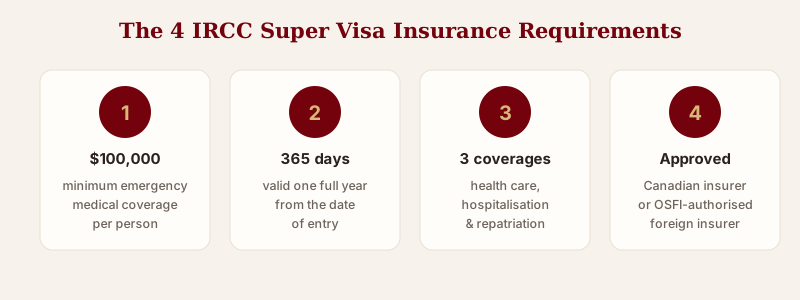
These are separate requirements, and both must be met. The income test is about the host; the insurance is about the visitor. Neither substitutes for the other, and a strong income does not soften the $100,000 rule.
The ordering matters financially. Confirm the income test before buying a policy, because insurance is the part you pay for and the income test is the part that more often fails. If a refusal does happen, most insurers refund the premium less an administration fee on proof of the refusal — and families on monthly plans have risked only the first payment.
Once you know the income test is satisfied, compare cover on the Super Visa quote, or see the Super Visa insurance page for the full requirement list.
Do you have to meet it every year?
A question that comes up constantly. The income test is assessed at the time of the application. A Super Visa can be valid for up to ten years, and there is no annual re-testing of the host's income for a visa already granted.
What does continue is the insurance obligation. Cover must remain valid for as long as your parents are in Canada, and an officer can ask to see proof on every entry. So the income test is a gate you pass once; the insurance is a commitment you keep renewing.
Common situations, and what usually helps
| Your situation | What usually helps |
|---|---|
| One weak tax year, otherwise fine | Use the better of the last two years (Option 1) |
| Slightly short in both years | Option 2, counting the visiting parent's own income |
| Spouse also earns | Have them co-sign the invitation letter and add their income |
| Self-employed, low reported net income | Speak to your accountant before applying, not after |
| Inviting both parents | Recount the household — two applicants, not one |
| Recently arrived in Canada | You may not yet have the tax history; plan the timing |
That last row matters for newcomers, who are often the people most eager to bring parents over. The test looks at Canadian tax returns, so someone in their first year here may simply not have the history yet. It is a reason to plan the application rather than assume it can happen immediately.
Where I can and cannot help
Worth being clear about the boundary. I am an insurance advisor, not an immigration consultant or lawyer. I can tell you what the insurance requirement is and arrange a policy that meets it. I cannot give immigration advice, assess your file, or represent you with IRCC.
What I can do on the income side is point you at the right rule — plain LICO, not LICO+30% — explain how family size is counted, and flag when something in what you have described suggests a problem worth taking to a licensed immigration professional before you spend money.
The sequence I would suggest: satisfy yourself on the income test using IRCC's own current figures; if it is close or complicated, speak to an immigration professional; and once you are confident on that, come to me for the insurance. Doing it that way means the part you pay for is the last step, not the first.