This is the question I get asked most by families planning to bring parents over, and the honest answer is that it depends less on which visa is "better" and more on how long your parents actually intend to stay.
Both are temporary resident visas. Both can be valid for up to ten years. The difference that matters is what happens each time they land in Canada.
The core difference: length of stay
On a standard visitor visa, a border officer normally admits a visitor for up to six months. On a Super Visa, parents and grandparents can be admitted for up to five years per entry.
That single difference drives everything else. If your mother wants to come for three months over the summer, a visitor visa does the job at lower cost and usually with a shorter wait. If your parents want to spend a couple of years helping with a new grandchild, the visitor visa route means repeated extension applications, each with its own fee, paperwork and risk of refusal. The Super Visa removes that cycle.
Insurance: mandatory versus merely sensible
Here is where the two genuinely diverge, and where families most often get caught out.
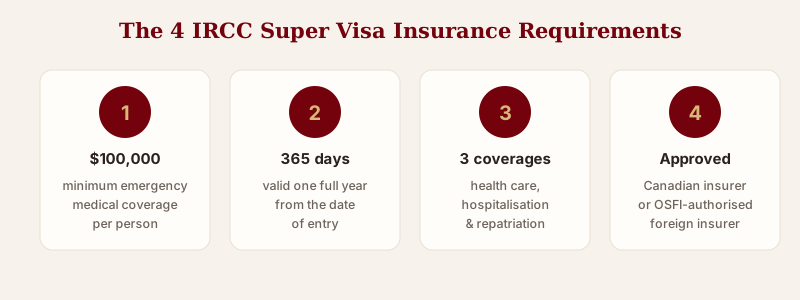
For a Super Visa, insurance is a legal requirement. The application will not succeed without proof of a paid policy providing at least $100,000 in emergency medical coverage, valid for a minimum of 365 days from entry, covering health care, hospitalisation and repatriation, from a Canadian insurer or an OSFI-authorised foreign insurer.
For a visitor visa, insurance is not required by IRCC. But "not required" is doing a lot of work in that sentence. Visitors are not covered by any provincial health plan, so a single emergency is paid entirely out of pocket. I have seen the bills. A night in hospital runs into thousands; a cardiac event or a fracture requiring surgery runs far higher. Skipping coverage to save a few hundred dollars is a bad trade at any age, and a worse one for a parent in their seventies.
Cost, honestly compared
The visa fees are similar — a temporary resident visa is $100 per person plus $85 for biometrics either way. The difference sits in the insurance.
Super Visa insurance must run a full year and meet the minimum coverage, so it is a substantial commitment — though monthly payment plans have made it much more manageable than paying a year up front. Visitor insurance for a three-month trip costs considerably less, simply because it covers less time.
Compare like with like, though. If your parents will actually be here for a year, the "cheaper" visitor route requires a year of visitor insurance anyway, plus an extension application partway through. The gap narrows quickly.
Processing time
Super Visa applications generally take longer to process than standard visitor visas, and the gap varies considerably by country. You can see current figures for both on our Super Visa page and visitor insurance page, pulled live from IRCC.
That difference matters for planning. If a grandchild is due in eight weeks and the Super Visa queue for your country is running several months, the practical answer may be a visitor visa now and a Super Visa later.
The requirement people forget: your income
A Super Visa places a condition on you, not just your parents. As the host, you must show income at or above the Low Income Cut-Off for your household size, including the visiting parents in the count. You will also need to provide a signed letter of invitation committing to financial support.
A standard visitor visa has no formal income test for the host, though your parents must still satisfy an officer they have sufficient funds and will leave at the end of their stay.
Recent changes have made the Super Visa income requirement somewhat more flexible, allowing a visiting parent's own income to count toward the total in certain circumstances. If you were told previously that you did not qualify, it is worth rechecking rather than assuming.
A practical way to decide
Choose a visitor visa if: the visit is a few months, this is a first trip, you are not sure how often they will come, or you do not meet the income requirement yet. Buy visitor insurance regardless.
Choose a Super Visa if: your parents want extended stays, they will be helping with childcare or family care, you meet the income threshold, and you would rather not repeat extension applications every six months.
One thing worth knowing: these are not mutually exclusive over time. Plenty of families start with a visitor visa for a first trip, then apply for a Super Visa once they know longer stays are wanted and their income situation supports it.
Where I fit in
I do not process visa applications — that is immigration work, and if your case is complicated you want a licensed immigration consultant or lawyer. What I do is arrange the insurance, which for the Super Visa is a hard requirement and for a visitor visa is simply the sensible thing to do.
The part that takes real work is matching your parents to an insurer whose pre-existing condition wording actually fits their health history. That is where claims get denied, and it is not something a price-comparison site handles well. If you would like that done properly, get in touch — the conversation is free and there is no obligation.
The two visas side by side
| Super Visa | Visitor visa (TRV) | |
|---|---|---|
| Who can apply | Parents and grandparents only | Any eligible visitor |
| Stay per entry | Up to 5 years | Usually up to 6 months |
| Validity | Up to 10 years, multiple entry | Up to 10 years, multiple entry |
| Medical insurance | Mandatory, $100,000, 1 year minimum | Not required, but strongly advisable |
| Host income test | Yes — minimum necessary income | No formal test |
| Letter of invitation | Required, with financial support promise | Helpful, not required |
| Immigration medical exam | Required | Sometimes, depending on circumstances |
| Work permitted | No | No |
Proving your income: what changed in 2026
The income test is the part of a Super Visa application that most often causes trouble, and it became more forgiving in 2026. Two points are worth knowing before you conclude your family cannot qualify.
The threshold is plain LICO. A great many articles state it is LICO plus 30%. That higher figure belongs to sponsoring a parent for permanent residence under the Parents and Grandparents Program — a different programme entirely. Applying the wrong number convinces families they fall short when they do not.
As of 31 March 2026, there are two ways to prove it. IRCC's application guide now allows either the better of the host's last two tax years, or at least 75% of the threshold in the most recent year topped up with the visiting parent's own income. The second route is a real change: a parent's foreign pension can now help close a gap.
One trap survives both routes. Family size includes more people than families expect: the host, their spouse or partner, every dependent child regardless of custody arrangements, every parent applying at this time, anyone previously approved on a still-valid invitation, and anyone the host has previously sponsored whose undertaking still runs. Undercounting is a common reason a file falls short. Because the dollar thresholds are revised each January, check IRCC's current table rather than any figure quoted on an insurance site, including this one.
The insurance difference, in practice
For the Super Visa, insurance is a document that decides the application. For a visitor visa it is optional — but "optional" is doing a lot of work in that sentence.
A visitor without provincial health coverage pays the full cost of any care. A hospital stay runs into thousands of dollars a day before treatment is counted, and getting someone home by air ambulance can cost more than a Super Visa policy's entire $100,000 minimum. The requirement exists because the exposure is real, not because IRCC is being cautious.
| Super Visa insurance | Visitor insurance | |
|---|---|---|
| Minimum coverage | $100,000 by rule | You choose — commonly $50,000–$150,000 |
| Minimum term | 365 days | Any length, from a few days |
| Repatriation | Required | Often optional |
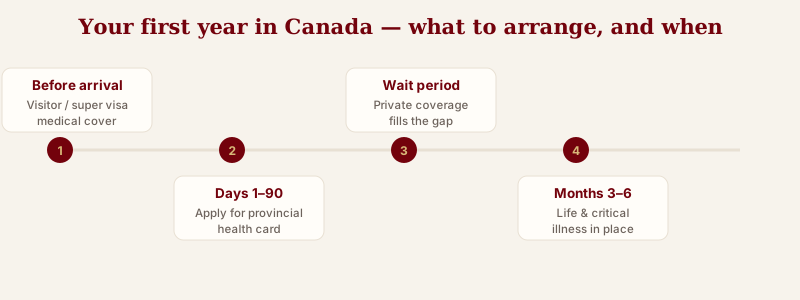
| Buying after arrival | Must be in place for the application | Possible, usually with a waiting period |
| Accepted for a Super Visa | Yes | No |
If your parents are coming on a visitor visa, price it on the visitor insurance quote; for the Super Visa route use the Super Visa quote, which only shows plans meeting the IRCC rules.
Cost over time, not on day one
A visitor visa looks cheaper, and for one short trip it is. The comparison changes once you look across several years, because a Super Visa is bought once while repeat visits mean repeat applications and repeat policies.
Consider a family whose parents visit for roughly six months every year. On visitor visas, that is a fresh application cycle and a fresh insurance purchase each time, with premiums rising as the parents age. On a Super Visa, one application covers up to ten years, and insurance is renewed annually at the age reached — which rises too, but without the repeated application effort and refusal risk.
Where the visitor visa genuinely wins is the short, occasional visit: a wedding, a birth, a few weeks in summer. Paying for a year of $100,000 coverage to support a three-week trip makes no sense.
Which should your family choose?
| If this describes you | Likely answer |
|---|---|
| Parents want to stay many months at a time | Super Visa |
| Help with a new baby or during illness | Super Visa |
| A short trip for a specific event | Visitor visa |
| Host income is clearly below the threshold, both routes | Visitor visa for now |
| Parents want to test living in Canada before committing | Super Visa |
| You are unsure how often they will visit | Super Visa — it keeps options open |
A Super Visa does not oblige anyone to stay five years. It permits it. Many families use one for a series of ordinary-length visits simply to avoid reapplying, which is a perfectly sensible reason to choose it.
What neither visa does
Worth stating plainly, because these come up constantly:
- Neither permits work. A Super Visa is a visitor status with a longer stay, not a work permit.
- Neither provides provincial health coverage. Parents are not eligible for OHIP or its equivalents, which is exactly why private insurance matters on both routes.
- Neither is permanent residence. That is the Parents and Grandparents Program, a separate process with its own income test — the LICO plus 30% figure mentioned earlier.
- Neither guarantees entry. A visa allows travel to Canada; a border officer still decides admission on each arrival, and can ask to see the insurance.
What happens if the application is refused
Worth planning for on either route, because refusals happen to well-prepared families.
For a Super Visa, the insurance is usually already bought — that is the requirement. Most insurers refund the premium if the visa is refused, less an administration fee, on proof of the refusal letter. Terms differ, and it is one of the things worth comparing before buying rather than discovering afterwards. Families on monthly plans are exposed to less, having paid only the first instalment.
Neither refusal carries a formal appeal in the way a permanent residence decision might. The practical route is usually to address the reason and reapply. Common reasons on the Super Visa side are the income calculation, incomplete proof of the relationship, insurance that does not meet all four conditions, or a missing immigration medical exam. On the visitor side, refusals more often cite insufficient ties to the home country.
Applying for both, and switching between them
Two questions that come up often enough to answer directly.
Can parents hold a visitor visa and later get a Super Visa? Yes. Holding one does not prevent applying for the other, and families frequently start with short visits before deciding the longer route is worth the paperwork.
Can a visitor already in Canada move onto a Super Visa? The Super Visa is applied for from outside Canada. Parents already here on a visitor record generally look at extending their stay instead, which is a different process with different requirements. If the plan is long-term visiting, applying for the Super Visa before they travel is the cleaner path.
A practical sequence for the Super Visa route
- Check the income test first, using plain LICO and a correct family-size count, before spending anything. This is the requirement that most often stops an application.
- Get insurance quotes early, so the cost is known while you are still deciding. Comparing takes minutes; the wrong plan lasts a year.
- Check the stability wording against each parent's real health history, not the summary version.
- Buy and pay — in full or first instalment — and keep the confirmation showing amount, term and start date.
- Book the immigration medical exam with an approved panel physician. This is separate from the insurance and easy to miss.
- Assemble the rest: invitation letter, proof of relationship, proof of host status, income documents, passports, biometrics.
- Apply, and keep a copy of the insurance where your parents can reach it when they travel — an officer can ask on every entry.
Done in this order, nothing is bought before it is known to be needed, and the two requirements that cause most refusals are settled first.