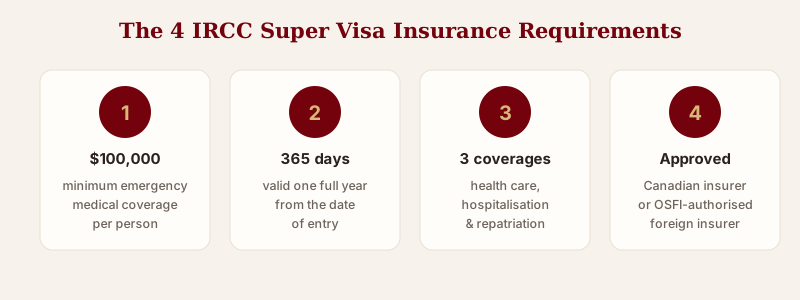
Super Visa insurance must cover a full 365 days, which historically meant a substantial single payment at exactly the moment a family was also paying for flights and application fees. Monthly plans have made that considerably easier, and they are now what most of my clients choose.
Three differences matter.
1. Total cost
Paying the full year up front is generally the lowest total cost. Monthly plans usually add a modest amount over the year to reflect the payment structure.
The gap is not usually large, and for most families the cash-flow benefit outweighs it. But you should see both figures before deciding. Any advisor showing you only the monthly number is not giving you the information you need.
2. What IRCC requires either way
This is the part that causes confusion.
The application requires proof of paid, active coverage for the full 365 days. A quote is not accepted. With a monthly plan, that means the initial payment must be made and you need documentation from the insurer confirming the policy is in force for the required period.
Monthly payment does not mean monthly coverage. The policy still runs a full year; you are simply paying for it over time. Make sure the confirmation letter you submit says so clearly.
If payments stop, the policy can be cancelled — and your parents are then in Canada on a Super Visa without the insurance the visa required. That is a serious problem, both practically and for any future application. Set up the payment on an account that will reliably have funds.
3. Refunds if the visa is refused
Most Super Visa policies refund the premium, less an administrative fee, if the visa is refused and coverage has not started.
With an annual payment you have paid the full year and are refunded most of it. With a monthly plan you have paid less up front, so there is less to recover — which is arguably an advantage if refusal is a real possibility.
Terms differ between insurers. Confirm the refund provisions before purchasing, particularly if there is any uncertainty about the application.
What happens if the visit ends early
A practical scenario. Your parents come for a year, but after five months decide to return home.
Most policies allow cancellation with a partial refund for the unused portion, generally provided no claim has been made and you give notice. With a monthly plan you simply stop future payments, subject to the terms.
Either way, tell the insurer rather than just stopping payment or assuming it lapses cleanly. Cancelling properly protects the refund and keeps the record straight for future applications.
Which to choose
Pay annually if you have the funds available, want the lowest total cost, and the application is straightforward.
Pay monthly if the up-front amount is difficult, you would rather keep cash available around the arrival period, or there is meaningful uncertainty about the visa outcome.
Neither is wrong. The important thing is that the policy meets the requirement — $100,000 minimum, 365 days, health care, hospitalisation and repatriation, from a qualifying insurer — because a cheaper policy that does not qualify is not cheaper, it is a refused application.
If you want both figures for your parents' actual ages and health history, that takes a short conversation and there is no cost to asking.
What IRCC actually accepts — the exact wording
This is worth quoting precisely, because families are often told monthly plans are risky. IRCC's own document checklist says the insurance must "be paid in full or in instalments with a deposit," and adds plainly that quotes aren't accepted.
So a monthly plan with the first payment made is acceptable. What is not acceptable is a quote, an unpaid application, or a policy where nothing has been paid yet. The distinction is payment, not payment schedule.
What you submit with the application is proof of that payment together with the policy confirmation showing the coverage amount, the term and the start date. If a visa officer cannot see those four things, the file is treated as though there is no insurance.
How monthly plans are actually structured
People often picture twelve equal payments. That is rarely how these work. The common shape is a larger first payment followed by a series of smaller ones.
| Element | Typical shape | Why it matters |
|---|---|---|
| First payment | Noticeably larger than the rest | Often includes the policy fee and the first month. Budget for it. |
| Following payments | Usually 10 or 11, equal | Fewer instalments than months, so the year is paid off early. |
| Administration fee | Charged by most insurers | The main reason monthly totals more than annual. |
| Payment method | Pre-authorised from a card or account | A failed payment can lapse the policy — see below. |
Not every insurer offers monthly, and the ones that do price it differently. That is exactly the kind of difference a side-by-side comparison exposes: the Super Visa quote shows the first payment, the recurring amount and the annual total together, so you can see the real cost of spreading it rather than guessing.
A worked comparison
Take a straightforward case: one parent, $100,000 of coverage, 365 days, no pre-existing conditions. Suppose the annual premium is $1,800 paid up front, and the same plan on monthly works out around $1,950 across the year once the fee is included.
| Pay up front | Monthly | |
|---|---|---|
| Due on day one | $1,800 | Roughly $300 |
| Total across the year | $1,800 | Roughly $1,950 |
| Extra cost | — | About $150, roughly 8% |
| Cash kept free on day one | — | About $1,500 |
Those figures are illustrative, not a quote — every insurer sets its own fee and your parents' ages change everything. The point is the shape of the decision: you are paying a modest premium to keep roughly $1,500 in your pocket during a month when a family is already paying for flights, and often for two parents at once.
Worth doing the sum on both parents together. When a couple is insured, the day-one difference doubles while the percentage stays the same, and that is usually when monthly starts to look sensible rather than merely convenient.
When a payment fails
This is the genuine risk of monthly, and it deserves more attention than it usually gets.
A missed instalment does not cancel the policy the same day. Insurers allow a grace period and will normally try the payment again, but if it stays unpaid the policy lapses. Two consequences follow, and the second is the serious one:
- Your parents are uninsured. Any medical event after the lapse is uncovered, which is the whole thing you were buying.
- They are out of status on the terms of the visa. The insurance must remain valid, and a border officer can ask for proof on every entry.
Practical protections: use a card that will not expire mid-term, keep a buffer in the account, and note the payment date somewhere the family will see it. If a card is replaced — lost, reissued, fraud — tell the insurer that week rather than waiting for a failed payment.
Renewal: the part nobody plans for
A Super Visa can allow stays of up to five years per entry, but insurance is bought a year at a time. If your parents stay longer, you will be buying this again.
Renewal is priced at your parent's age at renewal, not the age when they first arrived. Insurers price in age bands, so a birthday that crosses a band can move the premium sharply even though nothing else changed. Where a parent is sitting at the top of a band, it is worth asking what the following year looks like before settling on this year's plan.
The second renewal issue is health. Anything diagnosed or treated during the first year is a pre-existing condition at renewal. That can change which insurers will cover it and on what terms — another reason not to assume you will simply repeat this year's purchase.
Refunds: how the two structures differ
Most insurers refund the unused portion of a premium when parents go home early, provided no claim has been made, usually less an administration fee. How that plays out depends on which way you paid.
| Paid up front | Monthly | |
|---|---|---|
| Visa refused | Refund of premium, less fee, with proof of refusal | Stop the plan; you are out only what has been paid so far |
| Early departure | Pro-rated refund of the unused months | Cancel the remaining instalments |
| After a claim | Usually no refund | Usually must continue the term |
Read that middle row carefully, because it is the strongest argument for monthly that has nothing to do with cash flow: if the visa is refused, a family on a monthly plan has risked one payment rather than a full year's premium. Refund terms vary between insurers, and they are one of the things worth comparing before you buy rather than after.
So which should you choose?
A reasonable rule of thumb, though your circumstances beat any rule:
| If this is true | Leans toward |
|---|---|
| The full premium is affordable without strain | Pay up front — it costs less |
| You are insuring two parents at once | Monthly — the day-one figure is the obstacle |
| The application feels uncertain | Monthly — less at risk on a refusal |
| Flights and setup costs land the same month | Monthly — spread the load |
| You want the least paperwork | Up front — one payment, done |
Neither choice affects whether the visa is approved, and neither affects what the policy covers. It is purely a question of cash flow versus a modest total cost, plus that refund consideration if you are unsure about approval. If you want both figures side by side for your parents' actual ages, the quote tool shows them together, or see the Super Visa insurance page for how the coverage itself works.
Two things monthly does not change
Because monthly plans are sometimes described as a lesser option, it is worth being clear about what stays identical.
The coverage is the same. A monthly plan is not a cut-down policy. Same $100,000 minimum, same emergency medical, hospitalization and repatriation, same pre-existing condition wording as the annual version of that plan. You are changing the billing, not the contract.
The approval odds are the same. A visa officer is checking that qualifying coverage exists and has been paid into. There is no penalty, formal or informal, for having chosen instalments.
What monthly does change is the total cost and your exposure if things go wrong early — and those cut in opposite directions, which is why the answer is genuinely personal rather than a matter of one option being better.
Questions worth asking before you commit
Whichever way you lean, these are the things I would want answered by the insurer in writing:
- What is the first payment, exactly, and what does it include?
- How many instalments follow, and on what date each month?
- What is the total across the year, compared with paying up front?
- What is the grace period on a missed payment, and what happens after it?
- If the visa is refused, what is refunded, and what proof is needed?
- If my parents go home early with no claims, how is the refund calculated?
- Is there a fee to cancel, and does it differ between the two structures?
Any insurer worth buying from will answer all seven plainly. If the refund terms are vague, that tells you something useful before you have paid anything.
Insuring two parents: where the decision usually turns
Most of what is written about this assumes one traveller. In practice families are usually insuring a couple, and that changes the arithmetic in ways worth spelling out.
The percentage difference between monthly and annual stays roughly the same, but the absolute day-one figure doubles. A difference that felt manageable for one parent becomes the deciding factor for two, landing in the same month as two airfares and often a visa fee each.
Two further points specific to couples:
- The cheapest insurer for one parent is not always cheapest for both. Where the parents are different ages, or one has a health history and the other does not, insurers can split the pair very differently. Some price each traveller on their own terms; others apply a couple rate.
- They need not be on the same plan. Each parent needs their own $100,000 of qualifying coverage. Nothing requires both to come from the same insurer, and where one parent has a condition, splitting them occasionally beats forcing both onto the plan that suits the harder case.
The comparison handles both travellers together and shows each parent's premium alongside the combined total, which is the view you actually need when deciding how to pay.
A short worked example of the whole decision
Suppose parents aged 68 and 65 are arriving in late September for an extended stay, one with well-managed blood pressure. The family has the money for a year up front but would rather not commit it in the same month as flights.
The sequence I would work through: confirm both plans meet the $100,000 and 365-day rules; check the stability period against the blood-pressure history and discard any insurer whose wording would not pay; compare the two or three remaining on annual total; then look at what monthly costs with those same insurers, and what the first payment is. Only at that point does the payment question get answered — and by then it is a genuinely small decision, because the large ones have been made.
Families who start with "monthly or annual?" often end up on the wrong plan entirely, because payment structure is the last question, not the first.