Most travel insurance advice is about buying the policy. Almost none is about using it — which is unfortunate, because how you handle the first few hours substantially affects whether the claim gets paid in full.
The single most important step
Nearly every emergency medical policy requires notification before or immediately upon receiving care, and many require pre-approval for non-emergency hospital admission. Failing to make that call can reduce or void an otherwise entirely valid claim.
In a genuine life-threatening emergency, get care first. Then call as soon as anyone reasonably can — a family member can do it on the patient’s behalf.
People assume the assistance line is a bureaucratic hoop. It is not. Calling early usually produces a better outcome than presenting a bill afterwards, for a practical reason: the insurer can often arrange direct billing with the hospital, so you are not paying tens of thousands up front and waiting for reimbursement.
What the assistance line actually does
- Directs you to a facility appropriate to the problem, and one they work with
- Arranges direct payment where possible, so you are not out of pocket
- Coordinates with the treating physicians and monitors the case
- Organises repatriation to Canada where that becomes medically necessary
- Helps with the practical mess — translation, family communication, travel changes
Prepare three things before you travel
1. The policy number and 24-hour line, in two places. Printed in a wallet and saved in a phone. A policy nobody can find at 2am is not doing much.
2. Someone at home who knows the coverage exists. If the traveller is seriously unwell, they are not the one making the call. Tell an adult child or a sibling where the details are.
3. A written note of medications and conditions. Use generic drug names where you can — brand names differ between countries and cause confusion at exactly the wrong moment.
Keep everything
Claims are assessed on documentation. Collect it at the time, because reconstructing it later from another country is considerably harder:
- Itemised invoices, not just totals or credit card slips
- Receipts for anything you paid directly, including pharmacy
- The discharge summary and physician’s notes
- Any prescription records
- A note of who you spoke to at the insurer, and when
What it will not cover
Emergency medical insurance covers unforeseen emergencies. The test is not “is this medical?” but “was this unexpected and urgent?”
So it generally will not cover routine check-ups, scheduled follow-up appointments, refilling an existing prescription, dental cleanings, vision care, or elective procedures. Plan medication supply for the whole trip before departure — running out abroad is not an emergency for insurance purposes.
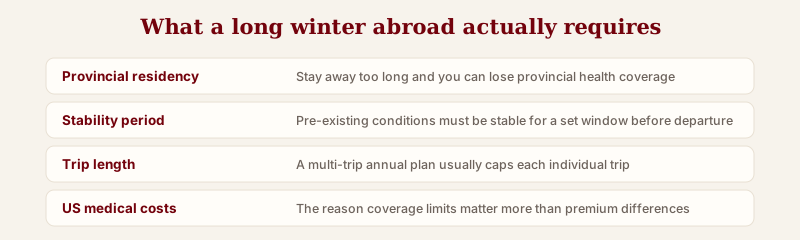
The other common exclusion is anything relating to a pre-existing condition that was not stable for the insurer’s required period before departure. A medication change in the weeks before travel is the usual culprit.
If a claim is refused
There is a defined path, and it is worth knowing it exists.
First, the insurer’s own internal complaint process, which ends with a written final position letter. With that letter you can approach the OmbudService for Life & Health Insurance — a free, independent, impartial national service whose members represent 99% of the Canadian market. It takes neither side. Beyond that sit the provincial regulators.
Denials must rest on a specific contractual ground and be justified in writing. If the reason given does not match what your policy actually says, that is worth challenging.
One thing worth doing today
If you have a trip booked, spend ten minutes now finding the assistance number and saving it somewhere you would find it in a hurry. It is the least interesting preparation you will do and the one most likely to matter.
The first hour: a checklist
| Order | Do this | Why it matters |
|---|---|---|
| 1 | Call the 24-hour assistance line | Most policies require it before non-emergency treatment. Skipping it is the most common reason a valid claim is cut. |
| 2 | Give the policy number and describe the situation | They confirm cover and often direct you to a facility that bills them directly. |
| 3 | Ask whether they will guarantee payment | This is what decides whether you pay up front or the insurer does. |
| 4 | Write down who you spoke to and when | A file reference protects you if the claim is later questioned. |
| 5 | Get treatment | In a true emergency this comes first — call as soon as you reasonably can. |
The exception worth repeating: if someone is unconscious, bleeding heavily or having chest pain, you get help first and call afterwards. No reasonable insurer expects a phone call before an ambulance, and policies word the requirement to allow for it. The requirement bites on the middle ground — a bad infection, a suspected fracture, a condition that has been worsening for a day or two — where there was time to call and nobody did.
Direct billing versus paying and claiming
Which of these happens is the single biggest factor in how stressful the episode becomes.
| Direct billing | Pay and claim | |
|---|---|---|
| Who pays the hospital | The insurer | You, up front |
| Typical for | Larger hospitals, arranged through assistance | Small clinics, pharmacies, remote areas |
| What you need | Policy number, assistance confirmation | A card with room on it, and every receipt |
| Reimbursement | Not needed | Weeks, sometimes months |
Calling assistance first is what makes direct billing possible. Walk into a clinic unannounced and you are almost certainly in the right-hand column, which means finding several thousand dollars on a credit card in a foreign country.
The paperwork that decides the claim
Claims are settled on documents, not on what happened. Collect these while you are still there, because getting them afterwards from another country is genuinely difficult:
- Itemised bills, not just the total. Insurers want to see what each charge was for.
- Proof of payment for anything you paid yourself — card receipts, not just the invoice.
- The medical report or discharge summary, stating the diagnosis and the treatment given.
- Prescriptions and pharmacy receipts.
- The doctor's note if you were told not to fly, which is what supports a trip-interruption claim.
- Anything in another language — ask for an English copy if one is available, or keep the original and expect the insurer to arrange translation.
Photograph everything on your phone as you go. Paper gets lost in transit; a photo taken in the clinic does not.
The exclusions that catch people out
Most refused claims fall into a handful of categories, and none of them are obscure fine print:
- An undeclared condition. By far the largest category. Insurers request medical records for significant claims, and the gap between the application and the records is where claims die.
- A condition that was not stable. Even when declared, if it changed inside the stability window — a dose adjustment counts — a related claim may not be paid.
- Alcohol or drugs involved in the incident. Widely excluded, and routinely checked when a hospital record mentions it.
- Not calling assistance when the policy required it.
- Ordinary care rather than an emergency. A repeat prescription or a routine check is not a sudden and unexpected event.
- Excluded activities. Some policies name specific sports and activities; worth a glance before a trip built around one.
If the claim is reduced or refused
A first refusal is not always the end of it. A methodical response works better than an angry one:
- Get the reason in writing, citing the specific policy clause. A vague verbal explanation is not something you can respond to.
- Read that clause against what actually happened. Claims are sometimes refused on a misreading of the medical notes.
- Gather evidence that addresses the stated reason — a letter from the treating doctor, or from your own physician confirming a condition was stable.
- Ask for a formal review. Every insurer has an internal appeals process, and you are entitled to use it.
- Escalate to the Ombudservice for Life and Health Insurance (OLHI) if the internal review fails. It is free and independent.
Where I can help most is at step one and two: reading the clause against the facts and telling you honestly whether there is an argument or whether the refusal is correct. That is worth knowing either way before spending months on it.
What to do before you leave Canada
Almost everything that goes wrong with a claim is decided before the trip starts. Five things worth half an hour of your time:
- Declare your health history properly. Including medication changes in the last year — a dose adjustment counts as a change. This one decision determines more claim outcomes than everything else combined.
- Check the stability period against your own recent history, not against how well you feel. If a condition changed four months ago and the policy requires six, you need a different policy.
- Save the assistance number in your phone, and write it somewhere that survives a dead battery.
- Tell your travelling companion where the policy is. If you are the one in the ambulance, someone else is making the call.
- Check what your credit card actually covers. Card benefits are often narrower than assumed, frequently have age limits, and usually require the trip to be paid on that card.
Trip interruption: the part people forget they bought
Medical emergencies abroad have a second cost that has nothing to do with hospital bills: the trip itself falls apart. Flights are missed, hotels go unused, and somebody may need to fly out to be with you.
Many policies include trip interruption cover, and it is claimed far less often than it should be, simply because people do not realise it is there. It can cover the unused portion of a prepaid trip, the cost of changing flights home, extra accommodation while you are unfit to fly, and sometimes travel and lodging for a family member to join you.
What unlocks it is almost always a doctor's note stating you were unfit to travel on the original date. Ask for it while you are still with the treating physician; obtaining it later from another country is often impossible. Keep every changed booking and receipt alongside it.