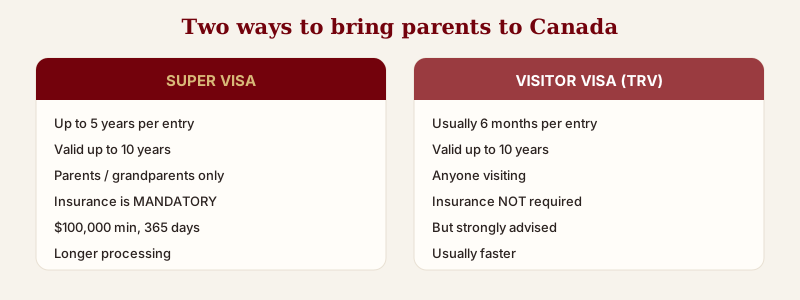
Not every visiting parent needs a Super Visa. For a visit of a few months on a regular visitor visa, insurance is not legally required — but going without it means any medical emergency is paid entirely out of pocket, and Canadian healthcare pricing for the uninsured is unforgiving.
Here is what actually decides whether a visitor policy does its job.
1. Buy before they fly
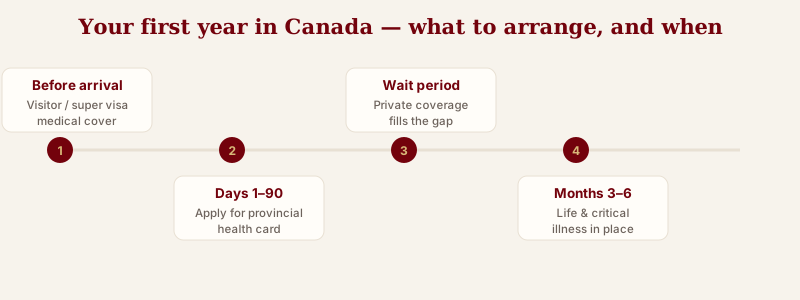
Coverage bought before departure is cheaper, broader, and free of the waiting period that applies to post-arrival purchases. It also lets you time the purchase around the stability window if a parent has a managed condition.
If they have already arrived, coverage can usually still be arranged — but a waiting period of several days typically applies, and anything that has already begun will not be covered.
2. Get the stability period right
The single biggest determinant of whether a claim gets paid.
Coverage of a pre-existing condition generally requires that condition to have been stable for a set period before the policy takes effect — often 90 or 180 days depending on the insurer and your parent's age.
Stable typically means no new diagnosis, no new symptoms, no change in medication or dosage, no new treatment and no hospitalisation for that condition during that window.
The medication clause catches the most families. If your mother's blood pressure prescription was adjusted six weeks before the flight — even reduced — that condition may fall outside coverage.
If a parent has any managed condition, ask their doctor whether upcoming medication changes can reasonably wait until after the visit, or plan the travel date around the stability window. This one step prevents most denied claims.
3. Choose the coverage amount deliberately
Visitor policies are commonly available from around $25,000 up to $150,000 or more. For a younger, healthy visitor a lower limit may be reasonable. For a parent in their seventies, it usually is not.
A serious cardiac event, a stroke, or a fall requiring surgery and rehabilitation can run well past $100,000 for someone with no provincial coverage. The premium difference between limits is proportionally much smaller than the difference in exposure.
4. Set the deductible to something you could actually pay
A higher deductible lowers the premium and is a sensible economy — provided the family could genuinely cover it. A $2,000 deductible you could pay is fine. A $5,000 deductible you could not leaves you effectively uninsured for anything smaller.
5. Check whether it can be extended
Visits get extended. A grandchild arrives early, a parent decides to stay through summer.
Most visitor policies can be extended, but usually only if you request it before the current policy expires and there have been no claims or new medical issues. Extending is far simpler than buying a fresh policy mid-visit, which may bring a new waiting period and new exclusions.
Note the expiry date somewhere you will actually see it.
6. Understand what it does not cover
Visitor insurance is emergency coverage. It does not cover routine check-ups, prescription refills for existing conditions, dental cleanings, vision care, or anything that could reasonably have been scheduled in advance.
If your father needs regular medication, bring an adequate supply or plan to pay for it. If your mother has a standing specialist appointment, that is not what this policy is for.
7. Make sure they can actually use it
The practical step people skip. Before they travel, make sure your parents have:
- The policy number and the insurer's 24-hour emergency phone number, on paper and on their phone
- An understanding that they should call the insurer before treatment where possible — many policies require notification, and failing to call can reduce a claim
- Someone in Canada who knows the policy exists and where the details are
A policy nobody can find at 2am in an emergency department is not doing much good.
If a Super Visa is the eventual plan
Worth noting that visitor insurance and Super Visa insurance are different products. A Super Visa requires a paid policy of at least $100,000 covering a full 365 days, in place before the application is submitted from outside Canada. Visitor insurance for a shorter trip will not satisfy it.
Plenty of families start with a visitor visa and shorter coverage, then move to a Super Visa once they know longer stays are wanted. That is a perfectly sensible progression.
If your parents are coming and you want the policy matched to their actual health history rather than picked on price, that is exactly the comparison I do — and it costs nothing to ask.
The checklist at a glance
| Decision | Sensible default | When to deviate |
|---|---|---|
| When to buy | Before they board | Never later, if you can avoid it |
| Coverage amount | $100,000 | Higher over 70, or with any condition |
| Deductible | $500–$1,000 | $0 if a condition means frequent small claims |
| Term | The full intended stay | Longer if plans may extend |
| Stability period | The shortest you can get | Only accept a long one if health is genuinely static |
| Extendable | Yes, confirm before buying | — |
How the same parents get very different prices
It is normal for quotes on identical parents, coverage and dates to differ by a third or more. Insurers disagree on two things above all: how much risk an age carries, and how tightly to define a pre-existing condition.
What follows is not "always take the cheapest". It is "never look at only one". A single quote tells you what one company thinks, and you cannot tell from the number alone whether it is the market rate or an outlier. Running both parents together on the visitor insurance quote shows the spread in a couple of minutes.
One thing worth knowing about couples: the cheapest insurer for one parent is not always cheapest for both. Where the parents are different ages, or one has a health history, insurers can split the pair quite differently. Nothing requires both to be on the same policy.
Stability periods, compared
| Period | What must not have changed | Suits |
|---|---|---|
| 90 days | Three months of stable treatment | Parents whose medication was recently adjusted |
| 180 days | Six months unchanged | The common middle ground |
| 365 days | A full year unchanged | Only genuinely static conditions |
"Unchanged" is stricter than families assume. A new prescription, a dose adjustment, a specialist referral, or a test ordered to investigate a symptom can all restart the clock — even where the parent feels well and the doctor considers them stable. This is the detail that decides whether a claim is paid, and it is why the cheapest plan is often the wrong purchase for a parent with any history at all.
Making sure they can actually use it
Families buy good cover and then leave the travellers unable to reach it. Before they fly:
- Print the policy and put it in their hand luggage, with the policy number and the 24-hour assistance number visible.
- Explain the assistance line comes first, before treatment where there is time. Failing to call is a common reason a genuine claim is cut.
- Check language support if their English is limited. Many assistance lines offer interpretation; know that in advance rather than at 2am.
- Tell them to keep every receipt and ask for an itemised bill and a discharge summary.
- Warn them it is not a health card. At smaller clinics they may need to pay and be reimbursed.
- Make sure someone in Canada has a copy too, so you can help from here if they are unwell.
Extending, and when to stop extending
Most policies can be extended before they expire, usually only where no claim has been made. Two rules: extend before the policy lapses, because a gap restarts any waiting period and re-opens the pre-existing question on anything treated in between; and once you are extending repeatedly, compare the running total against a single longer policy.
If the visits are becoming an annual pattern of several months each, the arithmetic usually stops favouring visitor insurance altogether. That is the point to look at whether a Super Visa fits, since it allows stays of up to five years per entry with insurance renewed annually rather than repurchased each trip. See Super Visa insurance for the requirements, which include $100,000 of coverage for a full year and a host income test.
What visitor insurance does not cover
Worth setting expectations with the whole family before anyone travels, because misunderstanding this is a common source of upset:
- Routine and preventive care. Check-ups, dental work, vaccinations, eye tests. This is emergency cover, not a health plan.
- Ongoing management of a known condition. Regular monitoring of stable diabetes or blood pressure is treatment, not a sudden event.
- Planned treatment. Travelling for a procedure is excluded everywhere.
- Pregnancy and childbirth, in most cases.
- Anything connected to an undeclared condition. The most expensive exclusion, and entirely avoidable at application time.
Parents sometimes arrive expecting to use the policy for a prescription refill or a check-up they have been putting off. Explaining in advance that it covers the unexpected catastrophe, not ordinary healthcare, prevents a frustrating conversation at a clinic desk.
A worked example
Take parents aged 68 and 65, visiting for four months, one with blood pressure managed on a stable dose for two years and one with no history at all.
The sequence I would work through: price both at $100,000 and at $150,000 and see how small the step actually is at these ages; check the stability period on the cheapest two or three insurers against that two-year-stable history — it comfortably clears a 180-day window, so plans with a shorter period are not worth paying extra for here; set a $1,000 deductible on the parent with no history and consider a lower one for the other; confirm both policies can be extended; then buy, before the flights.
The whole exercise takes about fifteen minutes and is the difference between a policy that pays and one that technically existed. If you would rather have it checked by someone who reads these wordings daily, that conversation costs nothing.