These two products are confused constantly, including by people who have bought one of them. The distinction is simple once stated, and getting it wrong means having no coverage when it matters.
The core difference
Travel insurance covers Canadians leaving Canada. It exists because provincial health plans cover little to nothing outside the country. It assumes you have provincial coverage at home and are temporarily away from it.
Visitor insurance covers people coming to Canada who have no provincial health coverage here. It exists because visitors are not covered by any Canadian public plan, so an emergency is paid entirely out of pocket.
Different direction of travel, different underlying gap, different product.
Who needs which
Travel insurance — Canadian residents going abroad, whether for a week in Mexico, four months in Florida, or a trip home to visit family. Also relevant for Canadians travelling within Canada but outside their own province, where some services may not be fully covered.
Visitor insurance — parents and relatives visiting Canada, tourists, people on visitor visas, and new immigrants and returning Canadians during the provincial waiting period. That last group is the one most often missed. A new permanent resident waiting three months for provincial coverage needs visitor-type coverage even though they now live here.
Practical differences
Pre-existing conditions. Both apply stability periods, but visitor policies tend to be more restrictive, particularly for older applicants — reflecting that many visitors are visiting parents in their seventies.
Coverage amounts. Travel policies often carry high or unlimited emergency medical limits. Visitor policies are typically sold in defined tiers — commonly $25,000 to $150,000 — so choosing the limit deliberately matters more.
Trip cancellation. Commonly available with travel insurance, protecting non-refundable trip costs. Rarely a feature of visitor insurance.
Purchase timing. Travel insurance is normally bought before departure and is straightforward. Visitor insurance can be bought after arrival, but with a waiting period and exclusion of anything already begun.
Where Super Visa insurance sits
Super Visa insurance is a specific form of visitor insurance with requirements set by IRCC: at least $100,000 in coverage, valid a full 365 days from entry, covering health care, hospitalisation and repatriation, from a Canadian insurer or an OSFI-authorised foreign insurer, and paid rather than quoted.
All Super Visa insurance is visitor insurance. Not all visitor insurance qualifies for a Super Visa — a shorter or lower-limit visitor policy does not meet the requirement.
Buying travel insurance for a visiting parent. A Canadian travel policy is designed for a resident with provincial coverage who is temporarily abroad. It generally will not respond for a visitor being treated in Canada, who has no provincial coverage at all. The names are similar; the products are not interchangeable.
Quick reference
- Canadian going abroad — travel insurance, single trip or multi-trip annual
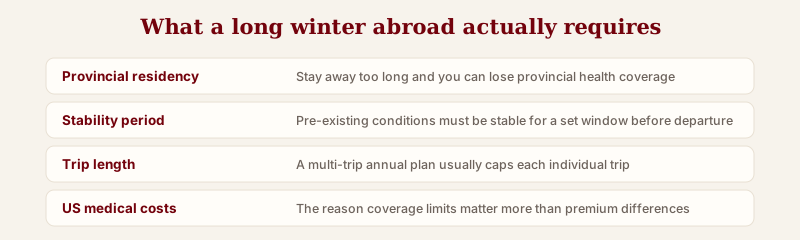
- Canadian spending a long winter abroad — travel insurance, checking the trip-length cap and provincial residency rules
- Parents visiting for a few months — visitor insurance
- Parents on a Super Visa — Super Visa insurance meeting the IRCC requirements
- New immigrant awaiting provincial coverage — visitor insurance for the waiting period
- Returning Canadian re-establishing residency — visitor insurance until provincial coverage restarts
Two things worth checking either way
The stability period for any pre-existing condition, and whether recent medication changes affect it. This decides more claims than any other clause in either product.
Whether the policy can be extended, and how, before it expires. Trips and visits both run long more often than people expect.
If you are not certain which product fits your situation, it takes about two minutes to work out. Better to ask than to find out at a hospital.
The three products side by side
| Visitor insurance | Travel insurance | Super Visa insurance | |
|---|---|---|---|
| Who it covers | People visiting Canada | Canadians leaving Canada | Parents/grandparents on a Super Visa |
| Provincial health behind it | None | Yes, partially | None |
| Minimum coverage | You choose | You choose | $100,000 by rule |
| Minimum term | Days to a year | Days to a year | 365 days |
| Repatriation | Often optional | Usually included | Required |
| Trip cancellation | Rarely | Commonly available | No |
| Accepted for a visa | No | No | Yes |
The row that explains most of the price difference is the second one. A Canadian travelling abroad still has provincial coverage paying a portion of emergency care, so travel insurance tops up a system that already exists. A visitor to Canada has nothing behind them, so visitor insurance is the entire safety net from the first dollar.
Why visitor insurance is not simply "travel insurance for Canada"
People assume the two products are interchangeable with the direction reversed. They are built differently, in three ways that matter.
The medical questions are stricter. Visitor plans ask more, and define pre-existing conditions more tightly, because they carry the whole risk rather than topping up a public system.
Waiting periods appear. Buy after the visitor has landed and most insurers will not cover illness starting in the first few days. Travel policies bought before departure rarely work this way.
Cancellation cover is usually absent. Visitor plans are medical products. If you want protection for non-refundable flights, that is a separate purchase and often belongs to whoever booked them.
Common situations, and which product fits
| Situation | What you need |
|---|---|
| Parents visiting for three months | Visitor insurance |
| Parents applying for a Super Visa | Super Visa insurance (365 days, $100,000) |
| You are off to Mexico for a week | Travel insurance |
| New permanent resident waiting for provincial coverage | Visitor insurance |
| Returning Canadian, coverage not yet reinstated | Visitor insurance |
| Work colleague visiting from abroad | Visitor insurance |
| Snowbird wintering in Florida | Travel insurance, long-stay |
| Family trip to another province | Travel insurance — yes, within Canada |
That last row surprises people. Provincial plans have reciprocal arrangements, but they are partial: an out-of-province hospital bill, an ambulance, or getting home after an injury can all leave a gap. It is a smaller gap than going abroad, not an absent one.
The waiting period, explained properly
This is the single most misunderstood feature of visitor insurance, and it only exists because of how people buy it.
If cover is purchased before the visitor arrives in Canada, it generally starts on the date you choose with no waiting period. If it is purchased after they have already landed, insurers apply a waiting period — commonly anywhere from 48 hours to about a week — during which sickness is not covered. Accidents usually are covered immediately; it is illness the clause targets.
The reason is straightforward: without it, families would buy cover the afternoon someone felt unwell. The practical lesson is equally straightforward. Buying before the flight costs no more and removes the gap entirely. If your parents have already arrived, see how visitor insurance works and buy today rather than tomorrow — the waiting period starts when the policy does.
Two mistakes that cost real money
Assuming a credit card covers a visitor. Card travel benefits typically cover the cardholder and their family travelling from Canada. A visiting parent is not usually an insured person under that benefit, and finding out at the hospital is a bad moment.
Buying visitor insurance for a Super Visa application. They are not interchangeable. A visitor policy that is cheaper, shorter, or lacks repatriation will not satisfy IRCC, and the application is refused over a document that felt like a saving. If a Super Visa is the plan, price it on the Super Visa quote, which only shows qualifying plans.
Choosing a coverage amount when there is no legal minimum
Outside the Super Visa there is no rule, which leaves families guessing. A reasonable way to think about it, by age and health rather than by budget:
| Visitor | Common choice | Reasoning |
|---|---|---|
| Under 40, healthy, short stay | $50,000–$100,000 | Serious claims are rarer; the floor still covers most emergencies. |
| 40–60, healthy | $100,000 | The usual default, and priced reasonably. |
| 60–70 | $100,000–$150,000 | Hospital stays lengthen with age. |
| 70+, or any managed condition | $150,000–$200,000 | Cardiac and stroke care escalates quickly; repatriation alone is costly. |
Because most claims never approach the limit, raising the ceiling usually costs proportionally less than people expect. Covering the first dollar is the expensive part; the upper layer is comparatively cheap. Run two amounts on the visitor insurance quote and the difference is often smaller than the assumption.
What none of these products cover
Whichever you buy, the exclusions are broadly similar and worth knowing before rather than during a crisis:
- Routine and preventive care. Check-ups, dental cleanings, prescription renewals, vaccinations. These are emergency products.
- Ongoing management of a known condition. Regular monitoring of a stable condition is treatment, not an emergency.
- Planned treatment. Travelling for a procedure is explicitly excluded everywhere.
- Pregnancy and childbirth, in most cases, beyond narrow complication clauses.
- Anything related to an undeclared condition. The most expensive exclusion of all, because it is self-inflicted at application time.
The practical takeaway is that these products protect against the unexpected catastrophe, not the cost of ordinary healthcare. Families who expect the latter are disappointed at exactly the wrong moment.
Newcomers and returning Canadians: the gap nobody warns you about
One group buys visitor insurance without ever being a visitor: people who have just moved to Canada, or Canadians returning after living abroad.
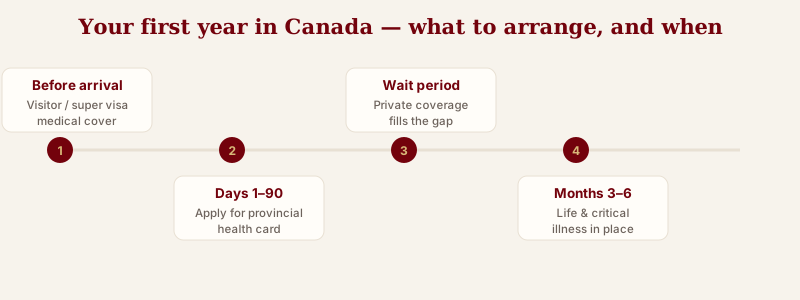
Provincial health coverage does not always begin the day you arrive. Some provinces impose a waiting period of up to three months for new and returning residents, during which you are responsible for your own medical costs exactly as a visitor would be. A new permanent resident who breaks an ankle in week two faces the same bill as a tourist.
Most visitor plans cover this situation explicitly, and it is worth asking for when you buy, because the policy needs to be written for a resident-in-waiting rather than a short-term visitor. Two things to check: that the plan covers you from your arrival date, and that it can be cancelled or shortened once provincial coverage begins, so you are not paying for months you no longer need.
The same logic applies to a Canadian coming home after a few years away. Coverage is not automatically reinstated on landing, and the assumption that it is has produced some genuinely painful bills.
Buying well, whichever product you need
The mechanics differ, but the discipline is the same across all three:
- Buy before travel. For visitors it avoids the waiting period; for Super Visa applicants it is required; for Canadians going abroad it is simply when cover is cheapest and broadest.
- Declare health history accurately, including medication changes in the past year. This single decision determines more claim outcomes than everything else combined.
- Read the pre-existing condition definition, not the marketing summary. The definition is what a claims adjuster applies.
- Match the term to the actual plan, and check whether it can be extended if the trip runs long.
- Compare more than one insurer. They disagree substantially on age and on health history, and the spread is usually wider than any setting you can adjust.
- Keep the policy reachable — printed, and in the traveller's own hands, not only in the inbox of whoever bought it.
None of that is complicated. It is just the part people skip when they are booking flights, and it is the part that decides whether the money spent turns out to have bought anything.