A mortgage renewal is mostly about rate. But it is also the natural checkpoint for a set of insurance questions that otherwise never get asked — and one of them is genuinely time-sensitive.
If you are switching lenders, your creditor insurance ends
This is the urgent one.
Mortgage life insurance purchased through your lender is tied to that mortgage with that lender. Move to a different lender at renewal and the coverage generally terminates. You would need to apply again with the new lender — at your current age, with your current health.
If your health has changed since you first bought the house, you may not qualify. I have seen people stay with a worse rate specifically because they could not replace the coverage, which is an expensive way to learn this.
If you are considering switching lenders and you rely on creditor insurance, apply for a personal life insurance policy first. Get it issued and in force, then switch. Personal coverage is not tied to any lender, so the question never arises again.
Your balance has dropped — is your coverage still right?
If you bought a personal term policy when you purchased the home, the death benefit has stayed level while the mortgage has fallen. That is not a problem; the surplus now protects other things — income replacement, education, a cushion for your family.
But it is worth checking the whole picture rather than the mortgage alone. Your income may have grown, you may have had another child, or you may have taken on other obligations. The coverage that fit five years ago may now be too little rather than too much.
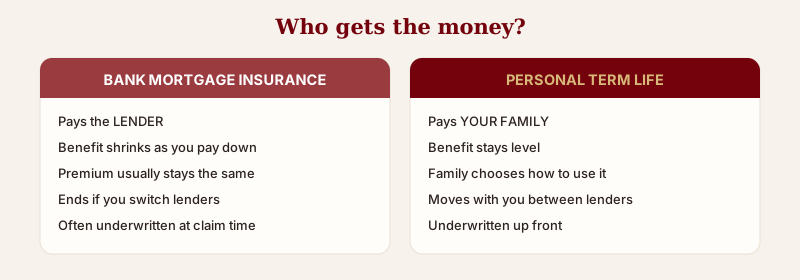
If you hold declining creditor insurance instead, note that your benefit has been shrinking while your premium likely has not. That is a reason to price personal coverage, which frequently costs less for more.
If your health has changed, do not cancel anything
A firm rule. If you have developed a condition since buying your current coverage, that policy is more valuable than it was — because replacing it may be difficult or expensive.
Never cancel existing coverage until replacement coverage is issued and in force. Approval is not the same as in force. Wait for written confirmation.
If you hold a term policy with a conversion privilege and your health has deteriorated, that privilege may now be the most valuable feature you own — it lets you move to permanent coverage without new medical evidence. Check whether it is still available, since conversion rights often expire at a set age or term point.
Is your term about to end?
Worth checking at renewal, because the two dates rarely align.
If your 20-year term expires in three years and you will still have a mortgage and dependants, act now rather than then. Renewing a term policy after expiry costs substantially more, since it is priced at your age at that time. Buying a new policy while you are three years younger and, hopefully, healthy is meaningfully cheaper.
Disability deserves a mention
Most homeowners insure against dying and not against being unable to work — even though, during working years, an extended disability is the more probable event and does the same damage to the mortgage payment.
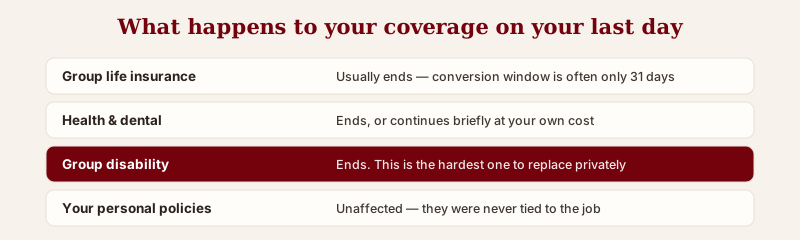
If you have group disability through work, understand its limits and that it ends with the job. If you have none, this is worth pricing while you are thinking about the mortgage anyway.
A five-minute checklist
- Switching lenders? Sort personal coverage before you switch.
- Compare your current coverage against your current obligations, not the ones you had at purchase.
- Health changed? Do not cancel anything, and check your conversion privilege.
- Term ending within a few years? Act now, not then.
- No disability coverage? Price it while the mortgage is front of mind.
None of this needs to slow down your renewal. But renewal is the moment you have the numbers in front of you, which makes it the easiest time to get this right.
Why renewal is the natural moment to check
Renewal is one of the few times the mortgage is actually in front of you. It is also the moment several insurance arrangements quietly change, usually without anyone mentioning it.
| What happens at renewal | Insurance consequence |
|---|---|
| You switch lenders | Creditor insurance from the old lender ends |
| You stay with the same lender | Creditor insurance usually continues |
| Your balance has fallen | Owned cover may now exceed the need; creditor cover has shrunk |
| You refinance for more | Cover may now be short |
| Several years have passed | Your term policy may be nearing its end or its conversion deadline |
The switch that leaves people uninsured
This is the one worth guarding against. Creditor insurance is tied to the loan, not to you. Move the mortgage to a new lender and the old policy ends — and the new lender's offer is a new application, assessed on your health today.
Someone who bought creditor insurance at 38 in good health and switches lenders at 48 after a diagnosis may find the new cover declines them, excludes the condition, or costs considerably more. They moved for a better rate and lost their insurability without being told that was part of the trade.
So: do not cancel or lapse any coverage until the replacement is in force. And if your health has changed at all since you took the original mortgage, sort the insurance out before committing to the switch.
The case for owning it instead
Renewal is also the sensible moment to ask whether lender-provided cover is the right product at all.
- The payout goes to the lender, clearing the mortgage. Your family cannot choose to keep a smaller mortgage and use the money for childcare instead.
- The coverage falls as you pay down while the premium generally does not — so the cost per dollar of protection rises every year.
- Health is often assessed at claim time rather than application time.
- It ends when the mortgage moves, as above.
An owned term policy inverts all four. See mortgage insurance versus term life and the Ontario mortgage life insurance gap.
Is your coverage still the right size?
Five years of payments later, the balance is smaller — but that does not automatically mean less cover is needed. The mortgage is only one part of what a household loses.
Run the question properly: debts outstanding, plus several years of income, plus childcare and education costs, less savings and existing cover. Plenty of households find the mortgage has shrunk while the family's needs have grown. See how much life insurance do I need.
And before cancelling anything that now looks oversized, check whether you could still buy it today at the same price. A policy issued when you were younger and healthier can be worth keeping even if the original reason has shrunk.
Check your term dates while the file is open
Two dates to find on any term policy: when the term ends, and when the conversion privilege ends. The second is usually earlier than people expect and is the option that protects you if your health changes. Once it passes it cannot be recovered. See converting term to permanent.
A five-minute checklist
- Are you switching lenders? If so, what cover ends on the day you do?
- Is anything you hold tied to the loan rather than to you?
- Has your health changed since you last applied for anything?
- Does the amount still match the household's actual need?
- When does your term policy end, and when does its conversion right end?
- Is disability cover in place? A mortgage does not pause for a back injury, and being off work is more likely than dying during the term.
If you want a second look before signing the renewal, get in touch — it is a short conversation and considerably easier before the paperwork is done than after.
What to ask the lender before signing
Lenders are not obliged to volunteer any of this, and front-line staff frequently do not know the answers. Ask anyway, and ask for the answers in writing.
- If I move my mortgage, what happens to the insurance I bought with it?
- Is my coverage amount fixed, or does it fall with the balance?
- Was my health assessed when I applied, or is it assessed at claim time?
- Who receives the payout — the bank, or my family?
- If I declined this before, can I add it now, and on what terms?
Question three is the one that matters most and gets the vaguest answers. Post-claim underwriting means the questions you answered at signing are reviewed after a death, and a discrepancy discovered then is found by your family rather than by you.
You are entitled to decline the lender's offer. You do not need to justify it, and declining has no bearing on whether the mortgage is approved.