Here is a finding that sounds contradictory until you look at the cause. Canadians hold more life insurance than ever — roughly $6 trillion of coverage across 23 million people. And households are still, on average, underinsured by about 14.5% relative to what their obligations imply.
The gap is not spread evenly. Ontario households have the widest shortfall in the country, at over 30%. Alberta sits around 21%, British Columbia just over 16%.
Why Ontario is worst
Mortgages. Ontario carries the highest average mortgage balances in Canada, and coverage has not kept pace with them. A household with a seven-figure mortgage in the GTA or Ottawa needs substantially more protection than the national average implies, and a policy bought when they had a $300,000 mortgage does not provide it.
That shortfall is not abstract. It is the difference between a family staying in the home and having to sell it in the year they lose a parent.
The real cause is not reluctance
People assume the gap exists because Canadians refuse to buy insurance. Mostly they have bought it. The problem is that life insurance gets treated as a set-and-forget decision.
A policy is arranged at one moment — a first home, a first child — and then left untouched for a decade while:
- the mortgage is refinanced upward for a renovation
- a second child arrives
- the family moves to a more expensive house
- income rises, and the standard of living the family would need to maintain rises with it
- a business starts, sometimes with personally guaranteed debt
Each of those raises the coverage needed. None of them prompts anyone to call their advisor.
A five-minute check
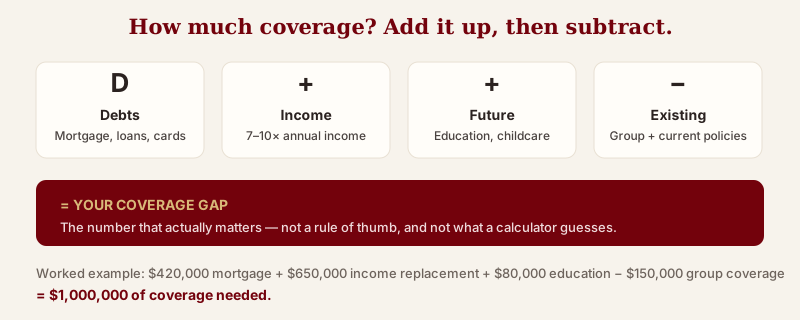
Work out the number rather than guessing at it:
- Current mortgage balance — the actual figure, not what you borrowed originally.
- Plus other debts — car loans, lines of credit, credit cards, anything personally guaranteed.
- Plus income replacement — your annual income multiplied by the years your family would genuinely need support.
- Plus future costs you intend to cover — education, childcare if a stay-at-home parent died.
- Minus existing coverage — group life through work, plus any personal policies.
What remains is the gap. There is a calculator on the life insurance page that does the arithmetic and shows the breakdown.
Two things that quietly make the gap worse
Group coverage counted as though it were permanent. Employer life insurance is typically one or two times salary, and it ends when the job does. Counting it as part of your protection is reasonable; counting on it being there in ten years is not.
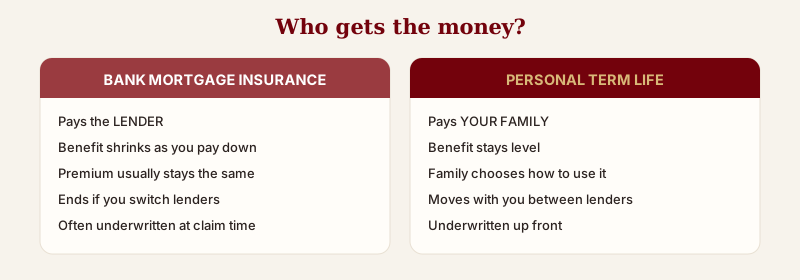
Declining creditor insurance counted at its original value. If your mortgage protection came from the lender, the benefit shrinks as the balance falls — while the premium generally does not. Someone eighteen years into a mortgage may be paying the same for a fraction of the coverage they think they have.
Mortgage renewal. You already have the numbers in front of you, you know the current balance, and if you are switching lenders it matters doubly — creditor insurance generally ends when you move, and you would have to requalify at your current age and health.
What to do about a gap
Usually less dramatic than people fear. Term insurance is priced far lower than most people estimate, and topping up existing coverage with an additional term policy is straightforward if you are in reasonable health.
Two rules if you are making changes. Never cancel existing coverage until the replacement is issued and in force — approval is not the same as active. And if your health has changed since you bought your current policy, that policy is more valuable than it looks; check whether it has a conversion privilege before doing anything with it.
If you would like the gap calculated against your actual numbers, that takes about twenty minutes and costs nothing.
Working out your own number
The calculation is simple arithmetic, and most people have never done it.
| Step | What to write down |
|---|---|
| 1. Mortgage balance | Today's figure, from your lender statement — not the original amount |
| 2. Other debts | Car loan, line of credit, credit cards, any personal guarantee |
| 3. Income replacement | Your net income × the years your family would need it |
| 4. Childcare and education | What changes if one parent is gone — often more than expected |
| 5. Final costs | Funeral, estate administration, any tax owing on death |
| 6. Subtract existing cover | Personal policies, plus group coverage at its current value |
| 7. Subtract liquid savings | What the family could genuinely access quickly |
Whatever is left is the gap. Most households doing this honestly for the first time find a number considerably larger than they assumed, and the reason is usually step six.
Why group coverage flatters the picture
Employer life insurance feels like a solution and behaves like a placeholder. Three reasons it rarely closes a mortgage-sized gap:
- The amount is small. A common formula is one or two times salary. Against a Toronto-area mortgage that is a fraction of what is needed.
- It ends with the job. Redundancy, a career change, retirement, or a long illness that ends employment all end the coverage — frequently at the exact moment health has changed and replacing it is hardest.
- It is not yours to control. The employer chooses the insurer, the amount and the terms, and can change them.
Group coverage is a genuine benefit and worth having. It is simply not a foundation, and counting it at full value when you calculate the gap is how households end up underinsured without knowing it.
What makes the gap grow quietly
A policy bought at the right level does not stay right. Four things move the number without anyone noticing:
- Refinancing or moving. A larger mortgage against unchanged coverage is the most common cause.
- A second child. Childcare and education costs roughly double while the policy stays put.
- A partner leaving work. The household drops to one income, so replacing that income matters more, not less.
- A term policy quietly nearing its end. A 20-year term bought when a child was born expires around the time university starts.
Closing a gap without starting again
Discovering a shortfall does not mean replacing what you have. Usually it means adding to it.
- Keep the existing policy. It was issued at a younger age and possibly better health; cancelling it to buy one larger policy often costs more overall.
- Add a second term policy for the shortfall, with a term matching what it is protecting — the remaining mortgage years, or the years until children are independent.
- Check any conversion privilege on the existing policy before deciding. It may let you convert to permanent coverage later without new medical evidence.
- Do it in the right order. New cover in force first, then adjust anything else. Never the reverse.
If you would rather see the arithmetic for your own numbers, the life insurance page sets out how the calculation works, and reviewing what you already hold costs nothing.
A worked example
Take a couple in their late thirties in the Greater Toronto Area. Mortgage balance $620,000. Two children, aged four and seven. Combined net income around $150,000, weighted toward one earner. Group life coverage of twice salary on the higher earner, nothing on the other. Savings of $40,000 they could actually reach quickly.
Run the arithmetic on the higher earner: $620,000 mortgage, plus roughly $30,000 of other debt, plus income replacement of perhaps $90,000 net for twelve years until the younger child is independent, plus childcare and education, plus final costs. Subtract group coverage of about $180,000 and the $40,000 in savings.
The shortfall lands comfortably over a million dollars — against a group policy that would also disappear the moment that job ended. And the second parent, carrying no coverage at all, represents a childcare cost of many years that nobody has insured.
The figure is startling the first time people see it. What is usually more startling is the premium: term coverage at that level for healthy people in their thirties costs less per month than most families expect, because the risk of dying in your thirties is genuinely low. That is exactly why it is the right time to buy.
Three objections worth answering
"My spouse could sell the house." They could. Whether a grieving partner should be forced to move two young children out of their home, school and neighbourhood in the same year is a different question. Insurance buys the choice.
"We'll get to it once things settle down." Premiums rise with age, and health changes without warning. The cheapest, easiest time to buy coverage is always now, and it gets steadily less so.
"We have group coverage at work." Worth having, not a foundation — small, temporary, and controlled by someone else. Counting it at full value is the most common reason a gap goes unnoticed.