Families with a parent in their eighties often expect to hear that Super Visa insurance isn't available. It is. The choice is narrower, the price is higher and pre-existing cover takes more care, but a parent of 80 or 85 can still meet the Super Visa requirement.
Who still quotes at 80 and 85
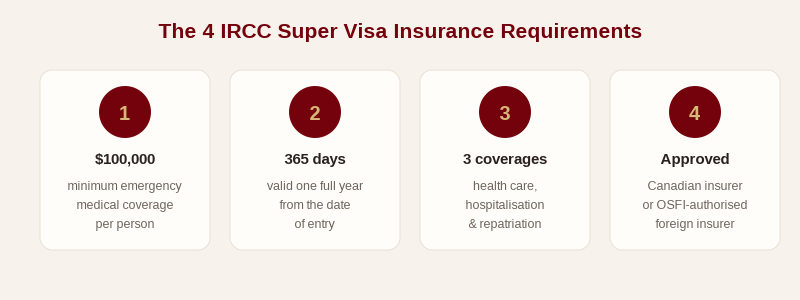
Most of the insurers I compare for Super Visa have rates at age 80 for $100,000 of cover. The details matter, because "available" can mean only one kind of plan, or only with a $1,000 deductible.
| Insurer | At 80 | At 85 |
|---|---|---|
| 21st Century | With or without pre-existing cover | With or without pre-existing cover |
| Insure Canada | $1,000 deductible; with or without pre-existing cover | $1,000 deductible; without pre-existing cover |
| JF | With or without pre-existing cover | With or without pre-existing cover |
| Manulife | With or without pre-existing cover | With or without pre-existing cover |
| Secure Travel (RIMI) | $1,000 deductible; with or without pre-existing cover | $1,000 deductible; without pre-existing cover |
| Travelance | With or without pre-existing cover | With or without pre-existing cover |
| TruStone | Without pre-existing cover | Without pre-existing cover |
| TuGo | With pre-existing cover | With pre-existing cover |
| Destination | Not quoted for $100,000 at 80 or over | |
| GMS | Must be under 80 when the policy starts | |
This reflects the rate sheets effective 1 July 2026 for $100,000 of coverage. Insurers set their own maximum ages and change them, so I confirm the age limit for your parent's exact birth date when quoting.
What it costs
At 80, the lowest annual premiums across these insurers run from about $3,500 for a plan without pre-existing cover and a $1,000 deductible, to almost $9,000 for a plan with pre-existing cover and no deductible. Those are "from" prices for a healthy applicant; medical answers can raise them.
Two things move the price most at this age:
- Pre-existing cover. At 80 it adds anywhere from about 10% to more than 70% to the premium, depending on the insurer, and it is also the part most likely to matter.
- The deductible. A $1,000 deductible saves roughly 20% on most plans, and with two insurers it is the only option at 80.
Monthly payments are available with several insurers at this age, which helps when the annual figure is a shock. I explain how the fees work in monthly versus paying the year up front.
Pre-existing conditions after 80
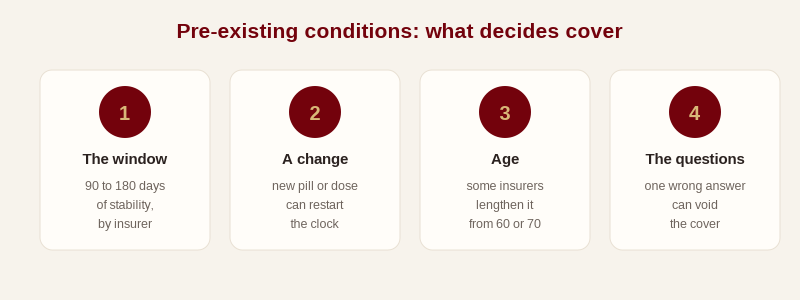
This is where most of the work is. By 80, very few parents have no medical history, so a plan that excludes pre-existing conditions leaves out most of the real risk. But pre-existing cover narrows with age:
- Some insurers stop offering it at 80 (TruStone in the rate sheets) or at 85 (Insure Canada and Secure Travel).
- Insure Canada and Secure Travel require every answer on the medical declaration to be no from 70 to 84, or pre-existing cover doesn't apply.
- Stability periods are usually 180 days at this age.
I go through how each insurer defines a stable condition in pre-existing conditions and stability periods.
Waiting periods can be longer at older ages if the policy is bought after arrival. JF, for example, applies a 15-day waiting period for sickness from age 86 when the policy is bought after arrival, against 48 hours for younger applicants within 30 days. Buy the policy before your parent leaves home and start it on the arrival date.
Is $100,000 enough at this age?
It is the IRCC minimum, and it is what most families buy. At 80 or older, I talk through whether a higher amount makes sense. A serious heart event with surgery and a week in hospital can use most of $100,000 at non-resident rates, and the premium for more coverage is often a smaller step than families expect. It's a judgement call, and it depends on what the family could pay if the bill went over the limit.
Where to start
Write down your parent's date of birth, their medications and doses, and the date of any change in the last year. With those, I can tell you within a day which plans they qualify for and what each would cost. You can also run the numbers in the quote tool first.
General information only. This article explains concepts in general terms and is not financial, tax, legal or insurance advice for your particular situation. Policy terms differ between insurers and change over time, so read the wording of the policy you are buying.