A Super Visa lets parents stay for years, so most of them don't stay put. There's a long weekend in New York, a family wedding back home, a winter spent with another child in another country. Families usually ask about the insurance afterwards. It's better to ask before.
Two different things are going on, and insurers treat them differently:
- A side trip: a trip from Canada to another country, then back to Canada. A week in the US is the classic example.
- A visit home: a trip back to the parent's own country, the place they normally live.
The general pattern
Super Visa insurance is emergency medical cover for a visitor in Canada. Anything outside Canada is an extra the insurer chooses to add, with its own limits. In the plans I compare:
- Most allow side trips, usually as long as the majority of the coverage period is spent in Canada.
- Some limit each side trip to a set number of days.
- Most do not cover medical costs during a visit home, even when the policy stays in force.
- Some need to be told before your parent leaves Canada.
The rules, insurer by insurer
| Insurer | Side trips outside Canada | Visits home |
|---|---|---|
| 21st Century | Allowed; the insurer must be told before leaving Canada | Check with the insurer before travelling |
| Destination | Covered up to the sum insured | Check the wording |
| GMS | Up to 30 days, starting and ending in Canada, no more than half the coverage period | Not a side trip; check before travelling |
| Insure Canada | Covered, with proof of leaving and returning to Canada | Check the wording |
| JF | Must start or end in Canada, up to 49% of the trip, at least 51% in Canada | Not covered: side trips can't be to the home country |
| Manulife | Start and end in Canada, up to the lesser of 30 days or 49% of covered days | Not covered |
| Secure Travel (RIMI) | Covered, with proof of leaving and returning to Canada | Check the wording |
| Travelance | Up to 45 days per trip; more than half of covered days in Canada | Check the wording |
| TruStone | Trips outside Canada allowed without cancelling, but not covered except in direct transit to or from Canada | Allowed without cancelling; not covered |
| TuGo | Travel anywhere, if most of the coverage period is in Canada and Canada came first | Allowed without ending the policy; not covered while there |
These are summaries of each insurer's plan details. The policy wording governs, and a few of these rules have further conditions, such as a limit per trip or a requirement to keep travel documents.
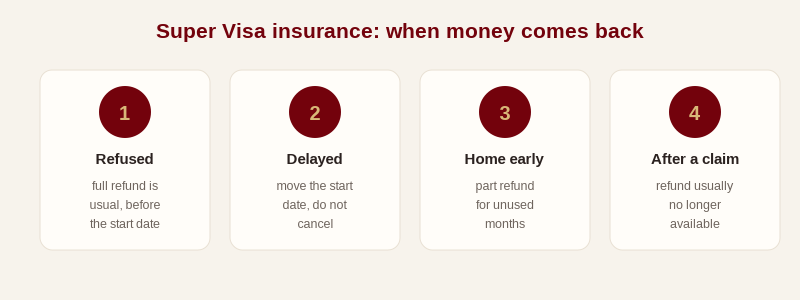
Several insurers ask for proof of when a parent left Canada and when they came back. Keep boarding passes or the airline itinerary for every trip, even a short one. They are also what you need to claim a refund for unused months if a parent goes home early.
Why visits home are rarely covered
Travel insurance is built around being away from home. The parent's home country is, by definition, not away, so insurers don't cover medical costs there. What some do allow is for the policy to stay in force while your parent is home, so it doesn't have to be cancelled and bought again on return.
That matters more than it sounds. If a policy is cancelled and a new one bought later, the new one can come with a fresh waiting period and fresh medical questions, and a condition that was stable last year may not be stable now.
Long trips home
If your parent will spend several months back home, there are three things to weigh:
- The majority rule. Several policies require most of the coverage period to be spent in Canada. A long trip home can break that rule.
- Refund versus continuity. Cancelling for a partial refund saves money now but means re-qualifying later. Keeping the policy keeps the cover in place for the return.
- The visa itself. IRCC expects valid insurance whenever your parent enters Canada. Make sure there is cover in force on the day they come back.
Before any trip
Three checks take five minutes:
- Read the side-trip clause of the actual policy, or ask me to.
- Count the days: the trip, and the total time outside Canada in the policy year.
- If the insurer wants notice, give it in writing before your parent leaves.
If you're still choosing a policy and you already know your parents will travel, tell me when you get a quote. It changes which plans make sense.
General information only. This article explains concepts in general terms and is not financial, tax, legal or insurance advice for your particular situation. Policy terms differ between insurers and change over time, so read the wording of the policy you are buying.