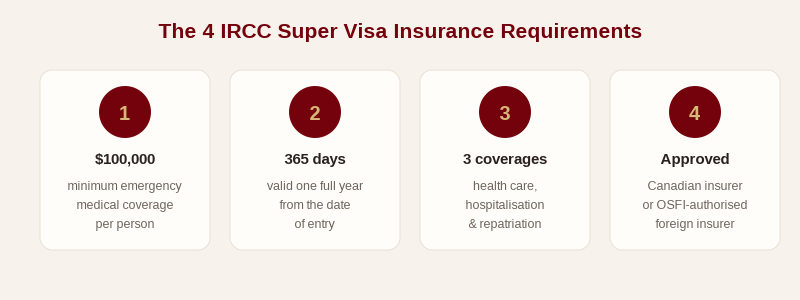
A Super Visa application needs proof that the insurance has been paid for. A quote is not enough. So families pay for a full year of cover, often a few thousand dollars for two parents, before they know whether the visa will come through.
The first question I am asked is always the same: what happens to that money if the visa is refused? The second comes a few months later: my parents want to go home early, do we get anything back?
The short answers are yes, and usually yes in part. The details depend on the insurer, and they are worth knowing before you pay.
If the visa is refused
The Super Visa insurers I work with normally refund the premium in full if the visa is refused, as long as the policy has not started. You send the refusal letter, the insurer cancels the policy and the money goes back to the card or account you paid with.
Three things can get in the way.
- The start date has passed. If the policy's start date arrives while you are still waiting for a decision, the insurer may treat the policy as active. Some will still refund in full with a refusal letter and proof your parents never travelled. Others will only refund part. The fix is easy: if a decision is taking longer than you expected, move the start date forward before it arrives. I cover this in choosing and changing the start date.
- An administration fee. Some insurers keep a small fee on any cancellation. Ask whether one applies on a refusal.
- A deadline. Some policies want the refund request within a set time after the refusal. Send the letter as soon as you have it.
A refusal is not the end of the application either. Many families reapply once they have fixed what the officer was not satisfied with. If you plan to reapply soon, ask whether the insurer can hold the policy and move the date instead of refunding and starting again.
If the visa is approved but travel is delayed
This is the most common situation and the simplest. Visas arrive late, flights get moved, a parent's health or a family event pushes the trip back.
Do not cancel. Ask to change the start date. Before a policy begins, insurers will normally move the date at no cost, and the full year of cover then runs from the new date. Some will reprice if a birthday falls in between and moves your parent into the next age band.
You may see this described online as putting the policy "on hold". There is no special hold status. It simply means the start date has been moved to a later day, and it has to be done before the original date arrives.
If your parents go home early
Parents often come for a year and leave after seven or eight months. A winter is enough for some people. Most Super Visa policies will refund the unused part, with conditions.
| Condition | What it usually means |
|---|---|
| No claim has been made | If the policy has paid a claim, or one is open, most insurers will not refund the unused months. |
| Proof of departure | A boarding pass, ticket or passport stamp showing the date they left Canada. |
| Request made promptly | The refund is counted from the day you ask or the day they left, depending on the insurer. Asking late can cost you a month. |
| Fees and minimums | An administration fee may be deducted, and some policies keep a minimum premium however short the stay. |
| How the refund is counted | Some insurers refund by the day. Others use a table that gives back less than the straight daily share. |
That last row matters more than it looks. Two policies with the same premium can return quite different amounts after eight months. If there is a real chance your parents will leave early, tell me when we compare plans and I will show you the refund wording next to the price.
An example of how the amount can differ
Say the premium for one parent was $2,400 for the year, and she flies home after eight months with no claims. These figures are only to show the method.
| Method | How it is counted | Refund |
|---|---|---|
| By the day | 4 unused months of 12, so one third of $2,400, less a $50 fee | $750 |
| By a refund table | The policy's table gives back a set percentage for each month completed, lower than the straight share | Less than $750 |
Neither method is unfair. They are simply different, and you can only choose between them before you buy.
When only one parent leaves
Parents are usually insured on one policy as a couple. If your father goes home after five months and your mother stays the full year, his part of the premium can normally be refunded on the same terms as above, and her cover carries on. Ask the insurer to confirm her cover in writing once he has been removed. If the couple price included a discount, her premium may be recalculated as a single traveller.
If the visa is approved but they decide not to come
This happens more than you would think. A parent's health changes, or a family matter at home takes over. If the policy has not started, treat it the same way as a delay: either move the start date if the trip is only postponed, or cancel before the start date for a refund. Insurers handle a cancellation before the start date without difficulty. Some keep an administration fee. The one thing not to do is nothing, because once the start date passes you are in early-return territory with no departure date to prove.
After a claim
Once a claim has been paid, the unused premium is normally not refundable. The insurer has carried the risk and paid out on it.
People sometimes ask whether they should pay a small bill themselves to keep the refund. For a walk-in clinic visit that costs less than your deductible, there is nothing to claim anyway. For anything larger, use the insurance. That is what you bought it for, and a refund of a few hundred dollars is not worth an unpaid hospital bill.
Monthly payment plans
Several insurers let you pay for Super Visa cover month by month. If the visa is refused before the start date, the deposit and any instalments paid are normally returned in the same way as a full payment. If your parents leave early, you are usually stopping future instalments, not waiting for money back.
Read the cancellation terms on a monthly plan carefully. Some charge a setup fee that is not returned. Some require a minimum number of payments. And stopping payments without telling the insurer is not the same as cancelling. The policy can lapse, which matters if your parents are still in Canada. There is more in monthly versus annual payment.
How to ask for a refund, step by step
- Tell the insurer or your advisor straight away. On a refusal, the day the letter arrives. On an early return, before the flight if you can.
- Send the document. The refusal letter from IRCC, or proof of departure such as the boarding pass and the passport page with the exit stamp.
- Confirm there are no claims. The insurer will check. If a bill is still outstanding from a clinic visit, say so.
- Check where the money is going. Refunds return to the card or account that paid. If that card has been replaced or closed, tell the insurer before they process it.
- Keep the confirmation. Ask for an email stating the amount and the date. If you are reapplying, you may need to show the old policy was cancelled.
What you will not get back
- Premium for months your parents were in Canada, whether or not they saw a doctor.
- Usually, anything once a claim has been paid.
- Fees the policy says are non-refundable.
- Money for a policy that was cancelled without the documents the insurer asked for.
Five questions to ask before you pay
- If the visa is refused, is the refund 100 percent, and is there any fee?
- What happens if the start date passes while we are waiting for a decision?
- Can I change the start date for free, and how many times?
- If my parents leave early with no claims, how is the refund worked out, and is there a minimum premium?
- What documents will you need, and how long does a refund take?
Ask for the answers in an email, or ask where they are in the policy wording. A sentence in writing is worth more than a promise on the phone a year later.
If you bought the policy through me, send me the refusal letter or the proof of departure and I will take the refund request to the insurer for you.
If you are getting ready to apply, you can compare Super Visa quotes from the insurers I work with, or ask me which plans have the refund terms that suit your family. The full list of what IRCC asks for is in Super Visa insurance requirements.
General information only. This article explains concepts in general terms and is not financial, tax, legal or insurance advice for your particular situation. Policy terms differ between insurers and change over time, so read the wording of the policy you are buying.