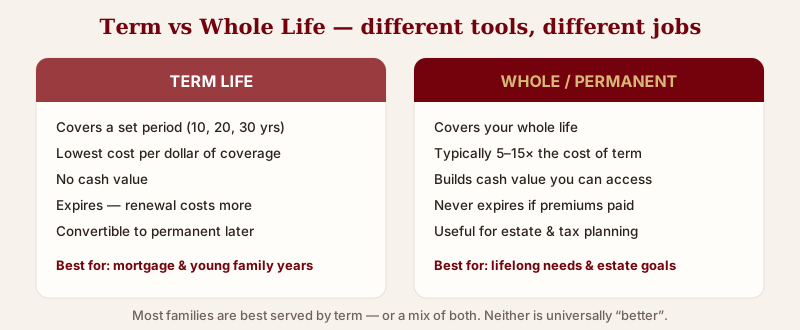
Term life insurance ends. That is the trade for its low cost, and it is entirely reasonable — but the ending catches people unprepared, because the renewal premium bears little resemblance to what they have been paying.
Why renewal is so expensive
Your original premium was priced on your age when you bought the policy. A 20-year term bought at 35 was priced on a 35-year-old.
At renewal you are 55. The renewal premium reflects a 55-year-old's mortality risk, and many policies then increase annually rather than staying level. It is not a penalty; it is simply the honest price for insuring someone twenty years older.
The good news is that renewal is usually guaranteed — you can renew regardless of health. That guarantee is genuinely valuable for someone who has become uninsurable, and worthless for someone healthy who could buy cheaper coverage elsewhere.
Your three options
Let it lapse
Entirely reasonable if the need has ended. If the mortgage is cleared, the children are independent, and your spouse would be financially secure without you, you may simply not need coverage any more. Not every policy should be replaced.
Renew
Makes sense mainly if your health has deteriorated and you could not qualify for new coverage. The guaranteed renewal is then your protection. Expect a substantial increase, and check whether the premium then rises each year.
Buy new coverage or convert
If you are still in reasonable health and the need continues, a new term policy is usually far cheaper than renewing the old one. If the need has become permanent, converting — where your policy allows it without medical evidence — may be the better route.
The timing that matters
Here is the practical point. Act three to five years before expiry, not three months.
At 52 you can apply for new coverage as a 52-year-old, be underwritten, and lock in a rate. At 55, with the policy expiring next month, you are older, more rushed, and if underwriting turns up a problem you have no time to explore alternatives.
Applying early also means you keep the existing policy in force while the new one is underwritten — no gap, and a fallback if the application does not go well.
Approval is not the same as in force. Wait for written confirmation that the new policy is active before letting the old one lapse. This applies at every stage of life and it is the most common avoidable mistake in insurance.
Reassess the need honestly
Twenty years on, your situation has changed. Run through it properly:
- What debt remains? A mortgage nearly paid off needs far less coverage than one at the start.
- Who still depends on you? Adult children generally do not; a spouse relying on your pension may.
- What would your death cost? Consider the tax on a deemed disposition — a cottage or portfolio with large accrued gains can create a real bill.
- Is there a permanent need? A dependant with a disability, an estate liability, a business obligation.
Many people need less coverage than before. Some need a smaller permanent policy rather than a large term one. A few need more than they realise, because their estate has grown and the tax with it.
If your health has changed
Then your existing policy is more valuable than it looks, and two features matter enormously: the guaranteed renewal, and the conversion privilege if it is still available.
Check whether conversion is still open — it often expires before the term does. Converting to permanent coverage may cost more per year than renewing initially, but it does not expire again and it will not escalate annually.
In this situation, do not shop around casually. Applying and being declined creates a record. Get advice on which route is realistic before submitting anything.
What to do
- Find your expiry date and your conversion deadline.
- Diarise a review three to five years before expiry.
- Reassess the need honestly — it may be smaller, or different in kind.
- If healthy, price new coverage rather than accepting renewal.
- If not, examine renewal and conversion before applying anywhere.
- Never create a gap.
If you have a term policy approaching its end and want the options laid out against your actual situation, that is a straightforward conversation and worth having early rather than late.
Why the renewal premium is such a shock
A level term policy charges one premium for the whole term, priced on your age and health at the start. At the end, most policies renew automatically — but on a yearly basis, repriced at your attained age, with no new medical.
That renewal is deliberately expensive, for a reason worth understanding. The insurer must assume the worst about anyone who chooses to renew, because the healthy people leave and buy fresh cover while those who cannot pass a medical stay. Pricing has to cover that, so the renewal rate reflects a pool of people who are, on average, in poor health.
It is not a penalty. It is the price of cover with no health questions asked, and for someone genuinely uninsurable it can still be the right buy.
Your options, side by side
| Option | Medical needed | Cost | Best when |
|---|---|---|---|
| Let it lapse | — | Nothing | The need has genuinely ended |
| New term policy | Yes | Lowest, if you qualify | Health still reasonable |
| Renew the existing one | No | Highest, rising yearly | Short bridge, or uninsurable |
| Convert to permanent | No | High but level | Health changed and the need is lifelong |
The fourth row is the one people miss, and it often has a deadline that arrives before the term ends — see converting term to permanent. Check it before you do anything else, because once it passes that option is gone for good.
Start two years out, not two months
This is the single most useful thing on this page. A new application takes weeks, sometimes months if the insurer asks for records from your doctor. Leaving it until the renewal notice arrives means deciding under time pressure, which is how people end up paying renewal rates by default.
| When | What to do |
|---|---|
| 24 months before | Check the conversion deadline and whether the need still exists |
| 18 months before | Get quotes on a new policy; apply if the numbers work |
| 12 months before | New policy should be in force; only then cancel the old one |
| Renewal date | Nothing left to decide |
Never cancel the old policy until the new one is actually in force. Approved is not in force. A gap of even a few weeks is an uninsured gap, and people have died in them.
Ask honestly whether you still need it
Term insurance is supposed to end. It was bought to cover a stretch of years when other people depended on your income, and if that stretch is over, letting it lapse is a legitimate answer rather than a failure to plan.
Run through it honestly. Is the mortgage paid? Are the children independent? Does your spouse have enough without your income? Is there enough saved that a death would not change anyone's standard of living? If all four are yes, the money may be better spent elsewhere.
Where a need usually remains: a dependent who will never be independent, a business that owes money, a tax bill at death on a cottage or investments, or a spouse whose pension drops sharply when you die.
If your health has changed
This is where the decision gets real, and where the order matters.
- Check the conversion option first. No medical, and the health class from your original application still applies.
- Apply for new cover anyway if conversion is gone. A condition does not automatically mean a decline — many are accepted at standard or mildly rated. See life insurance with pre-existing conditions.
- Consider converting part rather than all, keeping a permanent core at a manageable premium.
- Look at non-medical options if you are declined — smaller amounts, no health questions, higher cost per dollar. See non-medical insurance.
- Renew yearly as a last resort, and treat it as a bridge while you arrange something else.
What to do now
Find the policy. Note two dates: when the term ends, and when the conversion privilege ends. Those two dates drive every decision on this page, and most people cannot name either.
If you would like someone to read the contract with you and price the alternatives before the renewal notice lands, get in touch — there is no cost for the conversation. The life insurance page covers the products themselves.
A worked example
Take someone who bought $500,000 of 20-year term at 40. The term ends at 60. Three plausible situations, three different answers:
| Situation | Sensible move |
|---|---|
| Mortgage paid, children working, good health | Let it lapse, or keep a small permanent policy for final expenses and tax |
| Still has a mortgage and a spouse who needs the income | Apply for a new 10 or 15-year term now, while 60 is still insurable |
| Diagnosed with something at 57 | Convert before the privilege ends; renew only as a bridge |
Notice that only the third case involves renewing, and even there it is temporary. Renewal is rarely a destination.
If you have already let it lapse
A policy that has lapsed is not always gone. Most insurers allow reinstatement within a set window — commonly up to two years — if you pay the missed premiums and provide evidence of insurability. It is worth one phone call before assuming you have to start over, because reinstating an old policy priced at a younger age can be considerably cheaper than a new one.
If the window has closed, treat it as a fresh application and be realistic: the price reflects your age now. That is still better than remaining uninsured while a dependent relies on your income.