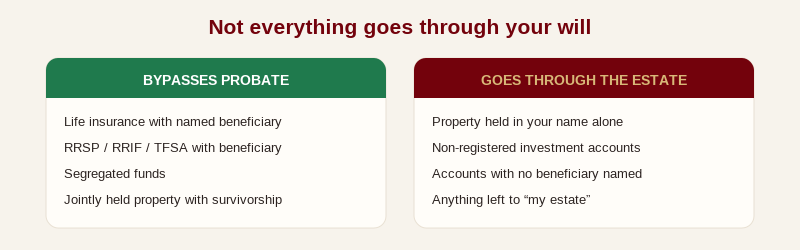
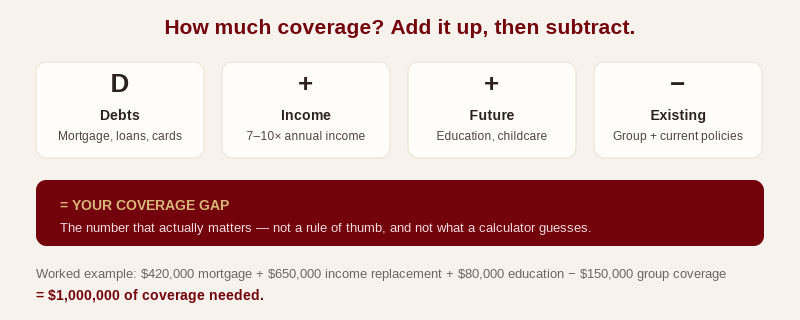
People going through a separation have a great deal to think about, and insurance is understandably near the bottom of the list. It is also the item most likely to be left untouched, which is how policies end up paying an ex-spouse twenty years later.
Divorce does not update your beneficiaries
The most important point, and the most commonly assumed away.
A divorce decree does not automatically remove a former spouse as beneficiary on a life insurance policy, an RRSP, a TFSA or a pension. Rules vary by province and by account type, and litigation over this is common — but the reliable position is to assume nothing changes unless you change it.
Sit down with a list of every policy and registered account and check who is actually named. Not who you believe is named — log in and look. This takes an afternoon and prevents an outcome that cannot be corrected after death.
Where it is more complicated
You may not be free to remove an ex-spouse, and it is important to know which situation you are in.
Separation agreements and court orders frequently require one party to maintain life insurance naming the other, or the children, as security for spousal or child support. The logic is sound: if the payor dies, the support obligation stops, and the insurance replaces it.
Where such an obligation exists, changing the beneficiary can put you in breach of a court order. Some agreements go further and require the ex-spouse to be named as an irrevocable beneficiary, which means you cannot change it without their written consent.
Check your agreement before changing anything. If the obligation exists, comply with it — and diarise when it ends, because these requirements are often tied to the duration of support and people keep paying for coverage long after the obligation lapses.
Where insurance secures a support obligation, the amount required usually declines over time as the remaining support shortens. Some agreements permit coverage to reduce accordingly, or allow the payor to own the policy while naming the recipient irrevocably. Both can save money while satisfying the order.
Group benefits
An ex-spouse generally loses eligibility as a dependant on your employer's health and dental plan once you are divorced, and often on separation. Timing varies between plans.
Two practical consequences. If your children remain on your plan, confirm that is documented and that your ex knows how to submit claims. And if you were covered under your ex-spouse's plan, you are about to lose health and dental coverage — check whether their plan offers a conversion option, which usually has a short window measured in weeks.
Your own coverage need has probably increased
Counterintuitive but usually true.
Before separation, two incomes supported the household and either parent could partly cover for the other. After separation, you may be supporting children on one income, paying for two households, and carrying support obligations. If you die, there is no second parent's income already in that household to absorb it.
So the amount of life insurance that was adequate as a couple is frequently inadequate afterwards — for both parties. This is worth recalculating rather than assuming existing coverage still fits.
Watch for policies lapsing in the confusion
A mundane but real risk. When bank accounts are separated and payments redirected, premiums sometimes stop being paid — occasionally because each party assumed the other was handling it. A lapsed policy pays nothing.
Confirm which account each premium comes from and make sure it is one that will still exist next month.
A checklist
- Read the separation agreement for any insurance obligations before changing anything.
- List every policy and registered account and check the actual named beneficiary.
- Update designations where you are free to do so, including contingent beneficiaries.
- Appoint a trustee if minor children are beneficiaries.
- Confirm premium payments are coming from an account that will remain open.
- Recalculate your coverage need on your new circumstances.
- Diarise when any court-ordered coverage obligation ends.
- Update your will — a separate job, and one for a lawyer.
None of this is urgent in the first week. It is worth doing within the first few months, while the paperwork is out and the details are fresh.
What changes automatically, and what does not
| Item | Changes on its own? |
|---|---|
| Life insurance beneficiary | No — your ex generally stays named until you change it |
| RRSP, RRIF, TFSA designations | No |
| Group life at work | No |
| Pension survivor election | Often locked once made; check the plan |
| Spouse's coverage under your group plan | Usually ends on divorce, sometimes on separation |
| A will | Ontario law changed some outcomes on separation — do not rely on it |
The first row is the one that causes real harm. People separate, assume the paperwork sorted itself out, and die years later with an ex-spouse still named. The insurer pays the person on the form, not the person you would have chosen.
Being separated rather than divorced changes nothing about a designation you control. If you are living apart, this is already worth doing.
When you cannot simply change it
Two situations where the designation is not yours to alter.
An irrevocable designation. If your ex is named irrevocably, you need their written consent to change it — and possibly to surrender the policy or take a loan against it. Check which one your policy records before assuming.
A separation agreement or court order requiring cover. Where support obligations exist, agreements commonly require the payer to keep life insurance naming the recipient, so that support continues if they die. This is normal and sensible, and breaching it is a legal problem, not an administrative one.
Where that applies, two practical points are worth negotiating. Ask that the required amount declines as the obligation does — support for a twelve-year-old does not run forever, and insuring the original figure for twenty years overpays. And ask for a right to proof the policy is in force, because the common failure is not malice but a lapsed premium nobody noticed.
Your own need has probably gone up
This runs against intuition. People assume separating reduces the need for life insurance. It usually increases it, for a straightforward reason: there is no longer a second adult in the household to absorb the shock.
- One income now carries the household rather than two.
- Childcare costs rise when the other parent is not down the hall.
- Support obligations need funding if the payer dies.
- The parent with primary care needs cover too — if they die, the other parent faces full-time care and the cost of replacing everything that parent did.
That last point gets missed constantly, because the focus is on insuring the person who pays support. Both parents matter. See how much life insurance do I need.
Policies lapse in the confusion
A quiet risk during separation: premiums were paid from a joint account that is now closed, or by the spouse who no longer feels responsible for it. The policy lapses, nobody notices, and the cover is gone — sometimes the very cover an agreement requires.
- Move every premium to an account you control.
- Ask each insurer to send you notices directly, at your new address.
- Where an agreement requires cover, ask for confirmation in force each year — most insurers will provide it with the owner's consent.
- Check for a reinstatement window if something has already lapsed; many policies allow it within a couple of years.
Group benefits and the children
A spouse's coverage under a group plan usually ends at divorce, and sometimes earlier. Children normally remain covered under either parent's plan, and where both parents have coverage, coordination of benefits can leave the children better covered than before — worth checking rather than assuming.
For the spouse losing coverage, there is often a conversion right to an individual policy without medical evidence, exercisable within a short window — frequently 31 to 60 days. Miss it and you are back to full underwriting. See leaving your job benefits for how those conversion rights work.
A checklist
- Change beneficiaries on every policy and registered account — unless an agreement prevents it.
- Check your group life at work; it is the one people forget.
- Update your will and powers of attorney with a lawyer.
- Recalculate how much cover you actually need now.
- Insure both parents, not only the one paying support.
- Move premiums to your own account and confirm policies are in force.
- Diarise an annual check that any court-required cover is still active.
The legal pieces need a family lawyer. The insurance pieces I can go through with you — get in touch, or see beneficiary designations.
Health and dental cover for the children
Where both parents have workplace plans, children can usually stay covered under both, and coordination of benefits means one plan pays first and the other may cover part of the remainder. That can leave them better covered than under a single plan — but only if both parents keep the children listed and actually submit to both.
This is worth settling in writing rather than informally. Who submits first, who holds the benefit cards, how orthodontics or counselling are shared. These are the costs that generate arguments years later, and a sentence in the agreement prevents most of them.
If only one parent has a plan, note the cost of losing it: replacing family dental and drug coverage privately is a real monthly expense and belongs in the support calculation rather than being discovered afterwards.