Buying a home involves several products all described loosely as "insurance," and they do entirely different jobs. People sign for some without understanding them and skip the one that matters most.
Here is what each actually is.
1. Mortgage default insurance — mandatory under 20% down
Often called CMHC insurance, though other providers exist. If your down payment is less than 20%, this is required.
Critically, it protects the lender, not you. If you default and the home sells for less than owed, the insurer covers the lender's shortfall — and may pursue you for it. You pay the premium, usually added to the mortgage, and receive no personal protection.
Nothing to decide here; it is simply a cost of a smaller down payment. But understand you are not buying protection for yourself.
2. Property insurance — effectively mandatory
Home insurance covering the building and contents. Lenders require it, and you would want it regardless.
Two things worth checking rather than accepting defaults: whether you have guaranteed replacement cost or a capped amount, and whether you need overland water or sewer backup coverage, which is frequently excluded by default and increasingly relevant.
3. Title insurance — usually worth it
Protects against defects in the property's title: fraud, undisclosed liens, encroachments, survey problems, or someone with a legitimate claim on the property.
Usually a modest one-time premium at closing, and it protects for as long as you own the home. Title fraud is a real and growing problem in Canadian cities, and this is the product that responds to it.
Your lawyer will usually arrange it. It is generally good value.
4. Mortgage life insurance — the one to think about
Offered at the mortgage desk, often signed in a couple of minutes. It pays off the mortgage if you die.
For most buyers, a personal term life policy is the better instrument, for four reasons:
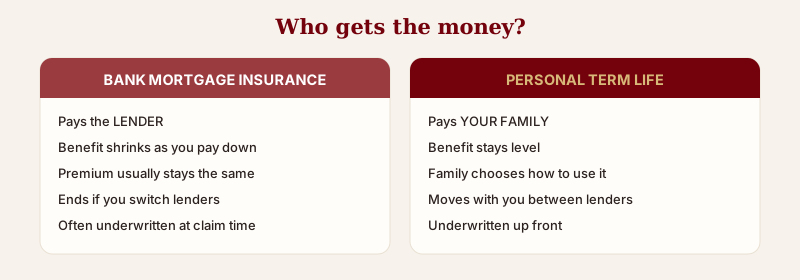
Who gets the money. Creditor insurance pays the lender. Term life pays your family, who decide whether to clear the mortgage, keep a cash reserve, or fund living costs.
The benefit shrinks. Creditor coverage declines with your balance while the premium usually does not. Term coverage stays level, so the surplus protects everything else.
Underwriting timing. Creditor insurance is often assessed at claim time. Term life is underwritten up front, so you know you are covered.
Portability. Creditor insurance ends if you switch lenders. A personal policy moves with you.
Apply for personal term life before or during the mortgage process, sized to the mortgage plus your family's wider needs. Once it is in force, decline the lender's coverage. If you already accepted creditor insurance, do not cancel it until the replacement is confirmed in force.
The one nobody mentions
Disability. During your working years, being unable to work for an extended period is more probable than dying — and it threatens the mortgage payment just as directly.
Lenders sometimes offer creditor disability coverage, which carries the same structural issues as creditor life insurance. A personal disability policy is generally better, and if you have group coverage at work, understand that it ends with the job.
Nobody raises this at the mortgage desk. It belongs on the list.
A checklist for buyers
- Mortgage default insurance — mandatory under 20% down, protects the lender.
- Property insurance — required; check replacement cost and water coverage.
- Title insurance — usually worth the modest one-time cost.
- Personal term life — arrange before closing, then decline creditor coverage.
- Disability coverage — review it, since the mortgage depends on your income.
- Update beneficiaries once the purchase completes.
Buying a home is usually the moment people first genuinely need life insurance, and it is also when they are busiest and most likely to sign whatever is put in front of them. A short conversation before closing tends to save both money and trouble.
Four products, four different jobs
| Product | Who it protects | Who pays | Optional? |
|---|---|---|---|
| Mortgage default insurance | The lender | You | No, under 20% down |
| Property insurance | You and the lender | You | In theory; no lender will fund without it |
| Title insurance | You and the lender | You, once | Yes, but usually worth it |
| Mortgage life insurance | The lender | You | Yes |
Read the second column again. Of the four things a buyer is asked to pay for, two protect the lender rather than the buyer. That is not a scandal — it is simply how lending works — but it explains why the pitch at the signing table rarely makes the distinction clear.
Why the lender's offer is so convenient, and so expensive
The mortgage life insurance offered across the desk is convenient for a reason: it is sold at the moment you are already signing a stack of documents, approval is usually a few health questions rather than a medical, and the premium folds into the mortgage payment. Nothing has to be arranged separately.
What you give up for that convenience is worth knowing:
- The payout goes to the lender, not your family. It clears the mortgage. Your spouse cannot choose to keep a smaller mortgage and use the money for childcare or to replace lost income.
- The coverage shrinks as you pay the mortgage down, while the premium generally does not. Year by year, the price per dollar of protection climbs.
- The health questions are often assessed when you claim, not when you apply. An answer that seemed fine at signing can be re-examined at the worst possible moment.
- It ends when the mortgage moves. Switch lenders at renewal and the cover generally stops, and you re-apply years older.
An owned term policy inverts all four: the money goes to the person you name, the amount stays level, health is assessed up front, and it follows you between lenders and houses. The comparison is laid out in detail in mortgage insurance versus term life, and the Ontario-specific version in the Ontario mortgage life insurance gap.
The sequencing mistake that costs people the most
Most buyers think about life insurance after closing, once the dust settles. That is the wrong order, and it is expensive for a specific reason: your health on the day you apply sets your price for the entire term.
Buying a home is often the busiest, most stressful stretch of a person's thirties. Blood pressure creeps up, a doctor orders tests, something gets investigated. None of it may turn out to be serious — but an application made in the middle of it can come back rated or deferred, and a rating stays for the life of the policy.
Applying while an offer is still conditional, rather than after closing, costs nothing extra and locks the price in at today's health. If you are already carrying a condition, life insurance with pre-existing conditions covers what that changes.
How much cover a mortgage actually calls for
A common default is to insure the mortgage balance. That is a starting point, not an answer, and it usually lands short.
| What people insure | What the household actually loses |
|---|---|
| The mortgage balance | The mortgage, plus the income that was paying for everything else |
| Nothing, because there is equity | Equity is not spendable without selling the home the family lives in |
| Whatever the lender quoted | An amount set by the debt, not by the family |
The honest question is not "what do we owe?" but "if one of us died tomorrow, what would the other need in order to keep this life running?" That usually includes the mortgage, several years of income, childcare, and a buffer so nobody has to make decisions in the first year. How much life insurance do I need works through the arithmetic.
Two coverages buyers skip and later wish they had not
Disability cover. You are statistically far more likely to be off work for months than to die during the mortgage term. A mortgage does not pause for a back injury or a cancer treatment, and a household with one income interrupted and no cover burns through savings quickly. See disability insurance.
Critical illness cover. It pays a lump sum on diagnosis of a covered condition, which can be the difference between taking a year off to recover properly and going back to work too early because the mortgage is due. See critical illness insurance.
Neither is mandatory and neither gets mentioned at the signing table, because the lender is not exposed to either risk in the same way.
What to do, and when
- While the offer is still conditional: get life insurance quotes. Applying early protects your price, and a policy can be cancelled if the deal falls through.
- Before the lawyer's appointment: decide on title insurance and arrange property insurance, since the lender will require proof of the latter.
- At the signing table: you can decline the lender's life and disability offer. Say you are arranging your own. You are not obliged to explain further.
- Within the first month: name beneficiaries on the new policy, and check the designations on anything else you hold.
- At every renewal: re-check. A lender switch ends their cover; an owned policy carries on.
If you would like the numbers for your own situation before you sign anything, book a free conversation — it costs nothing and it is considerably easier to do before the closing date than after it.
If you are buying with someone else
Joint purchases add a decision most buyers skip past. Two single policies or one joint policy?
| Two single policies | One joint first-to-die | |
|---|---|---|
| Pays out | On each death, separately | Once, on the first death |
| After a claim | The other policy continues | Cover generally ends |
| If you separate | Each keeps their own | Messy — the policy has to be unwound |
| Cost | Usually slightly more | Usually slightly less |
For common-law couples in particular, two single policies are usually the cleaner answer. They are simpler to split if the relationship ends, and each person controls their own beneficiary designation — which matters, because a common-law partner has no automatic inheritance right in Ontario without a will or a designation.